


👋🏾 Hi, hey, hello! Good Friday morning. Thank you for waking up with Congress Nerd Sunrise.
📌 New this morning: CBC ramps up organizing after voting rights ruling … Hinson pushes House GOP to ban prediction market betting
Happy Mother’s Day weekend to all the moms and mother figures celebrating today, especially my mom and my sister Ty, whose love, strength and steady presence shape our family every day.
Later this morning, the April jobs report will offer one of the clearest real-time tests yet of whether the labor market is merely cooling to a sustainable pace or beginning to stall under mounting economic pressure. With gas prices more than $1.40 higher than a year ago amid the war in Iran and inflation still running hotter than the Federal Reserve’s preferred target, the White House and Hill Republicans are eager for signs the economy remains resilient. Democrats, meanwhile, will scour the data for evidence to bolster their argument that GOP policies are deepening the kitchen-table stress many Americans already feel.
📬 Send me tips, scoops or just say hi: michael@onceuponahill.com
○ ●
FIRST THINGS FIRST
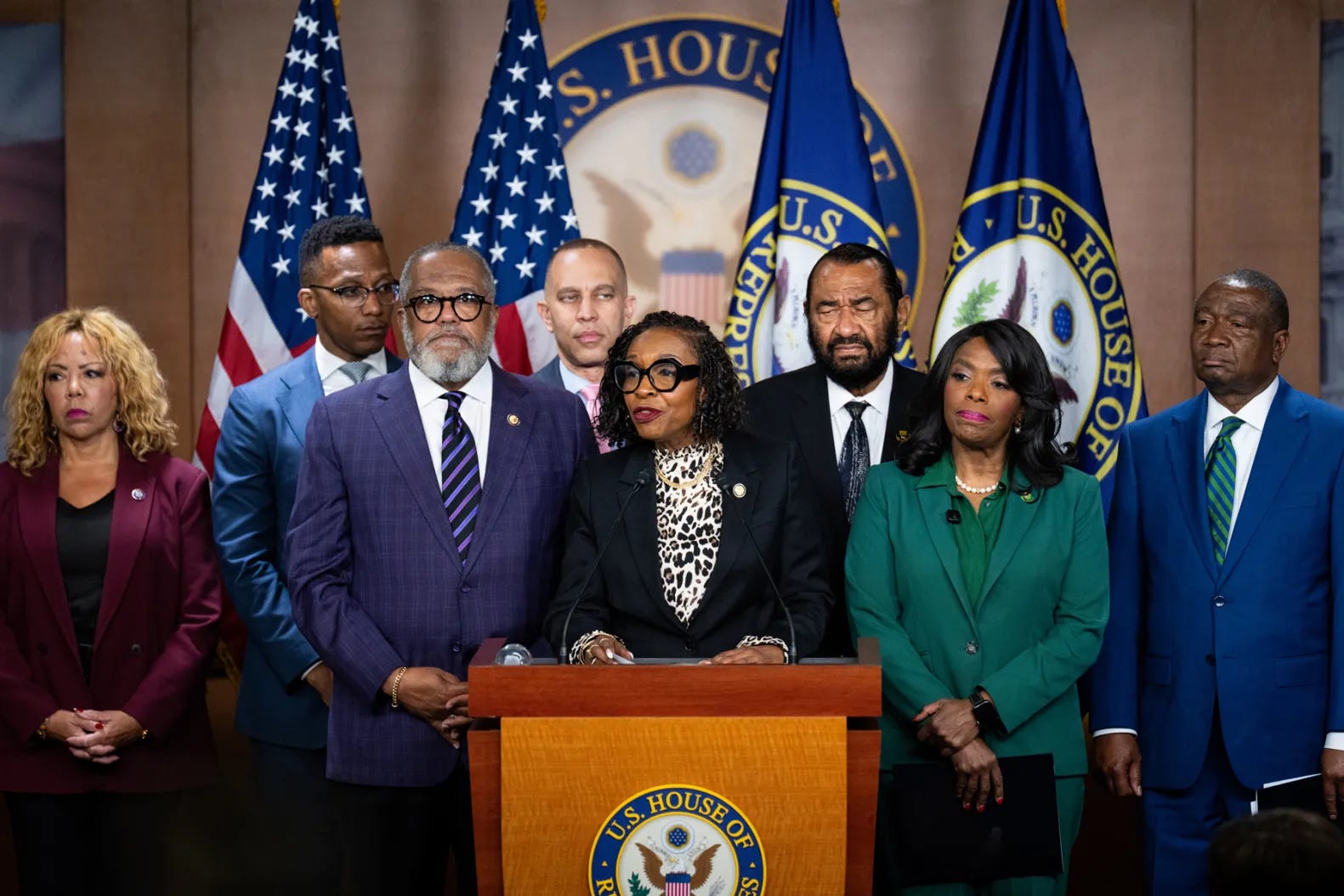
CBC ramps up organizing after voting rights ruling
Within 24 hours of the Supreme Court’s decision in Louisiana v. Callais, the Congressional Black Caucus’s political arm and Let It Resound—a 501(c)(4) group closely aligned with the caucus—committed an initial low six-figure investment to a rapid-response effort aimed at turning outrage over the ruling into organizing infrastructure and voter outreach.
A source close to the CBC described the effort as a coordinated social media push designed to reach Black voters, organizers, and community leaders in real time with information they can act on. The broader initiative is expected to grow into a seven-figure investment and will include tools and resources intended to help Americans respond to what caucus allies view as escalating attacks on voting rights and democratic participation.
The effort is also designed to shape the broader public narrative around the ruling while moving supporters toward real-world political engagement and organizing actions tailored to individual states, according to the source.
At the same time, CBC members have remained in close communication with local civic and elected leaders in affected states, convening strategy sessions and coordinating on-the-ground mobilization efforts.
The CBC’s response comes as Republican-led states across the South have aggressively moved to redraw congressional maps ahead of the midterms in ways Democrats argue could further erode Black political representation and eliminate Democratic seats.
Tennessee Gov. Bill Lee (R) signed a new congressional map Thursday aimed at unseating Rep. Steve Cohen (D-Tenn.), the lone Democrat in the state’s congressional delegation.
South Carolina, Alabama and Mississippi could also revisit their maps in ways that threaten Democratic-held seats represented by CBC members.
Louisiana lawmakers previously weighed redrawing their map to flip one or two Democratic districts before pausing the effort, while Florida’s newly redrawn map recently took effect in a move Republicans hope could net the party up to four additional seats.
Georgia appears more likely to wait until the next redistricting cycle in 2028, though Democrats privately acknowledge little is off the table anymore.
House Minority Leader Hakeem Jeffries (D-N.Y.) insists Democrats will still win back the majority this fall.
The Court’s conservative majority held in Callais that the state crossed a constitutional line by relying too heavily on race to draw Rep. Cleo Fields’s district, arguing the Voting Rights Act did not require Louisiana to create a second majority-Black seat. Justice Samuel Alito’s opinion further narrowed how Section 2 can be used, while Justice Elena Kagan warned in dissent that the Court was weakening one of the country’s central protections for minority voters. In practical terms, the ruling makes it harder to force states to create majority-minority districts and easier for legislatures to defend contested maps in court.
● ○
DEMOCRACY
Hinson pushes House GOP to ban prediction market betting
Rep. Ashley Hinson (R-Iowa) introduced legislation Thursday that would extend the Senate’s ban on participating in prediction markets to the House, adding momentum to a bipartisan push to curb lawmakers and government officials from profiting off politically sensitive information.
The proposal would update House rules to bar members of Congress, congressional staff and House officers from entering into agreements tied to the outcome of specific events.
“Members of Congress shouldn’t be able to use insider knowledge to make a profit. We should take immediate action to ensure DC politicians can’t make money off of policies they are influencing,” Hinson, who is running to succeed retiring Sen. Joni Ernst, said in a statement. “I am calling on our House Republican leadership to bring this to the floor immediately. It should receive unanimous support.”
Speaker Mike Johnson (R-La.) and House Majority Leader Steve Scalise (R-La.) did not respond to a request for comment.
The Senate ban was proposed by Senate Rules Committee Ranking Member Alex Padilla and passed by unanimous consent before senators left Washington last week for recess.
Senate Minority Leader Chuck Schumer (D-N.Y.) last Sunday urged the House and White House to follow the Senate’s lead and prohibit government officials from wagering on prediction markets. Schumer described the Senate action as the first step toward a broader federal ban that would extend across the executive and judicial branches.
A spokesperson for House Minority Leader Hakeem Jeffries (D-N.Y.) told me this week that Jeffries broadly supports the bipartisan effort and is reviewing the Senate measure with House Administration Committee Ranking Member Joe Morelle (D-N.Y.). As I reported in Tuesday morning’s Sunrise, the White House declined to say whether President Donald Trump believes the ban should apply to the executive branch.
The bipartisan push comes as public trust in Congress remains near historic lows. Just 17% of Americans say they trust the federal government to do what is right, while roughly eight in 10 voters believe lawmakers fail to separate their personal financial interests from their official duties, reinforcing perceptions that Washington is self-interested, inefficient and disconnected from ordinary Americans.