


👋🏾 Hi, hey, hello! Good Tuesday morning. Thank you for reading Congress Nerd Sunrise.
📌 New this morning: White House stops short of backing full prediction market ban … Senate GOP eyes $40B ICE boost in party-line package … Jeffries taps Morelle to lead New York redistricting response
Thanks to everyone who attended my talk yesterday morning at the Creator Journalism Summit at the National Press Club. And to the NPC Journalism Institute and URL Media for putting together a sharp, intentional convening around reimagining news and the future of the business.
📬 Send me tips, scoops or just say hi: michael@onceuponahill.com
○ ● ●
FIRST THINGS FIRST
White House stops short of backing full prediction market ban
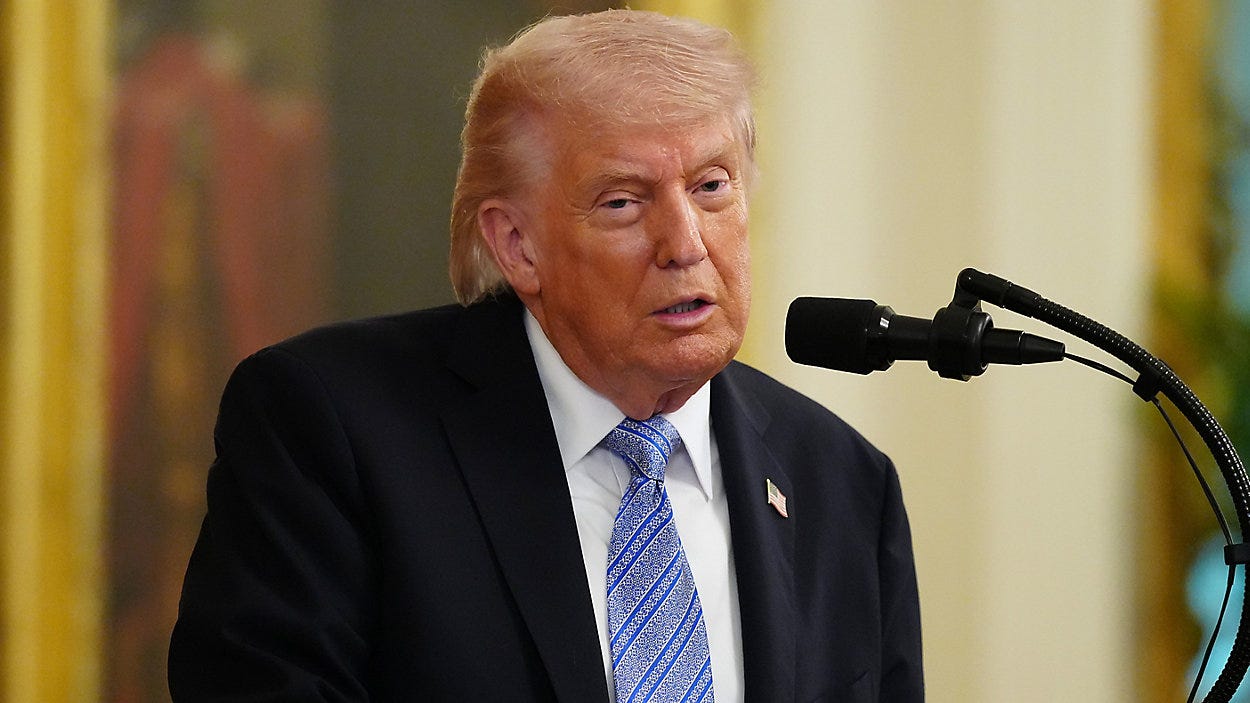
The White House said President Donald Trump believes government officials shouldn’t misuse nonpublic information for personal gain—including on prediction markets—but declined to say whether he supports extending the Senate’s new ban to the executive branch.
White House spokesperson Davis Ingle said that while the executive branch does not have a blanket prohibition on federal employees participating in prediction markets if done lawfully, existing ethics rules and criminal laws bar the use of nonpublic information for financial benefit. He added that White House staff were recently reminded that those restrictions apply to prediction markets.
“No government official should be misusing nonpublic information for their personal financial benefit—this includes misusing nonpublic information to place bets on prediction markets,” Ingle said.
The response echoes Senate Democrats’ concerns about insider trading risks but stops short of endorsing a government-wide prohibition pushed by Senate Minority Leader Chuck Schumer (D-N.Y.), leaving unclear whether the administration would back legislation or take executive action.
Prediction markets allow users to wager real money on the likelihood of future events—elections, interest rate decisions, wars, and legislation—effectively turning forecasts into tradable contracts, with prices reflecting the market’s implied probability of an outcome.
Platforms such as Polymarket and Kalshi have surged in popularity, drawing increased scrutiny from lawmakers over potential misuse of insider information.
The Senate’s unanimous ban took effect immediately after adoption of a rules change led by Senate Rules Committee Ranking Member Alex Padilla (D-Calif.) to close potential loopholes.
A spokesperson for House Minority Leader Hakeem Jeffries (D-N.Y.) told me he was broadly supportive of the bipartisan push and would be looking at the Senate-passed bill in conjunction with Morelle.
Update: This item has been updated to include comment from a spokesperson for Hakeem Jeffries.
● ○ ●
IMMIGRATION
Senate GOP eyes $40B ICE boost in party-line package
Senate Republicans have proposed a roughly $40 billion surge in federal immigration enforcement and border operations, including more than $30 billion for Immigration and Customs Enforcement, billions more for border personnel and surveillance technology, and $1 billion for President Donald Trump’s East Wing ballroom—despite the administration previously saying the project would be funded by private donations, not taxpayers.
The funding details—part of a second reconciliation package Republicans want to pass by the end of the month—were outlined in portions of the bill released Monday by Senate Judiciary Committee Chair Chuck Grassley (R-Iowa) and Homeland Security and Governmental Affairs Committee Chair Rand Paul (R-Ky.).
The proposals would lock in funding for ICE and U.S. Customs and Border Protection through the end of Trump’s second term using a process that bypasses a Democratic filibuster. The committees are expected to mark up its portion of the bill next week when Congress returns from recess.
“Republicans won’t allow our country to be dragged backwards by Democrats’ radical, anti-law enforcement agenda,” Grassley said in a statement. “The Senate Judiciary Committee is taking action to help provide certainty for federal law enforcement and safer streets for American families.”
Ryan was equally critical of his colleagues across the aisle.
“Senate Democrats refuse to vote for a single dollar to secure our borders or enforce our immigration laws, even against the most violent illegal aliens,” he said. “To make sure those vital functions are funded, my committee will vote later this month to give the funding needed.”
The proposed ICE funding would scale the entire enforcement chain—from arrest to detention to removal—while embedding the agency more deeply in local policing.
The package also includes nearly $3.5 billion for CBP to hire and train agents and support equipment, operations, and maintenance tied to immigration enforcement, along with a $2.5 billion supplemental fund for the Department of Homeland Security secretary to deploy across related programs.
The proposal comes days after the House passed a Senate DHS funding compromise—excluding ICE and CBP—following a record-long 76-day shutdown that disrupted agencies including TSA, FEMA, the Secret Service, and the Coast Guard, as Democrats pushed unsuccessfully for immigration reforms after federal agents killed two U.S. citizens in Minnesota during enforcement operations earlier this year.
Hill Republicans already provided roughly $75 billion directly to ICE for enforcement, detention, and operations last summer through the One Big Beautiful Bill Act, part of a broader $170 billion immigration enforcement package across DHS, including CBP and related programs. It was the largest ICE funding infusion ever enacted, turning the agency into the best-funded federal law enforcement operation in the country.

● ● ○
ELECTIONS
Jeffries taps Morelle to lead New York redistricting response
Hakeem Jeffries is putting a fellow New Yorker to work.
The Brooklyn Democrat has tasked House Administration Committee Ranking Member Joe Morelle (D-N.Y.) with sitting down with New York elected officials today to figure out a coordinated response to the Supreme Court’s ruling in Louisiana v. Callais.
The outreach is part of a broader push by Jeffries to work with allies across the country to map out lawful ways to protect voters and keep representation tied to communities and suggests his role in Democrats’ national response to the redistricting fights will stretch well past the 2026 midterms.
“While far-right extremists on the Supreme Court have twice recklessly cleared the path for partisan gerrymandering, Democrats refuse to unilaterally disarm,” Jeffries said. “This is just the beginning. Across the nation, we will sue, we will redraw and we will win.”
Morelle is set to huddle with Gov. Kathy Hochul, Assembly Speaker Carl Heastie, Senate Majority Leader Andrea Stewart-Cousins and Deputy Majority Leader Michael Gianaris to get on the same page about a state response.
What he’s putting on the table starts with a comprehensive legal review of New York’s strongest voting-rights tools, including a potential 2027 constitutional amendment.
From there, it’s about strengthening state guardrails against voter suppression and discriminatory rules, tightening protections for election workers and infrastructure, and taking a more aggressive approach to public education and rapid response to misinformation and intimidation.
Jeffries and Morelle are also pushing for closer coordination with national democracy, civil rights and legal groups on additional safeguards.
“The Supreme Court’s Voting Rights Act ruling is the latest civil rights and democratic disaster,” Morelle said. “We will not allow these efforts to silence communities or undermine fair representation.”