


👋🏾 Hi, hey, hello! Good Friday morning. Thank you for reading Congress Nerd Sunrise.
📌 New this morning: Republicans limp into recess after deadline scramble … Warnock defers filibuster talk as Dems plot voting rights push … Menefee moves to end House vacancy delays
Programming note: Once Upon a Hill will not publish Congress Nerd Sunset next week. The evening edition returns Sunday, May 12. I’m out of the office on Monday, May 4, so there will be no Congress Nerd Sunrise that day.
📬 Send me tips, scoops or just say hi: michael@onceuponahill.com
○ ● ●
FIRST THINGS FIRST
Republicans limp into recess after deadline scramble
Congress starts a 10-day recess today after a chaotic sprint to the finish this week, with Republicans checking off a stack of time-sensitive priorities before leaving town.
The House finally moved to reopen most of the Department of Homeland Security, ending a record-long shutdown that had started to show up in real life, including those long TSA lines and airport delays across the country.
Both chambers also kicked the can on Section 702, extending the government’s foreign surveillance powers into mid-June just hours before the deadline to buy time for a broader fight over reforms, including limits on warrantless surveillance of Americans.
On top of that, the House pushed through a partisan farm bill—with help from 14 Democrats—after a messy two-day Rules Committee meltdown and an overnight floor slog.
And Republicans adopted the Senate’s budget framework, clearing the way to fund ICE and CBP through President Donald Trump’s term.
Democrats, not surprisingly, aren’t impressed. They see a governing majority lurching from deadline to deadline, passing fixes they’d already proposed weeks earlier.
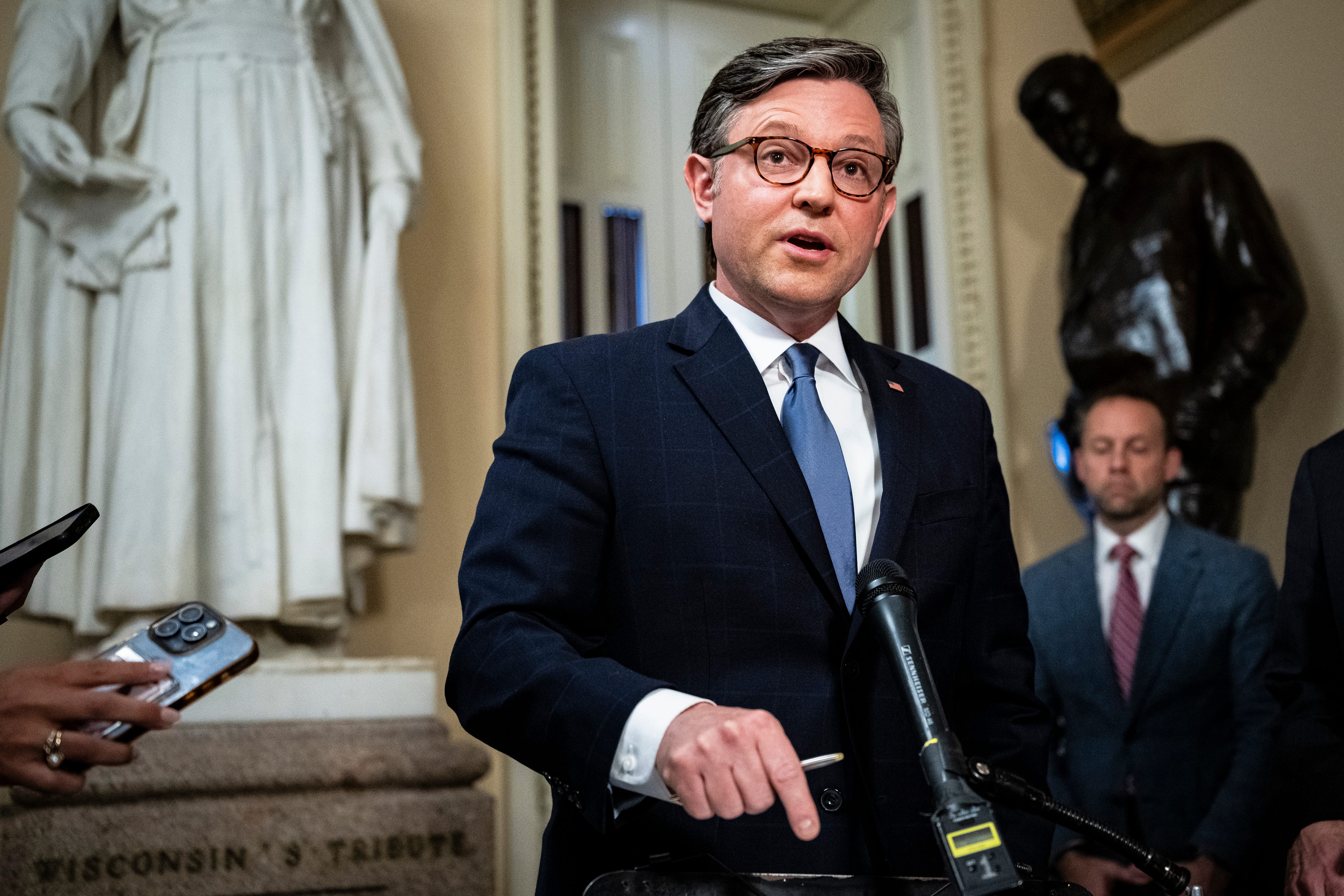
“Since February, we’ve been saying this was the solution, to fund DHS and to hold harmless FEMA and TSA and Coast Guard. [House] Republicans refused and said that it wasn’t possible,” House Democratic Caucus Chair Pete Aguilar (D-Calif.) said. “Clearly, they were wrong and they caved. And it just shows how chaotic this place is under Speaker [Mike] Johnson [(R-La.)].”
Aguilar said Democrats will press the argument this recess that Republicans aren’t delivering on the issues voters actually care about.
“We’re going to keep hammering that this group isn’t doing anything to make people’s lives better,” Aguilar said.
Johnson took a victory lap after getting through the week. But he took some bruises. The House cleared the DHS bill on a voice vote, the same tactic House Republicans blasted when the Senate used it weeks earlier, before Johnson ultimately accepted the outcome he’d delayed.
This week also exposed some early strain between Johnson and Senate Majority Leader John Thune (R-S.D.)—a partnership that’s undoubtedly about to be tested again.
Margins are tight in both chambers and House conservatives are clamoring to expand the reconciliation bill beyond ICE and CBP funding to include additional policy priorities in a dynamic that could complicate the path forward for Mike Johnson and John Thune as they race to meet Donald Trump’s June 1 deadline. Meanwhile, any serious 702 overhaul could run headfirst into an administration that prefers a clean extension. And the Senate will likely write its own farm bill, which GOP hardliners hate too.
Enjoy the breather. I promise you it won’t last.
● ○ ●
2026 ELECTION
VOTING RIGHTS
Warnock defers filibuster talk as Dems plot voting rights push
Sen. Raphael Warnock (D-Ga.) sidestepped fresh concerns about the Senate filibuster blocking future voting rights legislation to blunt the impact of this week’s Louisiana v. Callais Supreme Court decision, arguing the focus should be on Democrats reclaiming power first.
House Democrats reiterated this week—after the Court’s conservative supermajority narrowed Section 2 of the Voting Rights Act—that passing the John Lewis Voting Rights Advancement Act, which would restore and strengthen the landmark 1965 law banning racial discrimination in voting, would be a top priority if they retake the majority—a push Warnock has long championed as a lead sponsor.
The bill would almost certainly fall short of the 60 votes needed to advance in the Senate though, leaving Democrats without a clear legislative response to the court’s decision.
“I’m focused on winning the midterms so we can have the benefit of that kind of argument,” Raphael Warnock told me Thursday.
But after the Court ruled a congressional map could likely stand if a state shows it was drawn for partisan gain rather than racial discrimination, Warnock added that ending partisan gerrymandering should be part of the debate.
Warnock has introduced an amendment to the SAVE America Act to do just that. The provision is also included in the Freedom to Vote Act, another bill he leads that would set national standards for voting access, including early voting and mail-in ballots.
“There’s no question that our democracy is in crisis,” he said. “The Supreme Court poured fuel on that fire.”
The tenuous path forward for voting rights legislation reflects a familiar dynamic from 2021, when sweeping House-passed bills died in the Senate amid unified GOP opposition and resistance from then-Democratic Sens. Joe Manchin (W.Va.) and Kyrsten Sinema (Ariz.) to exempting the measures from the upper chamber’s 60-vote threshold.
Democrats controlled both chambers of Congress during this push, which had the backing of former President Joe Biden and former Vice President Kamala Harris. Regardless of what happens in November, a Republican will still be president—an obstacle that left some members I spoke to wondering if the conversation was even worth having at this point.
There’s a layer of irony here. President Trump has urged Republicans to scrap the filibuster and pass the SAVE America Act, a position that would render this debate largely moot.
But GOP senators, despite their usual deference to Trump, have shown no appetite to follow through, underscoring how firmly they would be expected to defend the 60-vote threshold if they return to the minority.

● ● ○
ELECTIONS
Menefee moves to end House vacancy delays
Rep. Christian Menefee (D-Texas) took action on Thursday to close what he calls a loophole governors can exploit to delay filling vacant House seats.
The Houston-area lawmaker rolled out his first original bill to impose a national timeline for special elections that was shaped by his own experience.
Menefee said the bill is personal after his district went nearly a year without representation before he was sworn in February to complete the term of the late Rep. Sylvester Turner (D-Texas), who passed away the previous March. Menefee argued the vacancy left constituents without a voice during votes on major legislation, government funding and even a prolonged shutdown, with no member in Washington to advocate on their behalf.
“So for my community, that was a heartbreaking period,” he told me. “And it was important for me to kick it off with making sure that that doesn’t happen to any other community again.”
Menefee argues the Constitution requires special elections but sets no deadline, creating a patchwork system where some states have no firm timeline and others rely on vague standards like “as soon as practicable.”
His bill—entitled the Special Elections Timeliness (SET) Act—would require states to complete special elections within 180 days of a vacancy. (If a regularly scheduled general election falls in that window, it counts.) The attorney general could sue to force compliance and “aggrieved” parties—including House leadership—could bring civil action.
“This bill is intended to be simple and straightforward. I don’t care if you’re Republican, Independent, Democratic, we should all be able to get behind the idea that taxing people without giving them representation is disenfranchising and straightforward,” Menefee told me. “Every community should be able to send a member to Congress. I don’t care how they vote. Once they get to Congress, they should be able to be in the room to represent your communities. And I hope that my colleagues get behind the effort.”