


FIRST THINGS FIRST
👋🏾 Hi, hey, hello! Good Thursday morning. Thank you for reading Congress Nerd Sunrise.
📌 New this morning: After Callais, Jeffries bets on candidate quality for the midterms … Callais decision sharpens CBC ground strategy … Schumer forms task force to counter election threats
💡 Here’s what you should know as you start your workday:
I. Speaker Mike Johnson (R-La.) made it through a second marathon vote series Wednesday night after cutting a deal to decouple the GOP farm bill from a separate measure allowing year-round sales of 15% ethanol.
The breakthrough came after an hours-long standoff with Midwest and farm-state Republicans, who held out for more than five hours and nearly sank a budget resolution needed to advance GOP plans on immigration enforcement funding while the Department of Homeland Security remains shut down.
The House will vote on the farm bill today before leaving for a weeklong recess, while the E15 legislation gets pushed to after lawmakers return on May 12. Both were initially slated to move together, but farm bill backers didn’t want the ethanol fight dragging down their vote. E15 supporters still get their shot—just on the other side of the break.
Johnson also scrapped a planned late-Wednesday-night vote series on farm bill amendments. The House opened debate at 10:45 p.m. and pushed through until just before 2:30 a.m., setting up final passage later today. The Senate is expected to take up its own version of the five-year farm and nutrition bill in the months ahead.
The speaker’s first extended floor revolt on Wednesday occurred during a morning series when he flipped more than half a dozen conservative hardliners during a two-hour procedural vote where the holdouts worked to secure concessions in exchange for their support in advancing Johnson’s agenda to the floor after it spent the first two days of the week stuck in the House Rules Committee.
II. The House passed a three-year extension of the government’s foreign spy powers ahead of tonight’s deadline in a dose of sweet redemption for Speaker Mike Johnson (R-La.), who suffered an embarrassing floor defeat earlier this month when he tried to pass a similar bill.
The final vote was 235–191-1, with 42 Democrats, 192 Republicans and an independent in support. 169 Democrats and 22 Republicans voted no. Democratic leadership was split: House Minority Leader Hakeem Jeffries (N.Y.), Minority Whip Katherine Clark (Mass.) and House Judiciary Ranking Member Jamie Raskin (Md.) voted against, while Caucus Chair Pete Aguilar (Calif.) and House Intelligence Committee Ranking Member Jim Himes (Conn.) voted in favor.
The bill’s fate in the Senate is uncertain after the House attached a ban on a central bank digital currency, which several senators oppose, fearing it would enable government surveillance and allow officials to track or restrict Americans’ private financial transactions. The Senate may try to pass and return to the House another short-term extension to prevent Section 702 of the Foreign Intelligence Surveillance Act from lapsing before both chambers can agree on a longer-term authorization.
III. Johnson’s floor drama ultimately faded into the background once the Supreme Court dropped its long-awaited decision in Louisiana v. Callais on Wednesday morning, sending shockwaves well beyond the Hill as the ruling will now make it harder to force states to draw majority-minority districts and easier for them to defend maps that don’t.
The conservative majority said Louisiana crossed a constitutional line by leaning too heavily on race in drawing Rep. Cleo Fields’ district—especially, in its view, since Section 2 of the Voting Rights Act didn’t actually require it. Justice Samuel Alito used the opinion to tighten the application of Section 2, while Justice Elena Kagan warned in dissent that the Court is weakening one of the country’s central protections for minority voters.
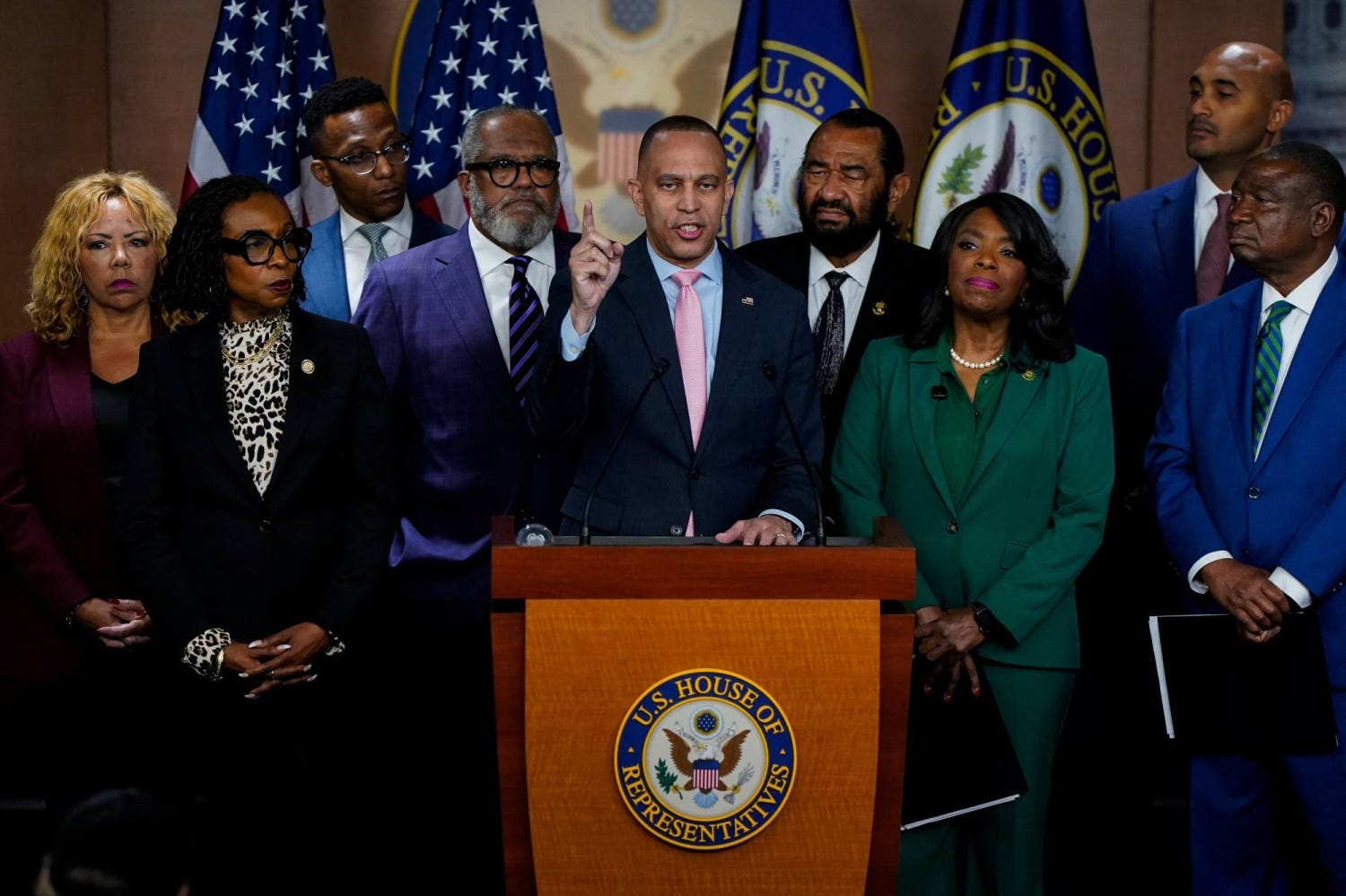
As I reported in Wednesday evening’s Sunset, the Congressional Black Caucus spent much of the day digesting the 92-page, 6–3 ruling and starting to map out what comes next. The group is zeroing in on passage of the John Lewis Voting Rights Advancement Act and broader Supreme Court reforms as relatively immediate responses if Democrats win back the majority in November.
But as you know from reading this newsletter, the legislative process moves slowly—and the conservative mapmakers aren’t waiting. Deep South red states are already racing to redraw their maps to lock in an advantage. Even some of the most optimistic civil rights leaders I texted with yesterday bluntly acknowledged that any countermove from Washington may ultimately be too little too late.
📬 Send me tips, scoops or just say hi: michael@onceuponahill.com
○ ● ●
2026 ELECTION
After Callais, Jeffries bets on candidate quality for the midterms
Moments after news of the Callais decision broke, Hakeem Jeffries stuck with his prediction that House Democrats will reclaim the majority in November—a confidence I later learned is rooted in the caliber of candidates his political operation believes it has recruited this cycle.
Jeffries told me that the effort started early. Party leaders began building their bench in 2025, targeting candidates they believe can compete in tough districts, raise money quickly and connect with voters on everyday costs.
“We began recruiting in 2025 in the early part of the year to make sure that we had the strongest possible candidates in order to run in districts that we knew would be challenging all across the country, and to fight through the Republican efforts to rig the midterm election,” Jeffries said.
He also pointed to the math. Democrats needed to flip 24 seats to win the majority in 2018 and ended up gaining 40. This time, he argued, the path is narrower—just three seats—with roughly 40 to 45 districts in play nationwide.
“We are on track to take back the majority. We know it. Donald Trump knows it,” Jeffries added. “And the reality is we’re just going to stay the course, continue to fight back, work through the obstacles and then we’re going to come out in the majority on the other side.”
A notable share of the slate includes repeat candidates who came close in 2024—people like Christina Bohannan in Iowa—who are now running again with stronger infrastructure behind them. The focus is on fewer unknowns and more candidates who have already shown they can raise money, run a district-wide campaign and hold up in a tough cycle.
You’re also seeing candidates whose résumés lean more toward community leadership than ideological branding—military veterans, local elected officials, tribal leaders, ministers—and who can talk about doing the job, not just debate it online. That’s by design in swing districts and even in some red-leaning territory.
And even as those backgrounds vary, the message has remained zeroed in on lower costs, accessible healthcare and economic stability for everyday Americans. That’s the throughline Jeffries is betting can translate across very different districts. The open question now is whether that theory holds with voters six months from now.
● ○ ●
2026 ELECTION
Callais decision sharpens CBC ground strategy
Congressional Black Caucus Chair Yvette Clarke (D-N.Y.) told me the caucus plans to lean on its on-the-ground infrastructure—grassroots groups, clergy networks and local partners—to reach voters in a fragmented media environment and connect with people who aren’t tuned into traditional political channels.
Midterms almost always bring lower turnout than presidential years, so Democrats are focused on shaping who shows up in November and where.
“We’ve got to turn voters out,” Clarke said. “We understand the assignment. Our partners and allies understand the assignment—we’re ready to go, and we’re mobilized.”
Beyond Black voters, Democrats know young people, suburban moderates and Trump-weary independents will also be key to a winning coalition. The challenge is reaching those groups consistently, credibly and at scale in an environment that’s splintered in every direction.
And in the aftermath of Callais, Democrats can’t lean as much on map design to secure representation, which puts more pressure on campaigns to build winning coalitions through turnout and persuasion.
But Rep. Sydney Kamlager-Dove (D-Calif.), who serves as the CBC’s whip, argued the caucus has already shown it can win beyond majority-Black districts.
“Let’s not have a binary conversation about only Black people can represent Black seats because when we do represent a district, the entirety of the district rises,” she said. “This is a larger issue about snatching democracy from the hands of voters across this country and continuing to demoralize and marginalize the Black vote. So this is a call to action. If you are Black, if you love anything that is Black, you need to be working to get everybody registered to vote, because your vote’s on the line next.”
● ● ○
2026 ELECTION
Schumer forms task force to counter election threats
Senate Minority Leader Chuck Schumer (D-N.Y.) and several Senate Democrats launched a new task force to identify threats and safeguard elections ahead of the midterms, in response to what they see as continued efforts by President Donald Trump and national Republicans to undermine American democracy.
Schumer and a group of senators met with former Attorney General Eric Holder, elections attorney Marc Elias, and other top election experts on Wednesday afternoon as they began mapping out their election protection strategy for the fall.
“We’re looking at what we do before Election Day, what we do on Election Day, what we do after Election Day, and today, we’re ramping up our efforts,” Schumer said. “We see the need for it just today, in today’s Supreme Court decision, which was a despicable decision.”
The Democratic fear isn’t just that Trump might contest the results after Election Day. Party insiders warn that his administration and allies are trying to shape the electorate, control the rules, pressure election officials and pre-seed fraud claims before Election Day arrives.
Trump signed a March 2025 order seeking more federal control over election rules, and a March 2026 order aimed at citizenship verification and a national list of verified eligible voters. The White House casts this as a matter of election integrity, while critics call it an unconstitutional attempt to override state-run election systems.
The Trump administration has also pushed states to turn over voter-roll data, including nonpublic information, as part of its “election integrity” effort. The courts have rebuffed some of those demands, while voting-rights groups argue the data push could lay the groundwork for improper purges before November.
Administration officials have also tried to gain influence over elections in at least eight states through investigations, raids and demands for access to balloting systems and voter ID information. That’s the kind of federal pressure that national Democrats and state election officials warn could disrupt normal election administration.
Meanwhile, the Justice Department’s Voting Rights Section has been hollowed out and redirected toward voter-roll litigation and fraud claims. Democrats see that as especially alarming because the DOJ can shape both pre-election rules and post-election challenges.
Don’t forget about the SAVE America Act, which includes Trump’s proposal for federal proof-of-citizenship voting restrictions. 23 mostly Republican-led states have adopted pieces of that agenda, even if the federal bill stalls. Democrats argue that those rules risk blocking eligible voters who lack immediate access to documents such as passports or birth certificates.
And as I mentioned above, the Supreme Court’s Callais decision makes it harder to use Section 2 of the Voting Rights Act to challenge maps that dilute minority voting power, and GOP-led states are already moving quickly. Florida, for example, approved a new congressional map designed to boost Republicans after the ruling.
I’m told the task force will focus on quickly identifying problematic state actions, coordinating lawsuits, filing injunctions before rules take effect, and preparing for post-election challenges. But it can’t directly stop a state from passing a restrictive rule or redrawing a map. And with Republicans in control of Congress, the odds of passing new federal protections in time for 2026 are low. So structurally, there’s a limit to how much they can change the playing field.