


First Things First
👋🏾 Hi, hey, hello! Welcome to Congress Nerd Daily, Once Upon a Hill’s reported evening briefing chronicling the strategic decisions, procedural fights and campaign dynamics that determine how power is exercised, challenged and won on Capitol Hill.
In this evening’s edition: The White House and Senate Republicans have spent weeks clashing over surveillance powers, Iran negotiations and legislative strategy. Wednesday’s lunch with President Donald Trump could offer the clearest sign yet of where the relationship goes next. Plus, the Senate is on the verge of passing one of the biggest housing bills in decades and a bipartisan House deal on children’s online safety immediately runs into resistance from Senate Democrats.
Across the pond, United Kingdom Prime Minister Keir Starmer announced his resignation today after losing confidence in much of his own party, despite having won a landslide election two years ago. Labour Party members of parliament increasingly concluded he was no longer the best person to lead them into the next election, and a leadership transition is now expected, with Andy Burnham emerging as the favorite successor.
The parallels to U.S. politics are striking.
Voters punished the governing party despite economic indicators that were not uniformly bad. Starmer’s government could point to some achievements, but many voters felt little improvement in their daily lives. That dynamic should sound familiar to anyone who covered the 2024 election.
Immigration became a defining political vulnerability. Critics, both inside and outside Labour, argued that Starmer failed to address public concerns about migration. That helped fuel the rise of Nigel Farage and his populist Reform movement.
Traditional center-left parties are struggling across the democratic world. Labour’s crisis resembles the challenges facing Democrats in the U.S., center-left parties in Europe and center-left governments elsewhere: how do you satisfy an educated urban base while also retaining working-class voters who are increasingly attracted to populist movements?
On the campaign trail, James Talarico launched his first major general election television ad, backed by a seven-figure statewide buy that will run in the Dallas-Fort Worth, Houston, San Antonio, El Paso and Harlingen/McAllen media markets.
The 30-second spot, titled “Drowning,” centers on affordability, with Talarico arguing that rising costs for groceries, gas and health care have left many Texans struggling to stay afloat. The ad highlights his bipartisan record in the Texas House, including legislation to cap insulin costs, cut taxes for small businesses and deliver what the campaign describes as the largest property tax cut in Texas history.
But the message is notable for what it emphasizes and what it leaves out. Rather than leading with President Trump, culture-war issues or a traditional Democratic attack on Republicans, Talarico is making an economic argument aimed squarely at working-class voters. The ad also leans heavily into bipartisanship, a signal that his campaign believes persuadable voters remain open to candidates who can position themselves as problem-solvers rather than partisan warriors.
The buy marks one of the campaign’s largest paid-media investments to date and offers an early look at the argument Talarico plans to make against Texas Attorney General and Republican nominee Ken Paxton: Texans are paying more, the political system is broken and he has a track record of working across party lines to deliver tangible results.
The move comes as national Democrats increasingly view Texas as one of the party’s more intriguing long-shot opportunities this cycle, particularly after Paxton’s primary victory over Sen. John Cornyn reshaped the race and injected new uncertainty into the general election.
🔓 This edition is in front of the paywall. But if you want the Tuesday and Thursday editions, plus the Sunday lookahead, upgrade your subscription for full access to every edition and the complete archive. Whether you’re taking the votes, writing the bills, running the campaigns, shaping the message or trying to influence any of the above, Congress Nerd Daily helps you see around corners before everyone else catches up.
This week’s most interesting lunch
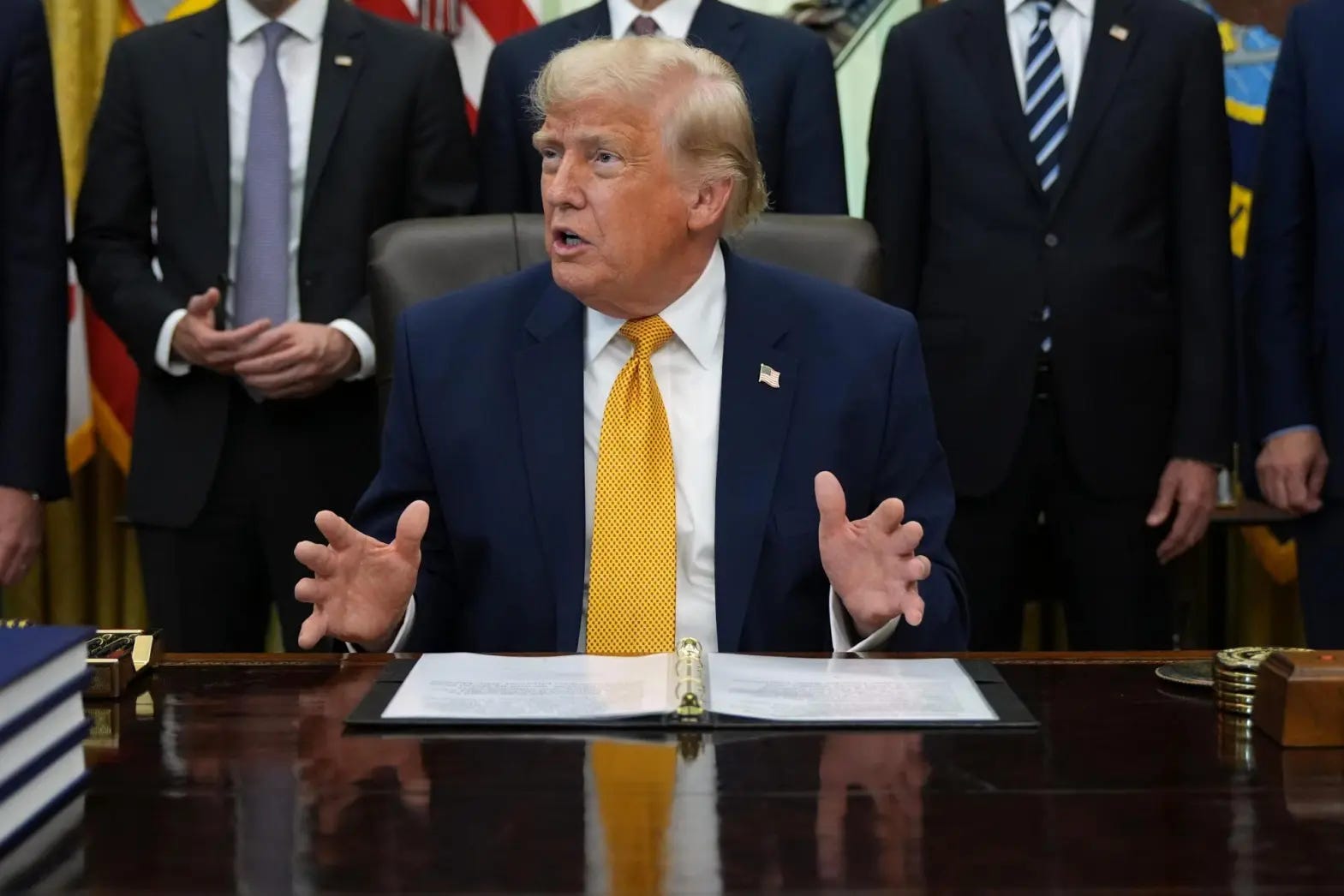
President Trump will meet with Senate Republicans on Wednesday at a lunch hosted by the Senate Republican Steering Committee, giving GOP senators an opportunity to discuss issues ranging from Iran and FISA to the party’s legislative agenda ahead of the midterms.
The visit comes during a stretch of unusually public disagreements between the White House and Senate Republicans over issues including surveillance authorities, the Senate parliamentarian and the administration’s handling of the anti-weaponization fund.
One revealing detail emerged Monday when Senate Majority Leader John Thune (R-S.D.) was asked whether he invited Trump to the gathering.
“I did not,” Thune told reporters this afternoon. “Rick Scott did.”
Scott, one of Trump’s closest allies in the Senate and a leading supporter of the SAVE America Act, chairs the Steering Committee and traditionally controls invitations to its weekly lunches.
Thune said he expects Wednesday’s conversation to cover a range of issues and suggested the SAVE America Act could be among them.
“I think it’ll be a lot of different things,” he said. “Hopefully, celebrating some of our successes, talking about the path forward.”
The meeting comes as Senate Republicans continue to search for a path forward on FISA reauthorization and await additional details on the administration’s negotiations with Iran.
On Iran: Thune said that senators are still waiting for a detailed briefing on the U.S.-Iran memorandum of understanding as negotiators continue talks overseas.
“Hopefully sometime this week,” Thune said when asked when Congress could expect an update. “Most of the briefers are overseas, so that’s the challenge we have right now.”
Vice President JD Vance said Iran has agreed to allow inspectors from the International Atomic Energy Agency back into the country, marking what the administration is describing as a breakthrough in the latest round of U.S.-Iran negotiations in Switzerland.
Speaking from the Bürgenstock resort near Lake Lucerne, Vance said discussions with IAEA officials could begin as soon as today.
The announcement followed a weekend of talks focused on implementing last week’s 14-point memorandum of understanding. Vance said negotiators also made progress on keeping the Strait of Hormuz open and creating procedures aimed at preventing future incidents from escalating into wider regional conflicts.
“The Strait of Hormuz is open today,” Vance said. “What we were trying to do yesterday was build a mechanism for keeping the Strait of Hormuz open.”
Vance also disclosed that Iranian officials at one point threatened to walk away from the talks after President Trump renewed public pressure on Tehran. But he said the negotiations continued well past 1 a.m. local time and that Iranian technical teams remain in Switzerland.
“No, they didn’t throw a wrench in the system,” Vance said of Trump’s comments. “We were negotiating well past one in the morning yesterday, so they didn’t walk out.”
The vice president described the current stage as the start of a longer diplomatic process rather than a final settlement.
“We set the foundation. We haven’t built the house, but we’ve laid a successful foundation to get to a good place for the American people,” Vance said.
On Lebanon, Vance said negotiators worked to establish a deconfliction mechanism to help prevent future flare-ups from spiraling into broader conflict. He said U.S. officials were in contact Sunday with Israeli, Lebanese, Saudi and Emirati counterparts.
Vance stopped short of calling for an Israeli withdrawal from southern Lebanon but said the administration is seeking to protect both Israel’s security and Lebanon’s sovereignty. He added that any durable arrangement would require cooperation from the Lebanese Armed Forces and Iranian efforts to restrain Hezbollah.
The vice president also said the administration is exploring ways to ensure any future release of frozen Iranian assets benefits the Iranian people rather than financing terrorism, though he did not indicate whether Tehran had agreed to any restrictions on the funds.
Thune also signaled skepticism toward any sanctions relief that is not directly tied to Iranian concessions on its nuclear program.
“I always want to tie lifting sanctions or financial incentives to conditions on Iranian behavior,” he said.
The comments offer an early indication of where Senate Republicans may draw the line as lawmakers begin evaluating any final agreement that emerges from the ongoing negotiations.
Separately, Thune appeared to confirm reports that the administration is preparing to send Congress a supplemental national security funding request totaling roughly $78 billion.
While saying he had not yet seen a formal proposal, Thune acknowledged the reported figure sounded familiar and argued any package should be viewed in the context of replenishing U.S. weapons stockpiles depleted by operations in Iran and other global commitments.
“We’re expecting a supplemental request,” Thune said. “We need to make sure we’re doing everything we can to replenish, resupply a lot of our munitions that have been depleted.”
The request is expected to become a major focus for appropriators once it formally arrives on Capitol Hill.
On FISA: Senate Republicans remain stuck in a holding pattern on FISA reauthorization as they await direction from the White House on the intertwined fates of Acting Director of National Intelligence Bill Pulte and U.S. Attorney Jay Clayton, who has been nominated to assume the role permanently.
“Not that I’m aware of,” Thune told me when I asked whether there had been any movement on the issue.
Still, he left little doubt that Senate GOP leadership wants to move quickly once the administration settles on a path forward.
“It’ll be nice if we can figure out how to get that teed up and ready to go, because Clayton and FISA really need to get done,” Thune said.
He acknowledged concerns that Congress could soon leave town for a two-week recess with FISA still expired.
“Of course I am [concerned],” Thune said. “We can, I think, move fairly quickly when we get the green light.”
Thune later reiterated that reviving FISA likely remains tied to Clayton’s confirmation, saying the Senate needs to “unlock FISA” and that effort will “probably be contingent on Clayton getting confirmed.”
📬 The best stories often start with a conversation. If you’ve got insight, context or something others are missing, my inbox is open. Send me tips, scoops or just say hi: michael@onceuponahill.com.
Senate on the brink of landmark housing breakthrough
The Senate is on its way to passing the 21st Century Road to Housing, one of the most significant bipartisan domestic policy achievements of this Congress and could become the largest housing bill enacted in more than three decades if it ultimately reaches President Trump’s desk.
The vote is still open, but is expected to pass by an overwhelming bipartisan margin.
The package is the product of years of bipartisan, bicameral negotiations between Senate Banking Committee Chairman Tim Scott (R-S.C.), Ranking Member Elizabeth Warren (D-Mass.), House Financial Services Committee Chairman French Hill (R-N.C.) and Ranking Member Maxine Waters (D-Calif.). It combines more than 45 housing provisions aimed at increasing housing supply, lowering costs, speeding development and expanding access to homeownership.
The political significance extends beyond housing policy itself.
The bill offers Republicans a chance to claim progress on affordability, one of the issues voters consistently rank among their top concerns heading into the midterms. And it represents a rare opportunity for Democrats to shape major domestic legislation despite being in the minority. Democratic priorities incorporated into the final package include provisions targeting institutional investors and private-equity firms that purchase large numbers of single-family homes, expanded affordable housing programs, disaster recovery reforms and efforts to address appraisal bias.
As I reported in Sunday’s edition, the next test comes in the House, where leaders are expected to consider the measure under suspension of the rules. That procedure is typically reserved for legislation expected to attract broad bipartisan support, suggesting House leaders believe the coalition that carried the bill through the Senate can hold together through final passage.

House E&C leaders announce kids online safety package
The leaders of the House Energy and Commerce Committee announced today that they have reached a bipartisan agreement on a comprehensive package to strengthen protections for children and teens online, potentially breaking years of congressional gridlock on the issue.
Chair Brett Guthrie (R-Ky.) and Ranking Member Frank Pallone (D-N.J.) said they have agreed to the Kids Internet and Digital Safety (KIDS) Act, a sweeping proposal that combines elements of more than a dozen bills previously considered by lawmakers.
The package pulls together provisions from several high-profile proposals, including the Kids Online Safety Act (KOSA), COPPA 2.0 and a series of measures focused on online privacy, social media safety, parental controls, data brokers, gaming platforms, messaging services and the role of algorithms and automated accounts.
The agreement is notable because children’s online safety has long been one of the few technology issues that attracts broad bipartisan support, yet Congress has repeatedly struggled to move legislation across the finish line amid disagreements over free speech concerns, platform liability and the scope of federal regulation.
According to committee leaders, the legislation would establish stronger privacy protections for minors, increase transparency around data collection and data brokers, expand parental tools and oversight, require certain safety features by default and impose new accountability requirements on technology companies.
The announcement also reflects a return to the Energy and Commerce Committee’s traditional role as a bipartisan dealmaking venue on major technology policy. By packaging together pieces of numerous previously introduced bills, committee leaders appear to be betting that a broader compromise can attract support from lawmakers who have championed different approaches to protecting children online.
The Senate, meanwhile, has largely remained focused on its own bipartisan KOSA/COPPA 2.0 framework. Senate champions have continued to push legislation built around KOSA’s “duty of care” concept, which requires platforms to mitigate harm to minors. That provision has been one of the biggest points of contention between the chambers because House Republicans previously removed it from their package.
Sen. Richard Blumenthal (D-Conn.), a KOSA sponsor, has already registered his opposition on X, effectively saying the House package stripped out the duty of care requirement that would obligate platforms to take reasonable steps to prevent harms to minors, which Senate supporters consider to be the bill’s core enforcement mechanism. If that provision is gone or substantially weakened, Senate backers may not view the House package as a viable substitute for KOSA at all.