


👋🏾 Hi, hey, hello! Welcome to Congress Nerd Daily, Once Upon a Hill’s reported evening briefing chronicling the strategic decisions, procedural fights and campaign dynamics that determine how power is exercised, challenged and won on Capitol Hill.
The Senate unanimously passed a resolution this morning congratulating the New York Knicks on winning the NBA Finals. The city is prepping for what could be one of the largest ticker-tape parades in its history when it honors the team tomorrow morning.
The celebration will begin at 10 a.m. in Lower Manhattan, with players, coaches and team officials traveling up Broadway through the historic Canyon of Heroes from Battery Park to City Hall Plaza, where Mayor Zohran Mamdani will present the team with Keys to the City. City officials are expecting enormous crowds after the franchise’s first championship in 53 years, with security checkpoints opening hours before the parade, restricted items along the route, and more than a ton of traditional white ticker-tape confetti set to rain down from office buildings overhead.
On the economic front, the Federal Reserve held interest rates steady for a fourth consecutive meeting and the first under Chair Kevin Warsh, while signaling a more hawkish outlook as policymakers grapple with inflation that remains above the central bank’s 2% target. The decision is likely to frustrate President Donald Trump, who has repeatedly urged the Fed to lower rates as Fed officials balance persistent high costs against a still-resilient labor market.
In this evening’s edition: Senate Republicans spent all day scrambling to interpret a Trump social media post that upended FISA talks, postponed a key intelligence hearing and left lawmakers searching for answers.
Plus, Senate Democrats say they’re drafting a universal child care bill now so they’ll be ready to move if they win back the majority and a new House Majority PAC investment suggests Democrats believe Republican political headwinds can overcome recent redistricting losses.
🔓 This edition is in front of the paywall. But if you want the Tuesday and Thursday editions, plus the Sunday lookahead, upgrade your subscription for full access to every edition and the complete archive. Whether you’re taking the votes, writing the bills, running the campaigns, shaping the message or trying to influence any of the above, Congress Nerd Daily helps you see around corners before everyone else catches up.
The Capitol Bulletin
Democrats add child care to affordability agenda: Senate Democrats are using their time in the minority to prepare what they hope will be a ready-made child care agenda if they win back Congress next year.
Appearing alongside Sens. Patty Murray (D-Wash.) and Elizabeth Warren (D-Mass.) and a group of child care providers and parents, Senate Minority Leader Chuck Schumer (D-N.Y.) this morning unveiled the party’s latest affordability initiative: a framework aimed at lowering child care costs, expanding access and strengthening the child care workforce.
The rollout coincided with a new Senate Democratic report arguing that President Trump and congressional Republicans have worsened the nation’s child care crisis through policies that have raised costs for families and strained providers.
But the bigger story may be what comes next. Murray and Warren said a Senate Democratic working group is already drafting legislation designed to move quickly if Democrats regain power. The goal, they said, is a universal child care proposal that would include universal pre-K, investments in providers and support for children with disabilities.
“When we get the majority in January, we will be ready to go,” Schumer said. “That’s why we’re doing this now.”
Democrats acknowledge they have little chance of advancing such a proposal while Republicans control Washington. Instead, they are using the remainder of this Congress to build consensus around what they describe as a “day-one solution” to one of the most persistent affordability challenges facing working families.
📬 The best stories often start with a conversation. If you’ve got insight, context or something others are missing, my inbox is open. Send me tips, scoops or just say hi: michael@onceuponahill.com.
The Trail
Democrats expand House battlefield despite map setbacks: House Majority PAC is signaling confidence that Democrats can overcome a more difficult House map this fall, announcing an additional $11.48 million in television and digital reservations across Virginia and Florida.
The new spending includes more than $6.6 million in Virginia, where the Democratic super PAC is expanding beyond its initial reservations. That includes a new $2.06 million investment in the Richmond media market, which reaches voters in Rep. Rob Wittman’s 1st District, alongside an additional $4.55 million in Norfolk, home to Rep. Jen Kiggans’ battleground district.
The move comes after Democrats suffered a pair of setbacks in the redistricting wars this spring. The Supreme Court’s ruling in Callais opened the door for Republican-led states to redraw congressional maps, while a separate Virginia court decision eliminated a potential avenue for Democrats to gain seats in the commonwealth. Even so, HMP says nearly 80% of its reservations are in offensive districts, suggesting the group believes Republican political headwinds remain strong enough to keep expanding the battlefield as Democrats push to retake the House.

The Top Story
President Donald Trump lobbed another hand grenade into Senate Republicans’ already-stalled effort to revive a key foreign surveillance authority early Wednesday morning.
By lunchtime, the collateral damage included a canceled intelligence nomination hearing, fresh uncertainty over the future of Section 702 of the Foreign Intelligence Surveillance Act, renewed questions about acting Director of National Intelligence Bill Pulte’s role atop the intelligence community and a growing sense that even the president’s allies on Capitol Hill were struggling to understand what exactly the White House was trying to accomplish.
The confusion began at 3:54 a.m. Eastern time, when Trump posted on Truth Social that he would not support reauthorizing FISA unless Congress also passed the SAVE America Act, a controversial election measure that Democrats fiercely oppose and that lacks the votes to clear the Senate’s 60-vote threshold.
Trump also declared that the Senate Intelligence Committee’s scheduled confirmation hearing for Jay Clayton, his nominee to serve as director of national intelligence, would not move forward and that Pulte would remain in the acting role.
The post immediately raised a basic question: Was Trump announcing a new negotiating position, venting frustration or issuing a directive?
No one seemed entirely sure.
Senate Intelligence Committee Chair Tom Cotton (R-Ark.) initially signaled the hearing remained on track.
“Jay Clayton is a pending nominee before the Intelligence Committee,” Cotton wrote on social media this morning. “We will proceed with his hearing as scheduled unless the president directs him not to appear or withdraws his nomination.”
A short time later, Senate Majority Leader John Thune (R-S.D.) emerged from the Senate chamber after his daily floor remarks and was asked for a status update.
All he knew, Thune said, was that Cotton still intended to move forward with the hearing.
“And then from there on, we’ll just have to take it a day at a time until we get more clarity on what the White House position is on this,” he added.
Asked why he thought Trump kept intervening in the process, Thune took a quick beat.
“Good question,” he then said before walking away.
The exchange underscored the central reality of the day: Senate Republicans appeared to be learning the administration’s strategy in real time.
By noon, Cotton confirmed the situation had changed.
“It’s regrettable that the president has directed Jay Clayton not to appear at his confirmation hearing today,” Cotton said in a statement. “Mr. Clayton is a patriot and a highly qualified nominee, as the president has said repeatedly. While today’s hearing is now unfortunately postponed, I look forward to proceeding with his confirmation in the near future.”
The hearing never took place.
Democrats quickly seized on the developments as evidence that the biggest obstacle to reviving Section 702 was no longer partisan disagreement but dysfunction inside the White House itself.
“What we’re witnessing today is an extraordinary display of dysfunction from a president who seems determined to turn America’s national security into a political bargaining chip,” Senate Intelligence Committee Vice Chair Mark Warner (D-Va.) told reporters.
Warner argued that Democrats and Republicans had spent weeks negotiating a bipartisan path forward after Section 702 expired earlier this month. He acknowledged disagreements remained, including over surveillance reforms sought by Sen. Ron Wyden (D-Ore.), but insisted lawmakers had been engaged in good-faith discussions before Trump intervened.
“The truth is, even as Congress has tried to work together, the White House continues to move the goalposts,” Warner said.
Senate Minority Leader Chuck Schumer (D-N.Y.) went further, accusing Trump of deliberately sabotaging efforts to renew the surveillance authority.
“The fact that Trump withdrew Jay Clayton should erase anyone’s doubts: Trump wants FISA to stay expired,” Schumer said.
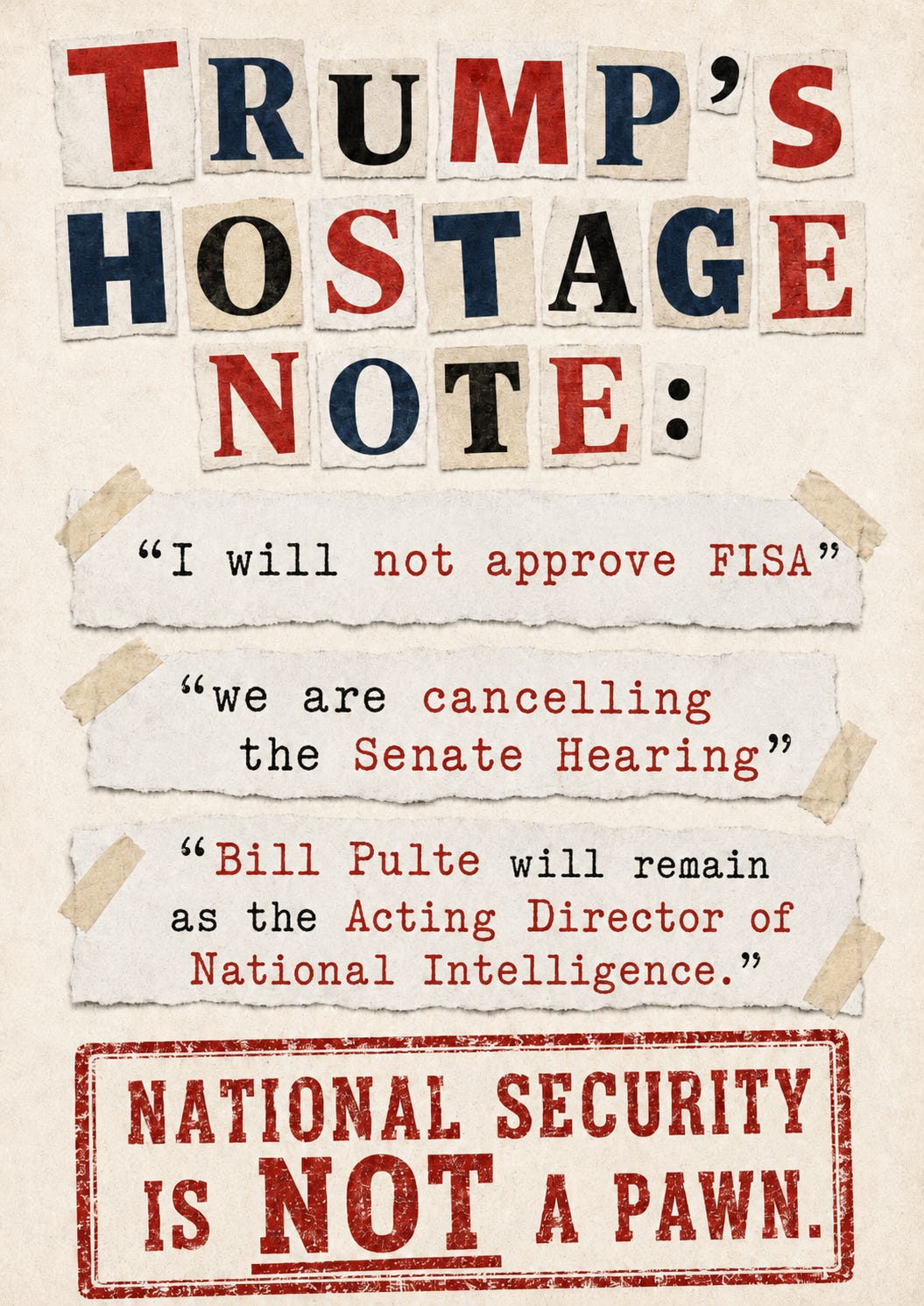
Standing beside a poster board that featured excerpts from Trump’s Truth Social post under the headline “Trump’s Hostage Note,” Schumer accused the president of holding national security “hostage” to unrelated political demands.
The centerpiece of those demands is the SAVE America Act, which would require documentary proof of citizenship to register to vote in federal elections. Trump’s insistence on linking the bill to FISA immediately complicated an already difficult legislative path.
Warner was blunt.
“FISA’s not going to be reauthorized if it’s attached to a SAVE Act, which is never going to pass,” he said.
The episode also reopened questions about Pulte, whose appointment as acting DNI sparked the current impasse.
Democrats have argued for weeks that Pulte lacks the experience required to oversee the nation’s intelligence agencies and have insisted that the administration put forward a qualified replacement before negotiations on FISA could resume in earnest.
Trump’s decision to keep Pulte in place appears to have hardened those concerns rather than eased them.
Perhaps the most revealing moment came when Warner was asked whether Clayton’s nomination had merely been postponed or withdrawn.
“I am not sure whether Jay Clayton has simply been postponed or withdrawn,” Warner said. “I wonder whether Jay Clayton knows whether he has been postponed or withdrawn.”
What remains unclear is where the administration intends to go next. And judging by the comments from both parties, lawmakers on Capitol Hill are still waiting for an answer.