


First Things First
👋🏾 Hi, hey, hello! Thank you for starting your day with Congress Nerd Sunrise.
📬 Send me tips, scoops or just say hi: michael@onceuponahill.com.
Texas Republicans on Tuesday night nominated a political flamethrower for the Senate while Texas Democrats spent the night settling a series of generational and ideological fights inside their own coalition.
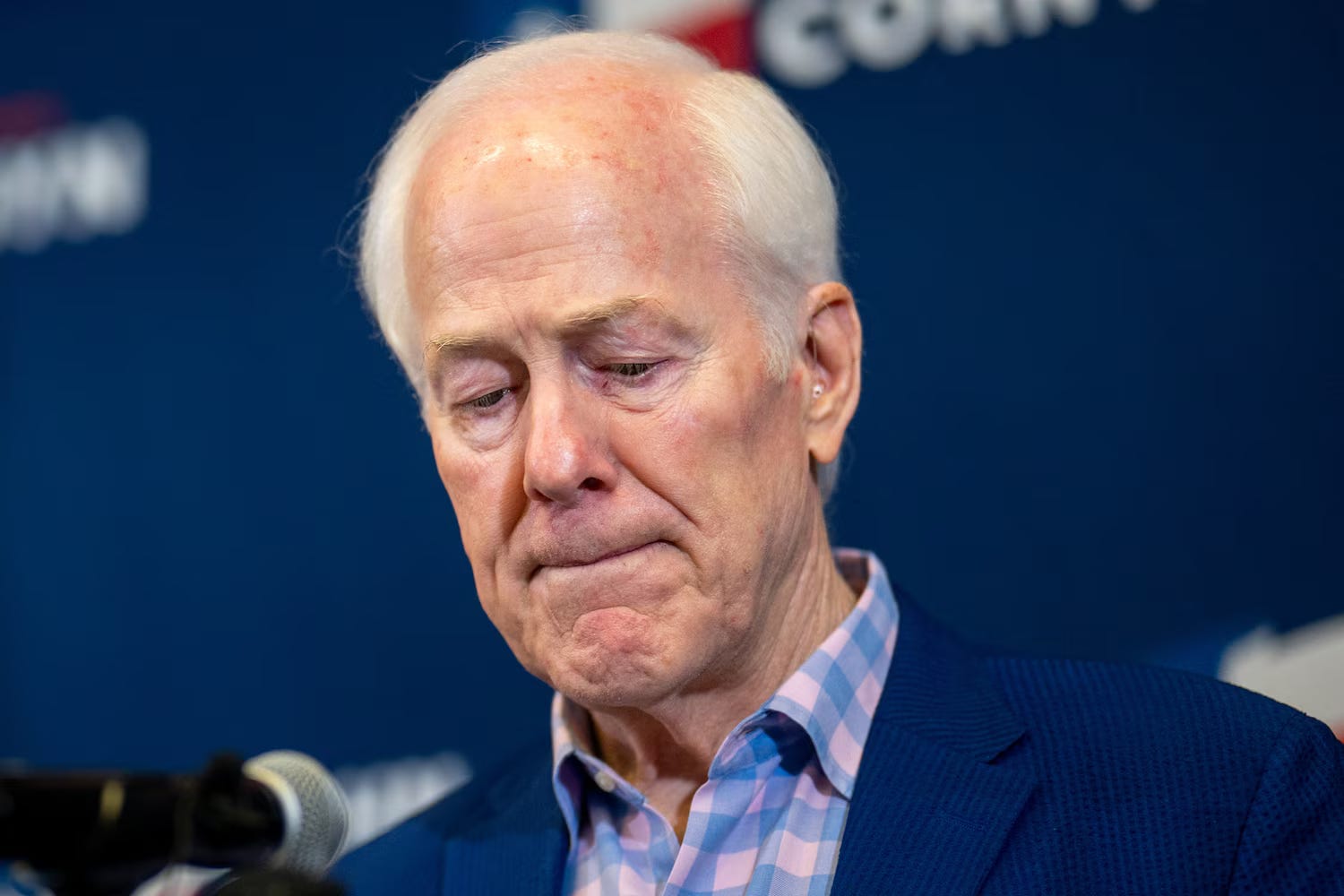
Attorney General Ken Paxton decisively ended Sen. John Cornyn’s four-term Senate career after defeating the incumbent in a bruising GOP runoff that doubled as the latest loyalty test inside President Donald Trump’s Republican Party.
Cornyn quickly pledged to support the Republican ticket in November, but his defeat instantly transforms him into one of several outgoing or politically untethered GOP senators no longer fully constrained by Trump-world pressures, alongside figures like Thom Tillis (N.C.), Bill Cassidy (La.), Susan Collins (Maine), Lisa Murkowski (Alaska) and retiring former GOP leader Mitch McConnell (Ky.) in a bloc could complicate Trump’s legislative ambitions at key moments over the next several months. The result also leaves national Republicans in an awkward position after months of warning primary voters that Paxton’s legal baggage and impeachment history could cost the GOP a Senate seat Democrats have not won since 1988.
Paxton wasted little time pivoting toward Democratic nominee James Talarico, casting him as culturally out of step with Texas voters, while Talarico struck a more conciliatory tone by praising Cornyn’s decades of service and openly courting disaffected Cornyn supporters into his coalition.
National Democratic operatives I texted with after the race was called for Paxton cautioned that Talarico remains a clear underdog in a state Democrats have not won at the presidential or Senate level in decades.
But they also argued Paxton’s nomination could force Republicans to spend millions of dollars defending a seat that otherwise may have allowed the GOP to focus more heavily on protecting vulnerable incumbents in states like Ohio, Alaska, Iowa, Maine, North Carolina and Nebraska while targeting Democratic Sen. Jon Ossoff in Georgia.
Those same operatives expect Republicans to aggressively define Talarico early, although some privately wondered whether Talarico’s political instincts would allow him to effectively counterpunch himself or whether that role would fall primarily to outside allies and surrogates.
The Democratic side of the ballot revealed a parallel appetite for change.
Rep. Christian Menefee defeated longtime Rep. Al Green in the redrawn TX-18 after a campaign that was centered heavily on generational turnover and the future direction of Houston-area Democratic politics. The race marked Menefee’s fourth campaign in just seven months and forced Green into a politically painful runoff against a fellow Democrat after last year’s redistricting scramble reshaped the district.
Former Rep. Colin Allred moved one step closer to returning to Congress after defeating Rep. Julie Johnson in TX-33, giving the Congressional Black Caucus an opportunity to offset Green’s departure as Republican legislatures in the Deep South work to gerrymander members of the powerful 62-person coalition out of power. And in TX-35, Democratic leaders got their preferred candidate when Johnny Garcia defeated controversial candidate Maureen Galindo after weeks of pressure from Democratic officials and allied groups alarmed by Galindo’s antisemitic comments during the campaign.
The night’s other major casualty was Rep. Chip Roy, who gave up a safe House seat only to lose the Republican attorney general runoff to state Sen. Mayes Middleton. Roy’s defeat is likely to reverberate beyond Texas, given his prominence inside the conservative movement and House GOP conference.
What Paid Subscribers are Reading
In last evening’s Congress Nerd Sunset, I wrote about how the Congressional Black Caucus is escalating its post-Callais pressure campaign by urging corporate America to speak out against what members and civil-rights leaders describe as efforts to dilute Black political representation across the South, reviving a civil-rights-era strategy built around economic pressure and institutional accountability. Still on the free plan? Upgrade your subscription for full access to this report and all future editions of Sunset.
Happenings
The House and Senate are out.
President Trump will hold a cabinet meeting at 11 a.m., followed by policy meetings at 3 p.m. and 4 p.m.
In the Know
— Two top House Democrats demanded answers on Tuesday in a letter to Secretary of State Marco Rubio after reports that Trump administration officials used U.S. embassies in Asia to pressure foreign companies into making million-dollar donations tied to a Trump-aligned fundraising operation that offered access to President Trump during America 250 celebrations. The letter from House Foreign Affairs Committee Ranking Member Gregory Meeks (D-N.Y.) and House Natural Resources Committee Ranking Member Jared Huffman (D-Calif.) escalated Democratic scrutiny of what they described as a potential “pay-to-play” scheme that blurred the line between official diplomacy, political fundraising and foreign influence ahead of the nation’s semiquincentennial celebration this summer.
— House Oversight Committee Ranking Member Robert Garcia (D-Calif.) on Tuesday named Rep. Lateefah Simon (D-Calif.) to lead the caucus’s new task force focused on civil rights and government accountability, as Democrats continue to sharpen their oversight strategy against President Trump’s second-term agenda despite being in the minority. The move signals Democrats plan to use the panel as another messaging and investigative hub on issues ranging from voting rights and immigration to disinformation and discrimination ahead of the 2026 midterms.
— A bipartisan group of House lawmakers led by Reps. Mark Pocan (D-Wis.) and Nick Langworthy (R-N.Y.) urged Health and Human Services Secretary Robert F. Kennedy Jr. to tighten rules at the National Institutes of Health governing animal suppliers for federally funded research after a Wisconsin beagle breeding facility accused of extensive animal welfare violations remained eligible under current policy. The effort reflects growing bipartisan pressure in Congress to strengthen oversight of animal testing and federal research ethics as the Trump administration simultaneously pursued a broader push to phase down mandatory animal testing requirements across the government.