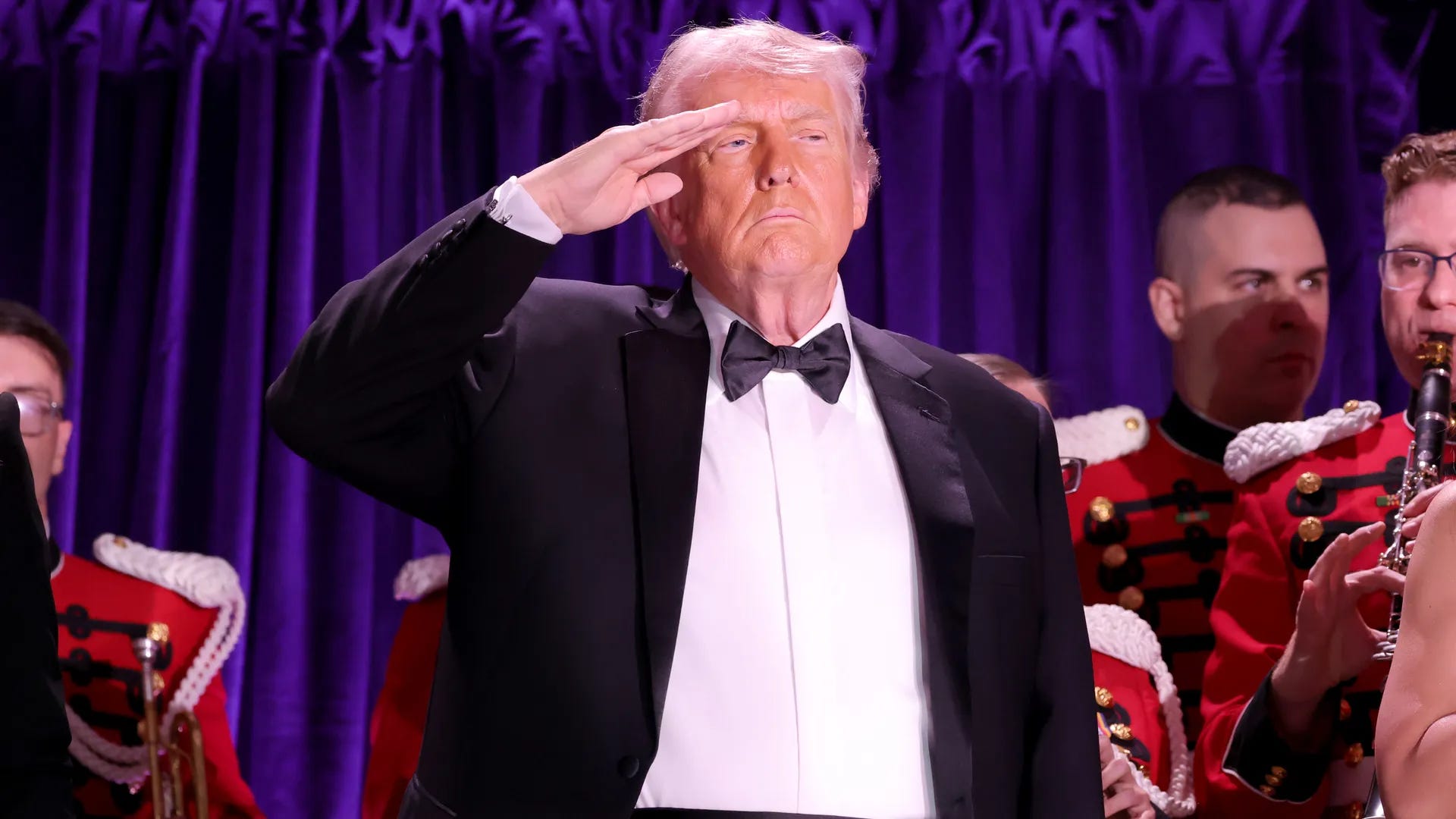
Trump allies seize on shooting to push ballroom
Plus: Tillis drops his Warsh blockade, Dems slam BIA’s DACA decision and the DOJ green-lights return of firing squads.

FIRST THINGS FIRST
○ ● ●
👋🏾 Hi, hey, hello! Good Sunday evening. Thank you for starting your workweek with Congress Nerd Sunset. Sending love and light to my Washington press club colleagues who were in harm’s way this weekend at the White House Correspondents’ Dinner this weekend. Despite the chaos, which you’ll read about below, many provided invaluable reporting to keep the public—and each other—informed about the developments as they unfolded. It was a demonstration that an independent and free press is as vital to democracy now as it has ever been.
📬 Get in touch: michael@onceuponahill.com
Tillis drops Warsh blockade • Sen. Thom Tillis (R-N.C.) said Sunday morning that he will vote to advance Kevin Warsh’s nomination to lead the Federal Reserve out of the Senate Banking Committee this week after the Justice Department closed its criminal investigation into cost overruns tied to renovations at the Fed’s headquarters. U.S. Attorney for the District of Columbia Jeanine Pirro said the Fed’s inspector general will take over the matter and deliver a comprehensive report to prosecutors.
Tillis, who had warned the probe threatened the Fed’s independence, said he is taking the DOJ at its word that the investigation into Fed Chair Jerome Powell is closed. However, President Trump suggested over the weekend that the closure could be conditional. Tillis said the central bank should move past the episode and refocus on its core mission. Powell’s term ends May 15, setting up a narrow window for the Senate to act on Warsh’s nomination.
● ○ ●
Dems slam BIA DACA decision • Democrats slammed a new Board of Immigration Appeals ruling that narrows how much protection Deferred Action for Childhood Arrivals recipients get in deportation proceedings. In the BIA decision, it held that immigration judges cannot terminate removal cases based solely on a person’s DACA status, emphasizing that deferred action does not confer a legal right to remain in the United States or block deportation.
Instead, judges must weigh other factors, including the Department of Homeland Security’s interest in continuing the case, effectively giving the government more room to pursue removals even when someone has active DACA protections.
The decision doesn’t end DACA or explicitly target Dreamers for deportation. But it removes what had functioned, in some cases, as a practical off-ramp from immigration court, which Democrats fear will result in more DACA recipients remaining in proceedings, where the risk of deportation increases.
● ● ○
DOJ green-lights return of firing squads • The Justice Department on Friday approved expanding federal execution protocols to include firing squads, part of a broader push by the Trump administration to restart and accelerate the use of the death penalty. The directive instructs the Bureau of Prisons to add firing squads and other methods to ensure executions can proceed even when lethal injection drugs are unavailable, while also streamlining internal processes for capital cases.
The move effectively reverses the Biden-era moratorium on federal executions and reauthorizes the use of pentobarbital-based lethal injections alongside alternative methods. Democrats quickly condemned the decision, arguing it revives outdated and inhumane practices. Senate Judiciary Committee Democrats, led by Ranking Member Dick Durbin (D-Ill.), criticized the policy as “cruel” and inconsistent with modern standards of justice, warning it could face significant legal challenges and deepen concerns about the fairness and application of capital punishment.
Know someone else who lives and breathes Congress? A gift subscription is a simple way to keep them in the loop on the strategy, negotiations and leadership politics driving the day on Capitol Hill.
THIS WEEK IN CONGRESS
Trump allies seize on shooting to push ballroom
Washington heads into a consequential legislative session still reeling from the shooting on Saturday at the White House Correspondents’ Dinner, where a lone suspect, armed with multiple weapons (including a shotgun, handgun, and knives), charged a U.S. Secret Service checkpoint before being subdued and taken into custody within minutes while guests were already seated inside for dinner.
At least one federal agent was struck but protected by body armor, and no fatalities were reported. Local and federal authorities said the incident appeared to involve a single actor with no ongoing threat, though the motive remains unknown and charges are pending. Inside the ballroom, guests were told “shots fired” and took cover as President Donald Trump, Vice President JD Vance, members of Congress, and other officials were evacuated. Law enforcement ultimately cleared the venue and treated it as a crime scene, forcing the event’s postponement.
In the immediate aftermath of the shooting, right-wing influencers, congressional Republicans, and Trump allies pointed to the incident as justification for building a White House ballroom capable of hosting large events under tighter presidential security control. Senate Budget Committee Chair Lindsey Graham (R-S.C.) said he would introduce legislation to fully fund the project.
But several Democratic sources I’ve spoken to in the hours since the incident say MAGA’s ballroom campaign rests on a contested premise since the dinner is organized by the White House Correspondents’ Association, not the White House. Presidents attend only by invitation, which places the event structurally outside the executive branch’s control.
And while President Trump has since promoted the ballroom as a security upgrade, the White House did not cite national security when it first unveiled the project last year. It has yet to submit a formal funding request to Congress, even as allies now press for taxpayer support for a project the president has said would be privately financed.
The sources were quick to question both the timing and substance of the ballroom push, casting it as a political response that moved faster than the facts around the incident itself.
“It is hard to trust this president or his administration. Last night’s incident at the WHCD raised too many unanswered questions and the immediate prompts from conservative outlets to re-examine the skepticism around approving and fast-tracking this ballroom reads right out of a television episode,” a House Democrat who did not attend the dinner told me. “Trump can control this narrative and its players. Meanwhile, Americans are still reeling under the high costs of tariffs, the Iran War and cuts to healthcare and a cabinet of incompetence.”
A Democratic operative who skipped the dinner over Trump’s attendance side-eyed what they described as a coordinated pro-ballroom influence campaign that unfolded as details about the incident were still emerging.
“I find it odd that he held a presser immediately after that and as he went on TV advocating for the ballroom, scores of right-wing Twitter accounts all tweeted nearly identical wording saying the same,” the operative said.
The ballroom project is a full-scale replacement of the White House East Wing to provide the White House with a permanent indoor venue for state dinners and large events, replacing the current reliance on tents on the South Lawn. The entire East Wing—traditionally home to the First Lady’s office and visitor entrance—was demolished last fall, including historic elements like the Family Theater and East Colonnade. The Office for the First Lady and staff have been temporarily relocated.
The ballroom is being pitched not just as an aesthetic but also as security infrastructure, with features such as bullet-resistant glass, “drone-proof” protections, modern defenses and expanded underground facilities.
The funding structure is where the project gets especially murky, though. It’s being financed through hundreds of millions in private donations from many anonymous donors. Critics—especially watchdog groups and Democrats—say this raises conflict-of-interest risks, especially if donors have business before the federal government.
And while the ballroom is under construction, its future remains legally unresolved, with courts still deciding whether the project can proceed as structured.
“We looked at all of the conditions that took place tonight. And I will say, you know, it’s not a particularly secure building,” Trump said while making the case for his ballroom during a press conference at the White House after the shooting.
Beyond the legislation that Graham said he will propose to fund the ballroom, the South Carolina Republican also said he would push for the Senate to fully fund the Department of Homeland Security, which has been shut down for more than 70 days and oversees the U.S. Secret Service—the agency that employs the officer whose bulletproof vest was struck during the shooting.
Graham argued that Congress must ensure DHS is fully funded so that Secret Service personnel are paid and supported in carrying out their mission, adding that agencies such as Immigration and Customs Enforcement and Customs and Border Protection are equally critical to national security.
“It is long past time to fully fund DHS, as the threats against our country are growing exponentially,” Graham said. “I implore my Democrat colleagues to support fully funding DHS at a time of great danger to America.”
But it is not congressional Democrats who are holding up pay for Secret Service agents.
House Republican leadership has declined to take up a bipartisan Senate-passed deal that would fund most DHS agencies while leaving unresolved disputes over ICE and CBP. (Separately, Graham is backing a reconciliation effort to fund those immigration agencies for the duration of Trump’s second term—legislation Democrats wouldn’t be able to filibuster.)
House Minority Leader Hakeem Jeffries (D-N.Y.) told Fox News Sunday’s Shannon Bream on Sunday morning that Congress must ensure all DHS personnel—including Secret Service agents, TSA officers, the Coast Guard, and FEMA employees—continue to be paid and called attention to the broad support the Senate deal had from both parties and the president. But he said that disagreements over funding for ICE and broader deportation efforts remain unresolved and should be addressed separately.
“For the life of me, I’m not sure why that bill hasn’t been brought to the floor of the House of Representatives,” Jeffries said. “When we return tomorrow, it should be taken up immediately, and it will pass on a strongly bipartisan basis, so we can make sure that the Secret Service gets paid.”