


FIRST THINGS FIRST
👋🏾 Hi, hey, hello! Good Thursday morning. Thank you for waking up with Congress Nerd Sunrise. Today’s my birthday. I’m grateful to see another year, doing work that matters in a moment like this, surrounded by people I love.
📬 Get in touch: michael@onceuponahill.com
○ ● ●
GOP budget clears after overnight vote-a-rama • Senate Republicans adopted their budget resolution just after 3:30 a.m. in a 50–48 vote to advance their plan to steer billions of dollars in funding toward immigration enforcement over the remainder of President Donald Trump’s second term. Sens. Lisa Murkowski (R-Alaska) and Rand Paul (R-Ky.) joined all Democrats in opposition.
The vote followed a roughly six-hour vote-a-rama dominated by Democratic messaging amendments on cost of living—health care, groceries, housing, and energy—most of which failed on party-line votes or after falling short of the 60-vote threshold needed to waive Budget Act points of order.
Sens. Susan Collins (R-Maine) and Dan Sullivan (R-Alaska) repeatedly broke with Republicans to support several Democratic amendments. Both are up for reelection in November and defending seats Democrats are aggressively seeking to flip in hopes of winning back the majority. Sen. Chuck Grassley (R-Iowa) missed the votes as he recovers from a gallbladder procedure, while Sen. Mark Warner (D-Va.) has been out since announcing his daughter passed away this week.
A handful of votes stood out. The Senate unanimously adopted a GOP amendment from Senate Budget Committee Chair Lindsey Graham (R-S.C.) targeting the deportation of undocumented immigrants convicted of serious crimes. A bipartisan group—including Collins, Murkowski and some Democrats—also backed amendments on drug pricing and FEMA funding, though those efforts still fell short. Paul’s amendment to balance the budget failed overwhelmingly.
Republicans have cleared a key procedural hurdle for reconciliation, but the harder fight shifts to the House, where conservative holdouts remain skeptical of a bipartisan Senate deal to fund the non-immigration-enforcement-related DHS agencies—especially as the department’s shutdown stretches into Day 68. Both chambers must ultimately align on the budget resolution before committees can begin drafting the reconciliation bill.
● ○ ●
Thune preps clean FISA extension • Senate Majority Leader John Thune (R-S.D.) filed cloture on a clean three-year extension of FISA Section 702, signaling the Senate is prepared to act if House Republicans can’t quickly unify around a reform package.
The Senate is positioning a clean extension as the fallback option ahead of the April 30 expiration, raising the likelihood the upper chamber could jam the House if talks collapse—setting up a familiar clash between surveillance reformers and leadership in both chambers.
The move puts pressure on Speaker Mike Johnson’s conference, where negotiations remain deadlocked between privacy hawks pushing for warrant requirements and national security leaders wary of weakening surveillance tools—while the White House closely watches for any deal it can support.
Thune made clear the Senate isn’t waiting indefinitely.
“The House, I think, has probably till [today]—Friday, at the latest, actually—to come up with something,” he told me on Wednesday. “But if they can’t come together behind something, then, yeah, we’re prepared to move here.”
● ● ○
ICYMI: David Scott dies at 80 • Rep. David Scott (D-Ga.), a longtime fixture of Georgia politics and former chair of the House Agriculture Committee, died on Tuesday night while he was sleeping. He was 80.
Many members of the Congressional Black Caucus learned of his passing during its weekly meeting, where Rep. Emanuel Cleaver (D-Mo.) opened in prayer before Chair Yvette Clarke (D-N.Y.) addressed the group. On the floor, the House held a moment of silence and later adjourned in his honor.
Scott, who represented Georgia’s 13th District since 2003, made history as the first Black lawmaker to lead the Agriculture Committee and built a reputation as a centrist dealmaker focused on rural investment and financial services.
His death marks the fourth House Democratic loss of the 119th Congress and has renewed scrutiny of aging lawmakers on Capitol Hill, where Scott’s own health had drawn quiet concern and he was facing a competitive primary at the time of his death. Read more in last night’s Sunset.
CAMPAIGNS
Jeffries projects confidence on House as SCOTUS decision looms
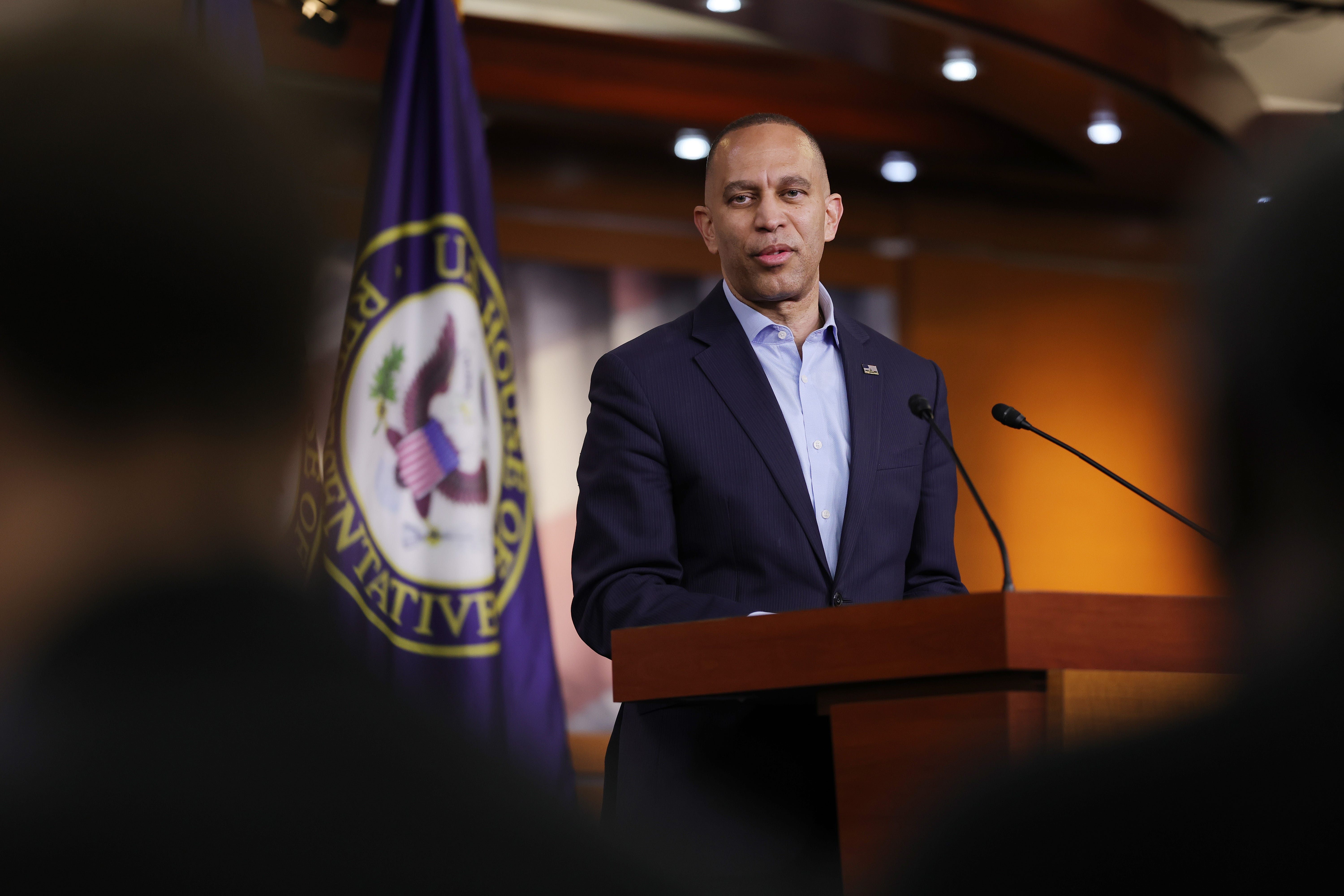
House Minority Leader Hakeem Jeffries (D-N.Y.) projected confidence on Wednesday that Democrats will win back the majority in 2026, even as the Supreme Court of the United States weighs a redistricting case that could reshape the map.
The Court has yet to rule in Louisiana v. Callais, a case with major implications for Section 2 of the Voting Rights Act and the future of majority-Black districts. Republicans see an opening to redraw maps if the justices weaken the law, but election experts say the window for sweeping changes before November 2026 is already narrowing.
“Whenever the Supreme Court decision comes down, hopefully a majority of the justices do the right thing,” Jeffries told me. “But whatever the circumstances are, we are committed to ensuring that there’s going to be a free and fair election in November, and when that happens, Democrats will take back control of the House of Representatives.”
Jeffries’ public confidence comes on the heels of the successful redistricting referendum in Virginia this week, where his political operation went all in to win the ballot measure that could net Democrats up to four seats if it survives a court challenge.
The delay in Callais has kept both parties in a holding pattern. But Jeffries argued the Supreme Court should stick with precedent and preserve Section 2, calling it a foundational, bipartisan civil rights law meant to safeguard fair elections. He pointed out that the Court—specifically Chief Justice John Roberts and Justice Brett Kavanaugh—upheld the provision as recently as 2023 in Allen v. Milligan, and said he sees no reason they would reverse course now.
“Now, I know that some of the far-right justices who are operating in the pocket of the Republican Party are trying to do everything possible to give MAGA extremists an electoral advantage,” Jeffries said in a thinly veiled reference to Clarence Thomas and Samuel Alito. “And we’re just not going to let it happen.”

While the courts sort out the Virginia referendum, Jeffries has shifted his focus to Florida, where Republican lawmakers are preparing to convene a special session next week to consider new congressional maps.
Jeffries, speaking to reporters during a Virginia victory-lap press conference, warned Florida Republicans against pursuing an aggressive redraw aligned with Gov. Ron DeSantis. He argued that such a move could backfire politically, citing Texas as a cautionary example and predicting Republicans would fall short of their most ambitious seat targets.
“Our message to Florida Republicans is F around and find out,” Jeffries said. “The Republicans are dummymandering their way into the minority before a single vote is cast.”
The irony is that, despite the ruthlessness Jeffries has demonstrated during the redistricting wars, it was just five years ago when a House Democratic majority passed the For the People Act, which would have effectively ended partisan gerrymandering nationwide by requiring states to use independent redistricting commissions for congressional maps. But it never took effect because it stalled in the Senate.
Jeffries said Democrats stand behind those efforts to establish a national standard but not at the expense of unilateral disarmament.
“Apparently, that’s what Donald Trump believed that we would do. That’s what [Trump political advisor] James Blair believed that we would do,” he said. “They had us confused in terms of the moment that we’re in and the need to push back consistently with the fierce urgency of now.”