

👋🏾 Hi, hey, hello! It’s Friday morning. Thank you for waking up to Congress Nerd Sunrise.
I’m exhausted, but still wired from the wild night that unspooled onto the House floor this morning. While you were sleeping, the FISA compromise that Speaker Johnson spent days brokering with his own members went up in smoke almost immediately after it became public. I’ve got the full play-by-play below.
I haven’t slept in nearly 24 hours—such is life on the congressional beat—so I’m about slumber. Have a great weekend!
📬 Get in touch: michael@onceuponahill.com

First Things First
Mejia wins New Jersey special runoff: Rep.-elect Analilia Mejia (D-N.J.) on Thursday night won the special election to fill the seat vacated by Gov. Mikie Sherrill (D-N.J.). Mejia, a progressive labor organizer and political strategist who co-led the Center for Popular Democracy, worked on Sen. Bernie Sanders’ 2020 presidential campaign, and served in the Biden-era Department of Labor, defeated Republican nominee Joe Hathaway in a race the AP called just seven minutes after the polls closed. (She will face Hathaway again in November for the chance to serve a full term.) When Mejia is sworn in, she will shrink Speaker Johnson’s vote margin on party-line bills from two to one, following the recent addition of Rep. Clay Fuller (R-Ga.).
Warren, Senate Banking Dems press Scott to delay Warsh hearing: Senate Banking Committee Ranking Member Elizabeth Warren (D-Mass.) led all 10 Committee Democrats on Thursday morning in a letter to Chair Tim Scott (R-S.C.) calling for the delay of next week’s nomination proceedings for Kevin Warsh, President Trump’s nominee to serve as the next Federal Reserve Chair, until the pretextual investigations into Chair Jerome Powell and Governor Lisa Cook are closed. They called for the Committee to instead hold a public hearing to assess President Trump’s involvement in directing these criminal investigations. After meeting with Warsh, Warren told reporters that her concerns about the nominee had deepened, citing his failure to disclose over $100 million in assets, his unexplained appearance in Epstein-related records, and an FBI background review that she said did not address either issue.
How a House GOP revolt sank Johnson’s FISA 702 vote
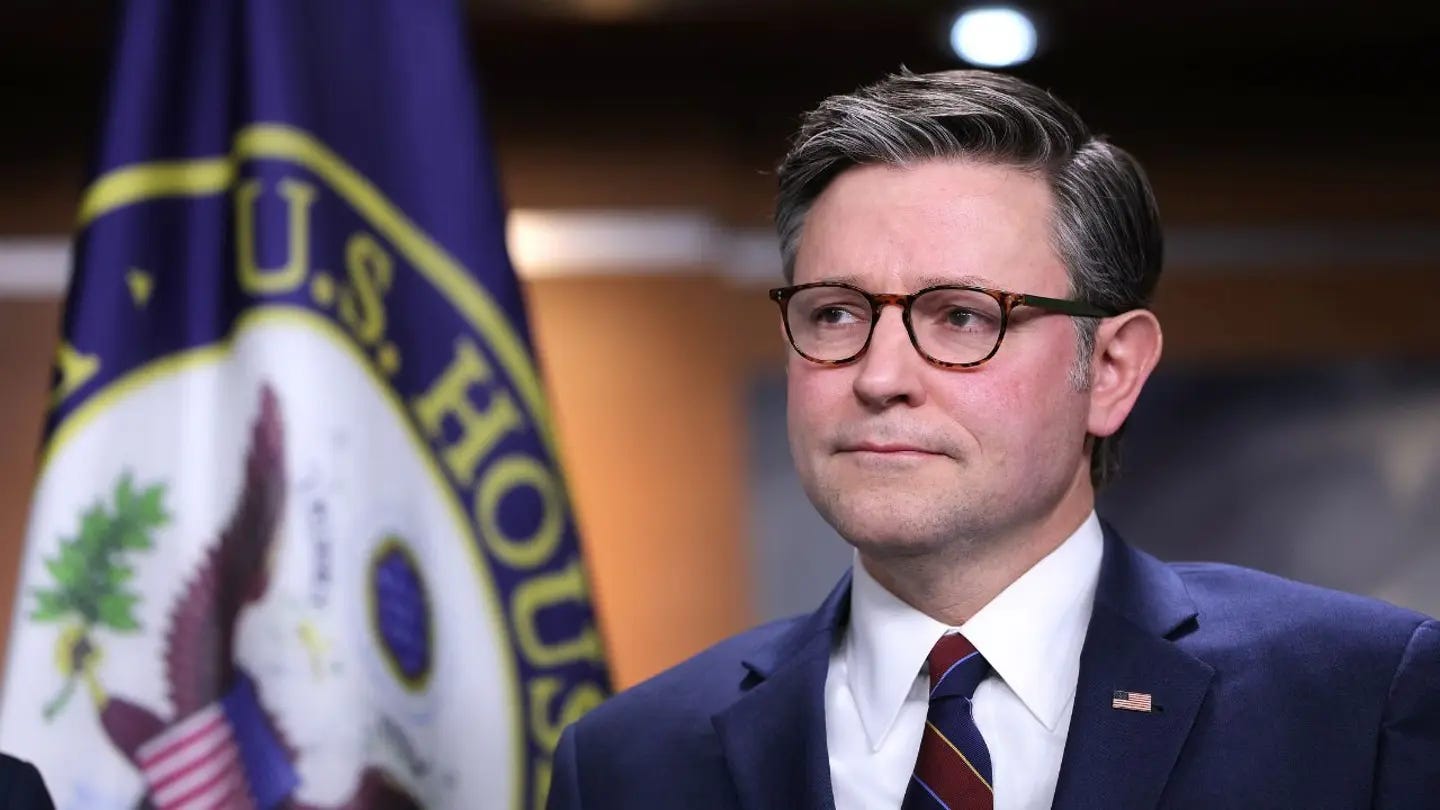
A handful of House conservatives delivered Speaker Mike Johnson (R-La.) a stunning rebuke early this morning, with a dozen Republicans rejecting a five-year package of reforms to the government’s warrantless foreign surveillance authority—known as Section 702—before 20 GOP lawmakers tanked a procedural vote to even debate a clean 18-month extension of those powers.
The episode marked a striking collapse—even for Johnson, who has already seen multiple rules fail under his speakership and several more come perilously close. After canceling and delaying votes this week to mediate between the House Freedom Caucus, which demanded stronger privacy protections, and the White House, which pushed for a clean, longer-term extension, he secured neither. Instead, the House passed a two-week extension of existing Section 702 authorities by unanimous consent before adjourning until Monday—buying Johnson time to regroup after a bruising night on the floor.
“Late-night votes never go well. People are punchy. That was tonight,” a House Democrat texted me as they left the floor just after 2 a.m. “We came back to vote down a bill we all knew was going to fail. This speaker cannot count.”
Not the usual GOP policy fight
Section 702 of the Foreign Intelligence Surveillance Act allows the U.S. government to collect communications of foreign nationals abroad without warrants, but it often captures data on Americans in contact with those noncitizens.
The Freedom Caucus and civil libertarians from both parties wanted structural reforms, especially a warrant requirement for queries of U.S. citizens. The tremendous trust gap that exists between House Democrats and the Trump administration, including acting Attorney General Todd Blanche and FBI Director Kash Patel, and the president himself, heightened the sensitivity against a straightforward continuation of the status quo without stricter guardrails.
“Sometimes it’s about the policy,” a House Democrat told me. Sometimes it’s about the people implementing the policy. This is one of those times.”
With Johnson facing a math problem with the rule on Wednesday afternoon, he canceled the vote series that had been scheduled for that time. He scrapped two additional afternoon series on Thursday amid ongoing talks among administration officials, House GOP leadership and the holdouts.
Just before midnight, House Majority Whip Tom Emmer’s office released text of the manager’s amendment to the unworkable extension and announced members would reconvene to debate the measure before advancing it to final passage.
The amendment extended Section 702 through April 2031—a major shift, given that leadership and the White House were seeking a shorter-term duration. It required a warrant to intentionally target a U.S. person’s communication and limited FBI “backdoor searches” to address the long-running abuse complaints. The bill also strengthened criminal penalties to include fines and prison time for unauthorized disclosure of 702 data, improper queries of U.S. persons and false statements to the FISA court. There was also a new structure around the FBI’s use of the provision and several explicit oversight provisions to try to claw back congressional visibility.
But House Democrats and several hardliners almost immediately expressed dissatisfaction with the proposal, specifically the warrant provision, which multiple people told me applied to targeting, not necessarily all database searches. In other words, the government can still act without a warrant if the person is a foreign agent, tied to a crime, or under other existing FISA authorities. This was a nonstarter for many members of the same group Johnson had been bargaining with for days. And within hours, the House had resumed the gridlock the speaker thought he had resolved.
To be clear, this debate wasn’t just a typical right-flank negotiation over how far to push policy. It reflected the fundamental divide over the surveillance authority itself. And instead of working to narrow that gap early, Johnson has let it spill into a late-stage scramble, canceling and postponing votes before trying again in the middle of the night.
“Nancy Pelosi would have never done this,” a House Democratic aide texted me, referring
The Senate path forward
Most senators went home for the weekend after the final vote of the week on Thursday afternoon, a signal of the little confidence they had that their GOP colleagues would make enough progress on a resolution to justify sticking around on a scheduled fly-out day.
Senate Majority Leader John Thune told me that the sooner the Senate received the bill from the House, the more likely it would be to process it quickly and readily. He was hesitant to take any options off the table, including a short-term funding patch if Johnson and the White House were unable to reach a deal with the Freedom Caucus.
But the South Dakota Republican acknowledged that almost any option they chose would require a time agreement to bypass the Senate’s traditional rules that allow for lengthy, unlimited speeches.
“At some point, it’s going to be a consent exercise. We’re going to need some cooperation to get it done before things go dark on the 20th,” Thune said. “I hope we have that level of cooperation, but we aren’t going to know that for sure until the House processes and sends it to us.”
The Senate will meet this morning to formally receive the bill. Thune could possibly set up the first procedural vote if no senators object on the floor.
It’s worth noting the House approved a significant piece of must-pass legislation with sweeping national security implications in the dark of night, weeks after conservatives slammed senators for passing a bipartisan deal to fund DHS, minus ICE and CBP. This place is full of ironies, I tell you.
Happenings
All times Eastern
The House is out.
The Senate is in at 10 a.m.
The House Appropriations Subcommittee on Military Construction, Veterans Affairs, and Related Agencies will hold a markup at 8 a.m. on the FY27 MilCon-VA funding bill.
The House Education and Workforce Committee will hold a hearing at 9 a.m. with Health and Human Services Secretary Robert F. Kennedy Jr. on HHS’s policies and priorities.
The House Appropriations Subcommittee on Financial Services and General Government will hold a markup of the FY27 FSGG funding bill.
The House Appropriations Subcommittee on Defense will hold a budget hearing at 9:30 a.m. in the National Guard and Reserve Forces.
Editor’s note: After a 2 a.m. adjournment and canceled floor votes, Friday’s committee schedule remains in flux. As of publication, these hearings and markups are still on the books.
● ● ● ● ○
Read All About It
“It’s not just Iran. Trump is flailing on multiple fronts” by Jonathan Lemire: “The president is on a losing streak, and even some of his aides are dismayed by his choices.”
“Trump picked the wrong pope to bully” by Ed Kilgore: “Pope Leo is very popular, even among Catholic conservatives who strongly disliked his predecessor.”
“What brought down Eric Swalwell” by Jon Allsop: “How the attention economy produced a moment of congressional reckoning.”