


👋🏾 Hi, hey, hello! Good Wednesday morning. Thank you for waking up with Congress Nerd Sunrise. Here’s what you should know as you start your day:
— Voters in Virginia on Tuesday evening approved a mid-decade redraw of the state’s congressional map, giving Democrats a chance to flip up to four seats in November and claw back some of the gains Republicans locked in through aggressive gerrymanders in Texas, North Carolina and Missouri as both parties battle for control of the House ahead of 2026.
The victory is also a major boost for House Minority Leader Hakeem Jeffries (D-N.Y.), whose allied groups poured millions into the referendum and who campaigned across Virginia in the weeks leading up to the vote. The scale of that investment underscored what was at stake: Jeffries’s path to becoming the first Black speaker could hinge, in part, on whether Democrats could claw back seats through redistricting. Virginia was central to that strategy.
“Democrats did not step back. We fought back. When they go low, we hit back hard,” Jeffries said in a statement. “Virginians spoke with a crystal-clear voice, voting to stop the MAGA power grab and protect the integrity of free and fair elections.”
Now, all eyes will shift further south to Florida, where the state legislature will convene next week to decide whether and how aggressively to gerrymander its map to reestablish a Republican advantage heading into the fall.
“We are prepared to take them all on, and we are prepared to win,” Jeffries said, while listing by name eight members of the Florida GOP congressional delegation who Democrats would target if state Republicans proceed. “Maximum warfare, everywhere, all the time.”
— The Senate is expected to vote today on a War Powers Resolution to force an end to the war in Iran. The measure, led by Sen. Tammy Baldwin (D-Wis.), is one of several measures Democrats have lined up as part of a strategy to force near-weekly votes and put Republicans on the record over what they describe as a reluctance to assert Congress’s Article I authority to declare war absent an imminent threat.
The vote comes a day after President Donald Trump announced a ceasefire extension with Iran, just hours before the existing truce was set to expire. The extension is effectively open-ended, intended to provide more time for negotiations, particularly with Pakistan’s mediation.
The decision amounts to a reversal for Trump, who earlier had signaled he didn’t want to extend the ceasefire and suggested time was running out for talks. The U.S. is maintaining its naval blockade of Iran, and Trump has warned military action could resume if talks fail. Tehran has not clearly endorsed the extension, and some Iranian officials are treating it with skepticism or outright suspicion.
— A bipartisan group of House lawmakers on Tuesday introduced the Congressional Pension Integrity Act to strip members of Congress of their taxpayer-funded pensions if they are convicted of serious crimes or violate House rules by engaging in sexual relationships with staff, closing gaps in current law that can allow lawmakers to retain benefits even after misconduct.
The measure, led by Reps. Suhas Subramanyam (D-Va.) and Anna Paulina Luna (R-Fla.) alongside Reps. Lauren Boebert (R-Colo.), Emily Randall (D-Wash.), Nancy Mace (R-S.C.) and James Walkinshaw (D-Va.), would apply to offenses including sexual assault, sex trafficking, violent crimes, bribery, fraud, election interference and obstruction of justice, and comes amid heightened scrutiny of how Congress handles misconduct, including cases where lawmakers resign before facing formal discipline.
The bill follows the recent resignations of former Reps. Eric Swalwell (D-Calif.) and Tony Gonzales (R-Texas), ahead of expected expulsion votes, spotlighted a gap in the rules that can allow members to exit before punishment and potentially keep their pensions.
📌 New this morning: Members turn the page after Cherfilus-McCormick exit … Democrats force rare hearing on ICE conduct, DHS shutdown
📬 Get in touch: michael@onceuponahill.com
○ ● ●
GOVERNMENT FUNDING
Schatz: Dems to center cost-of-living in vote-a-rama
Senate Democrats are preparing for a marathon vote-a-rama as soon as today, when they can offer an unlimited number of amendments to the GOP budget resolution Republicans plan to pass this week to unlock new immigration funding.
The rapid-fire voting session will begin once the chamber exhausts up to 50 hours of debate—time either side can yield back—and is expected to stretch for hours as Democrats force politically charged votes.
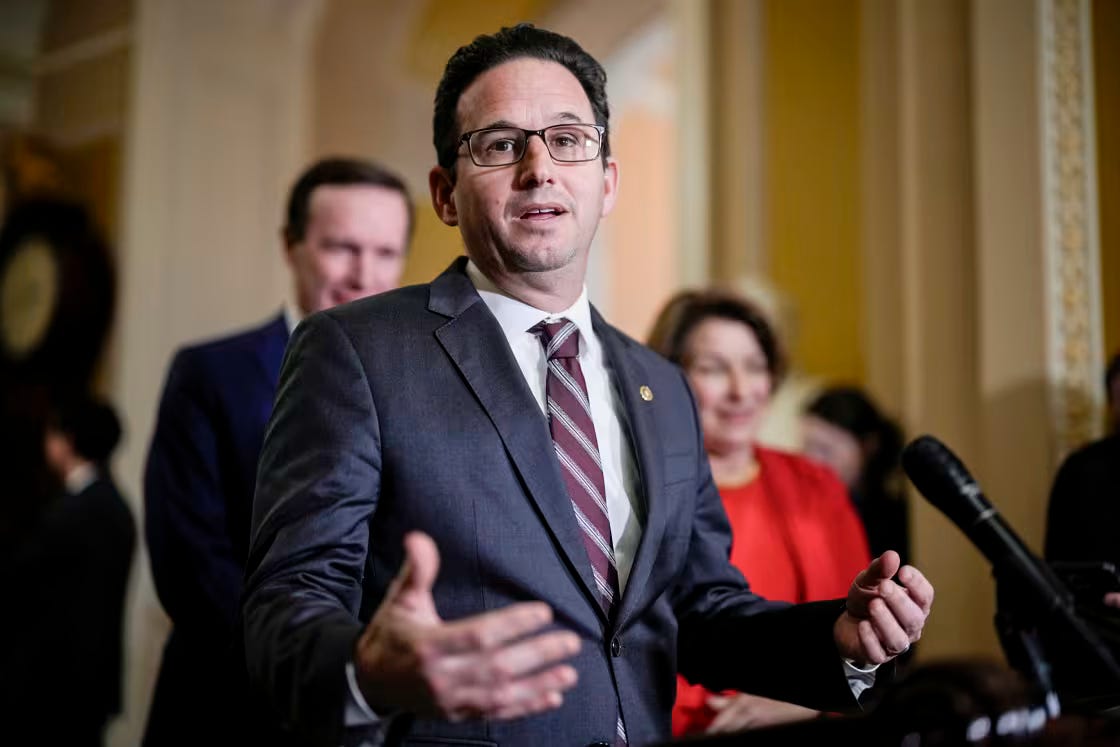
Sen. Brian Schatz (D-Hawaii), who is in line to serve as the number-two Senate Democrat next Congress, told me the caucus plans to keep its focus squarely on the affordability crisis throughout the process.
“We’re going to focus almost exclusively on the cost of living, and we’re going to make the point that they have this extraordinary tool, and they’re using it to pre-fund ICE with no reforms, rather than to reduce the cost of gasoline and electricity and groceries and health insurance,” Schatz said. “And so we’re going to make that case that they have an opportunity, they have the majority to try to do something about the cost of living, and they just literally won’t.”
Schatz, who currently serves as chief deputy whip, acknowledged some members may offer amendments on some of the reforms Democrats demanded during a recent round of unsuccessful negotiations with the White House.
“It’s not like you can just call a play and that’s the thing because every member has a right under the rules to offer an amendment,” Schatz said. “And I do think reforms related to ICE will be among the amendments considered, but our primary focus is going to be on the cost of everything.”
As for whether Democrats will use all of their debate time: “I don’t want to preclude anybody from using it.”
During vote-a-rama, senators are permitted to offer an unlimited number of amendments. Each is typically allowed only 30 to 60 seconds of explanation per side, followed by a 10-minute roll-call vote. The session continues until all pending amendments are disposed of or no more are offered, often lasting throughout the night. Even though most amendments to a budget resolution aren’t binding, they give the minority a chance to put members on record on politically sensitive issues.
As I reported in Tuesday evening’s Sunset, Senate Republicans voted to open debate on a 58-page budget resolution that provides a $140 billion budget allowance split equally between two committees—Homeland Security and Judiciary—over the next decade for immigration and border legislation.
No Democrats voted in favor of the procedural motion.
The two committees must report legislative text by May 15 for the Budget Committee to package into a single reconciliation bill. Republicans are aiming for a roughly $70 billion reconciliation bill, with duplicate instructions to Judiciary and Homeland Security designed to maximize flexibility given their overlapping jurisdiction. The GOP used the same playbook in last year’s budget resolution for the One Big Beautiful Bill Act.
A second vote-a-rama will occur later in the process once the actual reconciliation bill reaches the floor. President Trump has set a June 1 deadline for Hill Republicans to send the bill to his desk.
● ○ ●
THE HOUSE
Democrats turn the page after Cherfilus-McCormick exit
With Sheila Cherfilus-McCormick now out of Congress, House Democrats are eager to close the book on a bruising ethics saga and redirect attention to their midterm priorities, after what members have described, both privately and publicly, as an unwelcome distraction.
The sentiments followed days of quiet conversations among Democrats—many of them within the Congressional Black Caucus—that reflected deep unease about how to proceed.
Members wrestled with whether to move toward expulsion after the House Ethics Committee found Cherfilus-McCormick committed more than two dozen violations tied to allegations she misused roughly $5 million in federal funds, even as her criminal trial on related charges is not scheduled until early next year.
The divide—between enforcing standards now or waiting for the courts—could have surfaced in a floor vote but was ultimately resolved with her exit.
“That would have been a very hard vote,” a member, who planned to vote against expulsion and was granted anonymity to speak candidly about the situation, said. “I don’t think that anyone should be expelled, especially when there are criminal allegations, until they have been adjudicated in court.”
Rep. Sydney Kamlager-Dove (D-Calif.), who serves as the CBC’s whip, pointed to what she described as an uneven application of ethics standards, noting that Republicans have members facing their own investigations while pushing aggressively for Cherfilus-McCormick’s removal.
“The hypocrites have turned into the morality police, and many of the folks who were leading the charges to expel her have allegations that have been brought upon them that are equally damning,” she said. “So if there are court cases, let those get the proper space in front of a judge and a general.”
CBC Chair Yvette Clarke (D-N.Y.) said she discussed the political realities with Cherfilus-McCormick and what course of action might best serve her, emphasizing that while the conversation reflected input from other members, she was speaking personally rather than on behalf of the caucus.
“We knew that the sentencing phase of this was coming up,” Clarke said. “And the idea was, Listen, we know how much you love being a member. Your well being is most important.’”
Rep. Gregory Meeks (D-N.Y.), who chairs the CBC’s political arm, also expressed frustration that the expulsion push was fueled by partisanship. He accused Republican leadership of only accepting former Rep. Tony Gonzales’s resignation until Eric Swalwell stepped down.
“I hope that there’s one standard, which is really important for me,” Meeks added.
Hakeem Jeffries told reporters that Cherfilus-McCormick made the right decision on behalf of constituents to resign and is entitled to the presumption of innocence.
“House Democratic leadership will work with her staff to ensure that the needs of the people in her congressional district are met during this transition.”

● ● ○
IMMIGRATION
Democrats force rare hearing on ICE conduct, DHS shutdown
House Homeland Security Committee Democrats will hold a rare “minority day” hearing this afternoon to press the Trump administration over its mass deportation policies and the ongoing Department of Homeland Security shutdown, after Republicans declined to call key agency officials to testify.
Democrats used House rules to compel invitations to White House officials Stephen Miller and Tom Homan—the architects of the administration’s immigration crackdown—along with several U.S. citizens who allege they were shot, detained or otherwise mistreated by ICE and CBP.
The hearing, a continuation of a late-March session, is expected to feature some of the first on-the-record testimony from those individuals as Democrats seek to highlight the human impact of enforcement actions and force public accountability from administration officials.
Rep. LaMonica McIver (D-N.J.), a member of the committee, told me she expects Republicans to spend the hearing defending ICE’s funding with what she described as misleading arguments, while overlooking what she called the agency’s harmful treatment of U.S. citizens.
“What we’re going to continue to do, as we’ve been doing in every committee hearing, is to continue to talk about the cruelty that ICE has forced on to the American people, all of the things that they have been doing across the country that we see with our own eyes, in broad daylight,” she said. “And I think it’s important that we have these reforms and show the American people why we need these reforms.”
Rep. Delia Ramirez (D-Ill.), another Homeland Security Democrat, said it’s still unclear which administration officials will appear, accusing Republicans of keeping Democrats in the dark about whether Stephen Miller or Tom Homan will testify. She added that two Chicago residents are expected to speak and suggested their experiences could refocus attention on earlier immigration enforcement actions that she said have been overshadowed in the broader national debate.
“I want to make sure that it is a space where their voices are heard, but it’s also not a place where we’re just reliving their trauma and we’reactually talking about what we’re going to do so that never happens again,” she told me. “Because I hate this whole thing of, like a charity thing, ‘Oh, put the poor people, put the Black people, put Latino people, to just talk about their their sad story.’”