


👋🏾 Hi, hey, hello! Welcome to Congress Nerd Daily, Once Upon a Hill’s reported evening briefing chronicling the strategic decisions, procedural fights and campaign dynamics that determine how power is exercised, challenged and won on Capitol Hill.
Good luck to the lawmakers taking the field tonight for the annual Congressional Baseball Game at Nationals Park. The event raises money for the Washington Literacy Center, the Boys & Girls Clubs of Greater Washington and Washington Nationals Philanthropies. You can watch live on Fox Sports 1 or C-SPAN, or stream it through services like Fubo.
Before members trade floor speeches for fastballs, they got another reminder that inflation remains a political problem neither party can ignore.
The Consumer Price Index rose 4.2% from a year earlier in May, its fastest annual increase in more than three years. Prices climbed 0.5% from April, driven largely by a surge in energy costs tied to the ongoing war in Iran.
The details beneath the headline were somewhat less alarming. Outside energy-sensitive sectors such as travel and transportation, inflation continued to cool. Prices for new vehicles, furniture and prescription drugs all fell last month, a sign that broader tariff-related price pressures may be easing.
Still, the topline number is more than double the Federal Reserve’s 2% target, making it highly unlikely policymakers will cut interest rates when they meet next week. Markets broadly expect the Federal Open Market Committee to leave benchmark rates unchanged at 3.5%-3.75%.
President Donald Trump, however, had a different reaction.
Asked about the report in the Oval Office, Trump replied: “No, I love it, the numbers were great. You know what I really love? I love the inflation.”
House Minority Leader Hakeem Jeffries (D-N.Y.) could hardly have asked for a better soundbite.
“Every time Donald Trump opens his mouth about the economy, he significantly increases the likelihood that Democrats are going to take back control of the House of Representatives,” Jeffries said.
In this evening’s edition: Ted Cruz defends his college sports overhaul against growing criticism from the Congressional Black Caucus and civil-rights groups while outlining an ambitious path to passage. Plus: Johnson plans a FISA short-term extension vote that seems destined to fail.
🔓 This edition is in front of the paywall. But if you want the Tuesday and Thursday editions, plus the Sunday lookahead, upgrade your subscription for full access to every edition and the complete archive. Whether you’re taking the votes, writing the bills, running the campaigns, shaping the message or trying to influence any of the above, Congress Nerd Daily helps you see around corners before everyone else catches up.
The Capitol Bulletin
JOHNSON’S FISA GAMBIT: House Speaker Mike Johnson is giving Congress one more chance to avoid a lapse in federal surveillance authorities.
The Louisiana Republican announced this afternoon that he’ll put a three-week extension of Section 702 of the Foreign Intelligence Surveillance Act on the floor in the morning under suspension of the rules, a fast-track procedure that will require substantial Democratic support less than 48 hours before the authority expires.
The problem for Johnson is that many of the Democrats he needs don’t appear interested in helping him.
The latest push comes after Senate Democrats rejected a separate proposal to extend the authority through July 2 after a closed-door lunch meeting. And while Democrats aren’t expected to formally whip against Johnson’s bill, there is very little support inside the caucus for a short-term extension as long as President Trump plans to elevate Federal Housing Finance Agency Director Bill Pulte to serve as acting Director of National Intelligence.
House Minority Leader Hakeem Jeffries (D-N.Y.) left little room for ambiguity.
“Under no circumstances should we move forward with an extension of surveillance authority as long as Bill Pulte, who’s deeply unqualified, is on track to being the acting director of National Intelligence,” he told reporters.
Jeffries argued the White House, not congressional Democrats, is responsible for the impasse.
“If Donald Trump wants any shot at a short-term extension, he needs to pull back on the Bill Pulte nomination,” he said.
Not every Democrat is closing the door. Senate Intelligence Committee Vice Chair Mark Warner (D-Va.) said he could support a temporary patch if Principal Deputy DNI Aaron Lukas serves as acting intelligence chief instead of Pulte. Sen. Brian Schatz (D-Hawaii) said he’s open to an extension depending on the broader negotiations.
Privacy hawks are pushing in a different direction. Sen. Ron Wyden (D-Ore.) continued arguing that stronger warrant requirements and other reforms, not another short-term extension, are the key to assembling a bipartisan coalition.
For now, Johnson has a bill. Whether he has the votes is a different question entirely.
📬 The best stories often start with a conversation. If you’ve got insight, context or something others are missing, my inbox is open. Send me tips, scoops or just say hi: michael@onceuponahill.com.
The Big Story
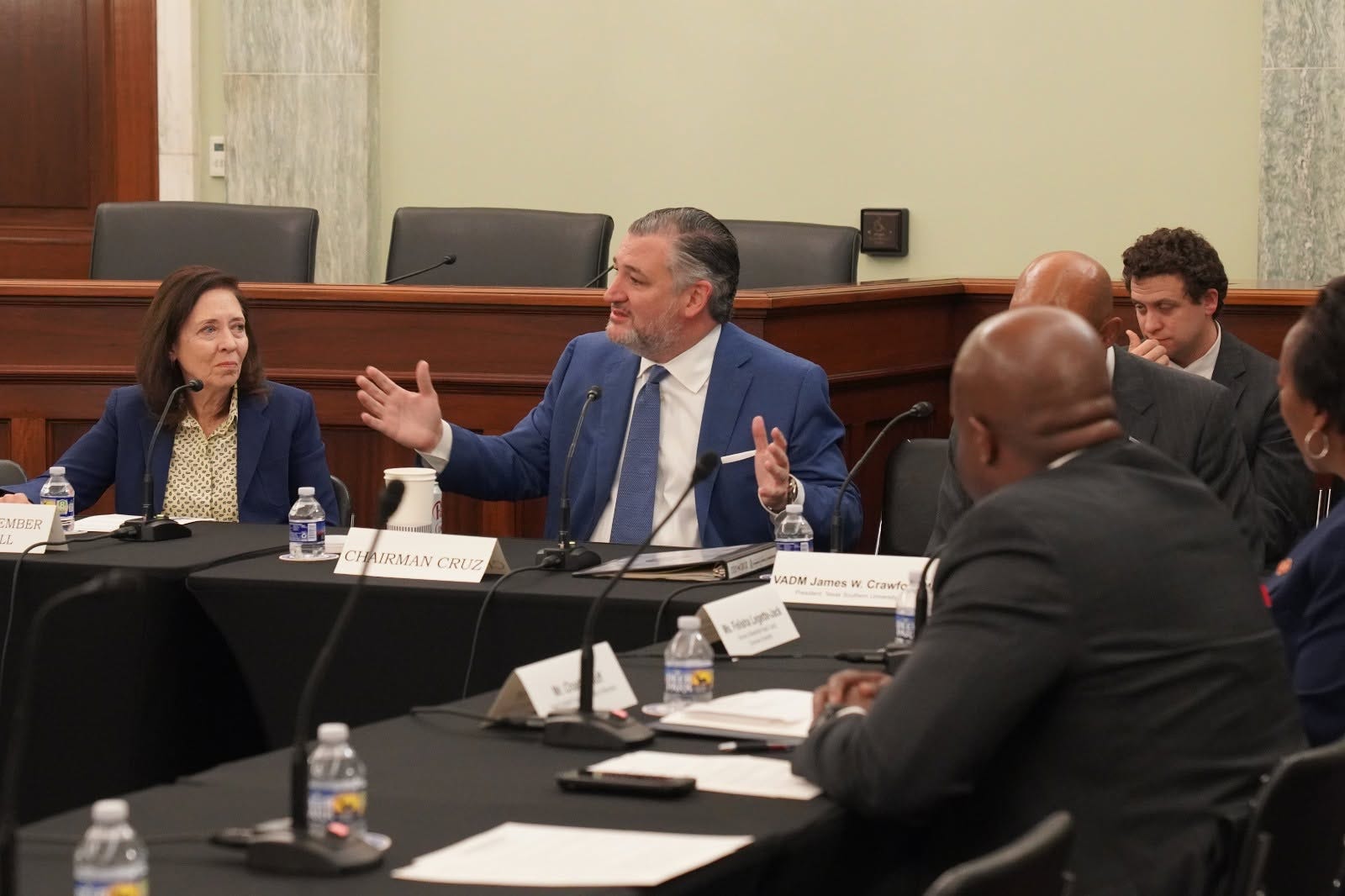
Senate Commerce Committee Chair Ted Cruz (R-Texas) continued his increasingly aggressive case this morning that Congress has little choice but to pass his bipartisan college sports overhaul and do it fast.
Speaking after a roundtable Wednesday with coaches, athletes, university leaders and conference officials, Cruz brushed aside criticism of the Protect College Sports Act and argued the legislation represents the only realistic path forward for a college athletics system he says is buckling under litigation, NIL disputes and transfer-portal instability.
“My appeal is this is the only train leaving the station,” Cruz said. “This bill, I believe, has a real prospect of passage.”
The legislation, introduced last week with Ranking Member Maria Cantwell (D-Wash.), Sen. Eric Schmitt (R-Mo.) and Sen. Chris Coons (D-Del.), would establish a national framework governing NIL compensation, athlete transfers, revenue sharing and college sports governance.
Cruz’s comments come as the Congressional Black Caucus and NAACP continue to press lawmakers to slow consideration of college sports legislation until athletics leaders engage more directly with concerns about voting rights and Black political representation following the Supreme Court’s Callais decision.
I asked Cruz what he would say to CBC members and civil-rights advocates who argue it is impossible to have a good-faith discussion about college sports legislation without first addressing the redistricting battles unfolding across the Deep South.
Cruz responded by arguing that failing to act would disproportionately harm many of the same communities the CBC says it is trying to protect.
“When the president of [Texas Southern University] says that [the consequences] would be devastating for HBCUs, they would be devastating for hundreds of thousands and over time millions of athletes,” Cruz said. “Failure is not an option.”
House Democratic Leader Hakeem Jeffries (D-N.Y.) was unimpressed.
“We’re not trusting the fate of Black America to Senator Ted Cruz,” Jeffries told me.
CBC Chair Yvette Clarke (D-N.Y.) went further, accusing supporters of the legislation of minimizing athletes’ ability to advocate for themselves.
“It’s very paternalistic,” Clarke said after the caucus’s weekly meeting. “They’re making it seem as though we don’t have the talent or expertise to help negotiate with our talent and their families and their congregations fair NIL contracts.”
The exchange highlights the emerging political challenge facing Cruz and Cantwell as they attempt to build support for a bill that has attracted significant backing from conferences, coaches and university leaders but still faces skepticism from civil-rights groups and some lawmakers.
Nonetheless, Cruz is pressing forward with an ambitious timeline.
He told reporters his goal is to move the legislation through Congress before the start of the upcoming school year, citing concerns from college athletics leaders about additional program cuts and uncertainty surrounding the transfer portal.
“My hope is that we get this passed before the beginning of the school year,” Cruz said.
Whether Congress can move that quickly remains unclear.
“We’re gonna huddle and see,” Cantwell said when asked when the Senate Commerce Committee might mark up the bill.
She acknowledged that women’s sports and Olympic sports could attract significant attention during the amendment process, particularly questions surrounding long-term funding protections.
“There’s a lot of attention already to that,” Cantwell said.
The Washington Democrat also pushed back on criticism from the CBC and NAACP, arguing that the Senate proposal differs substantially from the House’s failed SCORE Act.
“We’re talking to them about the differences between our bills,” she said. “We are showing them so that they understand we’re both fighting the SEC.”
Not every senator is sold.
Sen. Katie Britt (R-Ala.) told me she believes Congress must act to preserve college sports but said she still has concerns that would need to be addressed before she could support the legislation.
“There are a couple things where I have some concerns, and those concerns would need to be addressed for me to be able to get behind it,” Britt said. “There’s no doubt that we have to do something in order to save college sports and the integrity of it, but I also want to make sure that we allow the market to work.”