


👋🏾 Hi, hey, hello! Welcome to Congress Nerd Daily, Once Upon a Hill’s reported evening briefing chronicling the strategic decisions, procedural fights and campaign dynamics that determine how power is exercised, challenged and won on Capitol Hill.
In this evening’s edition: College athletics leaders warned that NIL chaos, transfer-portal instability and conference consolidation threaten the future of college sports, even as the Congressional Black Caucus urged senators to pump the brakes.
Plus: Senate Republicans finally moved their party-line immigration vote to the floor in a sprint to pass it tomorrow—after two controversial issues threatened to derail the package altogether—and how Democrats’ scare in CA-06 has folks scrutinizing the Golden State’s jungle primary system yet again.
First things first: Senate Democrats’ Election Protection Task Force met today with a group of prominent election lawyers and democracy advocates to discuss potential threats to the voting process, while House Administration Committee Ranking Member Joe Morelle (D-N.Y.) is preparing a separate members-only tabletop exercise focused on election security. People familiar with the efforts say lawmakers in both chambers are preparing for a range of scenarios that could disrupt voting.
On the foreign policy front, the House just passed House Foreign Affairs Committee Ranking Member Gregory Meeks’s (D-N.Y.) Iran War Powers Resolution in a 215-208 vote, marking the chamber’s first successful rebuke of President Donald Trump’s handling of the conflict after three previous House attempts failed. Four Republicans joined all voting Democrats in support of the measure, which follows Senate passage of a similar resolution last month and signals growing bipartisan concern about the administration’s conduct of the war. Democrats erupted in applause as the vote was gavelled to a close.
Last but not least: This edition is in front of the paywall. But if you want the Tuesday and Thursday editions, plus the Sunday lookahead, upgrade your subscription for the full Congress Nerd experience and access to the complete archive. Whether you’re taking the votes, writing the bills, running the campaigns, shaping the message or trying to influence any of the above, Congress Nerd Daily helps you see around corners before everyone else catches up.
THE CAPITOL BULLETIN
Senate opens debate on immigration bill after GOP retreats on two provisions
Senate Republicans began floor consideration of their immigration-focused reconciliation bill this afternoon after jettisoning two controversial provisions that had threatened to derail the package and divide their conference.
The Senate voted 53-46 along party lines to proceed to the legislation, unlocking up to 20 hours of debate before a marathon vote-a-rama on amendments. Sen. Michael Bennet (D-Colo.) did not vote.
The procedural breakthrough came hours after Senate Republicans released revised legislative text removing $1 billion in funding for security enhancements at President Trump’s planned White House ballroom and days after Acting Attorney General Todd Blanche testified under oath that the administration would no longer pursue a proposed anti-weaponization fund that had drawn skepticism from both parties.
The changes appeared to alleviate concerns among enough Senate Republicans to move the bill to the floor, reviving legislation that collapsed before the Memorial Day recess amid disputes over the two provisions.
Democrats argued that the revisions do little to change the package’s underlying substance.
“We remain a hard no on using taxpayer dollars to fund ICE to brutalize and kill American citizens,” House Minority Leader Hakeem Jeffries (D-N.Y.) told me this afternoon.
House Democratic Caucus Chair Pete Aguilar (D-Calif.) said Republicans removed the provisions only because they had become politically untenable, arguing Democrats remain focused on the bill’s roughly $70 billion increase in immigration enforcement funding and what they describe as insufficient oversight safeguards.
Senate Minority Leader Chuck Schumer’s (D-N.Y.) office signaled that Democrats plan to use much of their allotted debate time and continue highlighting the removed provisions during the amendment process.
“Tomorrow, we’ll keep forcing Republicans to answer for their priorities: Trump’s corrupt slush fund, his rogue police force, and his endless corruption,” a Schumer spokesperson said.
House Speaker Mike Johnson (R-La.) said the House could vote on the Senate-passed bill as soon as Friday morning. In anticipation of Senate action, House Republicans moved a procedural rule through the Rules Committee that would allow the chamber to take up the legislation immediately upon its arrival from the upper chamber.
📬 The best stories often start with a conversation. If you’ve got insight, context or something others are missing, my inbox is open. Send me tips, scoops or just say hi: michael@onceuponahill.com.
THE TRAIL
Democrats’ CA-06 scare revives an old California debate
The possibility of a Democratic lockout in a key California House race has reignited questions about the state’s top-two primary system, including from a member of House Democratic leadership.
Republican-turned-independent Rep. Kevin Kiley led the field Wednesday in California’s 6th congressional district, while Democrat Richard Pan and Republican Michael Stansfield remained locked in a close battle for the second general election slot. Democrats entered Election Day worried that multiple candidates could split the party’s vote and allow two non-Democrats to advance in a district the party redrew to favor Democrats.
The uncertainty prompted me to ask House Democratic Caucus Chair Pete Aguilar, a California Democrat, whether he believes the state’s jungle primary system is working as intended.
“Yeah, I don’t think it’s delivered what supporters said it would do,” Aguilar told me. “And what supporters said it would do is it would offer people an opportunity to support someone who was more ideologically close to you, and I don’t think that’s been the case.”
Instead, Aguilar argued voters largely default to partisan affiliations.
“I think what happens is people vote for the blue team or the red team, or they just don’t vote at all,” he said. “If you’re a Republican and you see two Democrats on the ballot, you skip it.”
Aguilar stopped short of calling for changes to the system, noting that “this is the law in California, we make it work.” But he also described himself as “more of a traditionalist” and said the experiment has produced “kind of a mixed bag.”
His comments came as Democrats watched late-arriving ballots in CA-06, hoping to avoid the very outcome critics of the top-two system have long warned about: a competitive race where vote-splitting, not voter preference, determines who advances to November.

The Big Story
The Senate’s most serious attempt yet to stabilize college sports ran headfirst today into a much larger fight over Black political power.
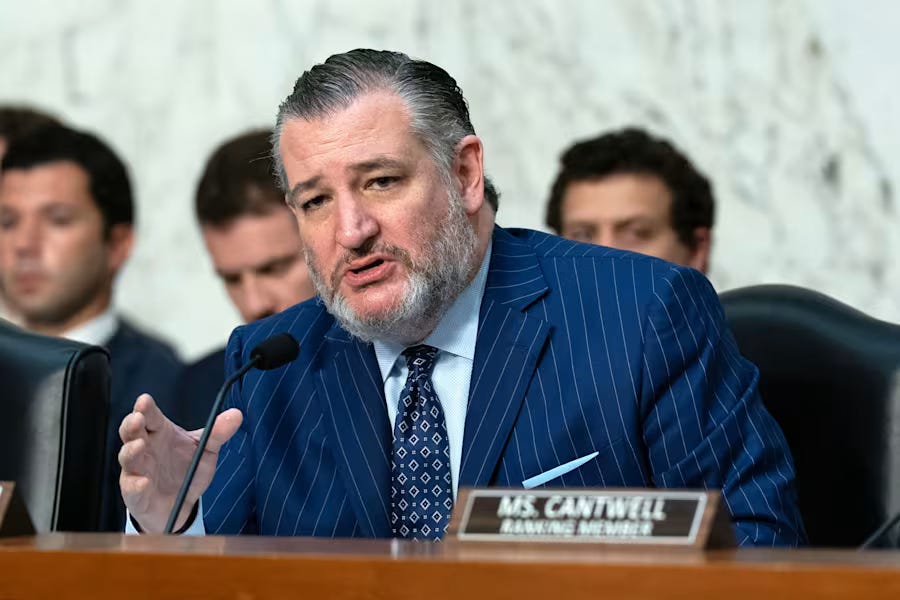
The Senate Commerce Committee held a three-hour-plus hearing on the Protect College Sports Act, bipartisan legislation from Chair Ted Cruz (R-Texas), Ranking Member Maria Cantwell (D-Wash.), Sen. Eric Schmitt (R-Mo.) and Chris Coons (D-Del.) that would create a national framework for name, image and likeness payments, transfers, revenue sharing and college sports governance after years of court rulings, state laws and market forces weakened the NCAA’s old model.
But less than an hour before the hearing began, the Congressional Black Caucus formally urged Cruz and Cantwell to pause consideration of the bill, arguing Congress should not confer new protections, authorities or legal certainty on college athletic institutions while their leaders remain silent amid what the caucus describes as attacks on Black political representation across the South after the Supreme Court’s Callais decision.
“The issue before us is larger than college athletics,” the Chair Yvette Clarke wrote on behalf of the CBC. “It is whether institutions that benefit from the talent, labor, and cultural contributions of Black communities can remain silent while the political power of those same communities is systematically weakened.”
That letter added a sharp political edge to what was already a consequential hearing.
Cruz opened the proceedings by arguing that “the foundation under college sports is cracking,” citing NIL spending, transfer portal instability, historic rivalries disappearing, professional athletes returning to college competition and the richest conferences pulling further away from everyone else.
“To be clear, this problem wasn’t caused by student-athletes profiting from their name and image and likeness,” Cruz said. “The problem is the old system was dismantled without a durable replacement.”
Cantwell made a similar case, warning that failure to act could hurt women’s sports, Olympic sports and the college pipeline the United States relies on to develop athletes.
“We cannot have a pay-for-play system” that cuts women’s and Olympic sports, she said.
The witnesses largely backed the bill’s basic premise that the current system is unsustainable, even if the legislation is not perfect.
Former Alabama football coach Nick Saban said he was not there to represent a team or conference but “to preserve college athletics as a whole.” He said NIL has become pay-for-play and warned that college sports have “moved away from development to focusing on money and not life skills.”
Notre Dame Athletic Director Pete Bevacqua said Congress needed to act urgently to protect athletic departments and preserve the student-athlete experience.
“If Congress doesn’t act now, there are going to be thousands and thousands and thousands of stories of young men and women—particularly in football and men’s and women’s basketball—that bounce around to three, four schools,” Bevacqua warned.
Gordon Gee, West Virginia University’s president emeritus, said the bill would bring “common sense to a very intractable problem,” while Pac-12 Commissioner Teresa Gould said college athletics faces challenges too complex for any single bill but still requires immediate action.
The hearing’s first real note of skepticism came from Sen. Lisa Blunt Rochester (D-Del.), a CBC member and former head of the Metropolitan Wilmington Urban League, who said she had heard serious concerns from student athletes, families, labor unions and civil rights organizations.
“I understand also that the Congressional Black Caucus has sent letters to the chair and ranking member,” Blunt Rochester said. “This is just a really important issue at a very tough time, and so I hope that we take our time and get this right.”
She also questioned whether student athletes fully understand a provision that could leave them responsible for attorney fees and litigation costs if they sue and lose.
That line of questioning captured the emerging split around the bill. Its supporters view it as Congress’s last best chance to prevent college sports from devolving into a mini-NFL controlled by a handful of wealthy programs. Critics and skeptics worry that the bill could reconcentrate power among schools, conferences and the NCAA at the expense of athletes.
Sen. Andy Kim (D-N.J.), who questioned witnesses about injury prevention and player health, told me afterward that he is still learning the bill and plans to hear from New Jersey stakeholders.
“I think so much of the conversation so far has focused on the money,” Kim said. “I just wanted to make sure that we bring it on back. I’m a dad. I got little kids that are going to be in college in a couple years.”
Kim added that many college athletes will never play professionally and should be protected while they are still students.
“These are not professionals,” he said. “I just want to make sure they’re safe, and I just want to make sure that they’re being treated fair.”
Clarke was more direct outside the House Democratic Caucus meeting this afternoon.
“We just think the timing is horrible,” Clarke said. “Voting rights are the main issue for Americans across this nation right now, and to reward sort of these southern athletic conferences, who are the main drivers behind the SCORE Act … it just feeds the beast.”
Rep. Lori Trahan of Massachusetts, one of the House Democrats most engaged on college sports, gave Cruz and Cantwell credit for drafting a bipartisan bill, unlike the House’s failed SCORE Act. But she said Democrats are still reviewing whether the Senate proposal is sufficiently athlete-centered and protective of women’s and Olympic sports.
“There is a lack of consensus on a number of issues,” Trahan said.
That may be the real takeaway from Wednesday’s hearing.
Cruz and Cantwell have built a serious bipartisan vehicle on one of the thorniest issues in sports and higher education. But the CBC’s intervention made it clear that the bill’s path forward will not hinge solely on NIL rules, transfer limits or antitrust exemptions.
It will also test whether Congress can separate the business of college sports from the Black athletes and communities that made it so valuable in the first place.