


FIRST THINGS FIRST
👋🏾 Hi, hey, hello! It’s Thursday morning. Thank you for waking up with Congress Nerd Sunrise. Say hi or send me a tip: michael@onceuponahill.com.
Godspeed to NASA astronauts Reid Wiseman, Victor Glover, Christina Koch, and Canadian Space Agency astronaut Jeremy Hansen—the crew that last night launched Artemis II, NASA’s historic 10-day crewed mission that will send the four astronauts around the Moon and back in the first human lunar journey since 1972. Speaking of firsts, Glover is the Black man to pilot a mission to the moon. Koch is the first woman, and Wiseman is the oldest person to leave low Earth orbit. The backstory on the menu NASA prepared for the mission is super interesting, if I do say so myself.
The Senate in two hours will take another crack at what it attempted last Friday morning when it unanimously passed a bipartisan deal to fund the Department of Homeland Security—minus Immigration and Customs Enforcement and Customs and Border Protection—and end the longest shutdown in U.S. history before House Republicans rejected the compromise and passed a 60-day continuing resolution fully funding the department.
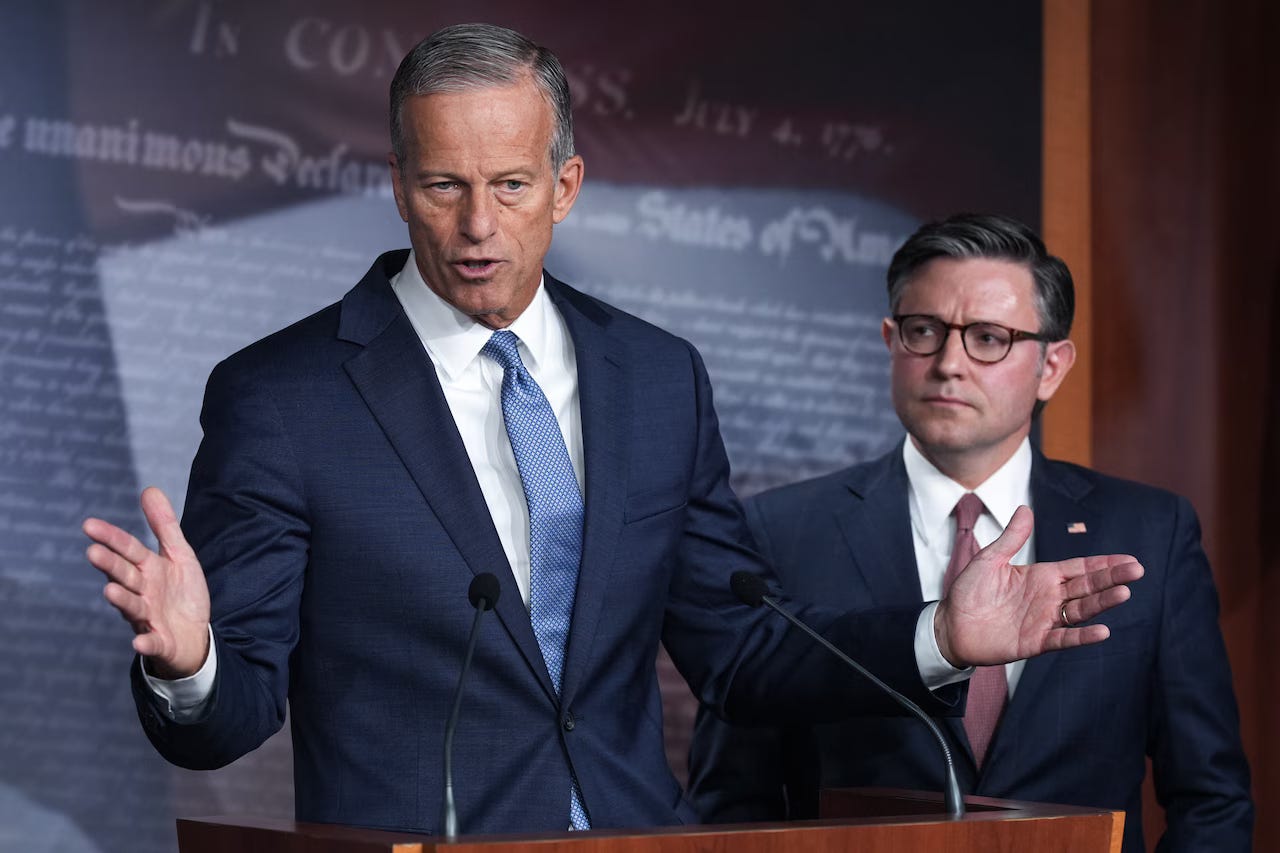
As I scooped on Wednesday, Senate legislative directors and chiefs of staff were informed that Senate Majority Leader John Thune (R-S.D.) is expected to set aside the House CR by voice vote during a pro forma session this morning and send the bill it passed back to the House. The senior aides were also told that the House is expected to pass the Senate bill during a separate pro forma session 90 minutes later, after which Trump is expected to sign.
A senior Republican leadership aide declined to confirm the specifics of Thune’s involvement or the House’s next steps, but told me the plan remains to move the Senate-passed DHS bill back to the House as early as this morning.
Any member can object to any motions put forward during these sessions.
The strategy was communicated less than an hour after Thune and House Speaker Mike Johnson (R-La.) released a joint statement announcing that congressional Republicans would pursue two parallel tracks to reopen DHS.
The first is to green-light the Senate deal that had the House votes to pass last week before Johnson succumbed to pressure from the right flank of his conference, who immediately and vocally rebuked the bill Thune sent over because it excluded federal immigration enforcement funding.
Step two is to refill ICE and CBP’s coffers for the next three years through the filibuster-proof reconciliation process that Senate Budget Committee Chair Lindsey Graham (R-S.C.) initiated before Congress left for the Passover and Easter recess.
“We cannot allow Democrats to any longer put the safety of the American public at risk through their open border policies, so we are taking that off the table,” Thune and Johnson said in their statement.
President Trump has asked the two leaders to send that reconciliation bill to his desk by June 1, an ambitious timeline given the House and Senate are only in session for five weeks before the deadline. It took Hill Republicans five months to pass the One Big Beautiful Bill Act through the same process last summer, though the Senate GOP hopes to scale back their House counterparts’ ambitions for a second megabill to accommodate Trump’s schedule.
The episode reflects an embarrassing cave on Johnson’s part.
The Louisiana Republican went on Fox and Friends earlier this week and accused the Senate of “playing games with real people’s lives” by refusing to take up a CR that lacks the support from enough senators to pass. Now Johnson will likely have to tamp down a revolt from hardline conservative and while spending the months ahead of the midterms slashing more social programs to fund an unpopular immigration agenda.
“I think he continues to jack up House Republicans and put them in binds,” A House Democrat said of Trump. “It’s what you do when you have no respect.”
Politics aside, this has been a painful ordeal for the hundreds of thousands of DHS employees who have worked without pay.
Although ICE and CBP won’t receive new funding under the Senate deal, an administration official told me all support staff at those agencies would be paid using funds from the OBBBA.
“No one impacted by Democrat intransigence will go without a paycheck as the administration works with the Congress to pass another reconciliation measure,” the official said.
WAR IN IRAN
Trump claims upper hand in Iran war, signals escalation ahead
President Trump used a primetime address from the White House Cross Hall on Wednesday night to argue the U.S. is gaining the upper hand in its war with Iran while signaling a potential escalation if Tehran does not move toward a deal.
Speaking 33 days into the conflict, Trump said U.S. forces have severely degraded Iran’s military capabilities and that Operation Epic Fury is close to achieving its central objectives, including neutralizing missile production, weakening Iran’s military infrastructure and preventing it from obtaining a nuclear weapon.
The roughly 20-minute speech came after weeks of criticism from Democrats who argue Trump waited too long to make a public case for military action taken without congressional approval. Chuck Schumer said ahead of the address that Trump’s decision to speak now was driven more by political pressure than national security concerns.
Trump sought to reassure Americans about the economic fallout, arguing that the U.S. is largely insulated from disruptions tied to the Strait of Hormuz and well-positioned to absorb any shocks. He also shifted responsibility to other nations that rely more heavily on Middle Eastern oil, urging them to take a more active role in securing the waterway.
At the same time, Trump made clear the conflict could intensify. He said the U.S. is prepared to expand its target set in the coming weeks if Iran does not agree to terms, while noting the administration has so far avoided strikes on certain high-impact economic assets.
The president attempted to project strength and optimism amid fierce political and economic headwinds, calling on Americans to put the current operation in perspective relative to past conflicts and arguing that the U.S. is approaching a point where Iran no longer poses a meaningful threat.
But Trump didn’t address whether the operation would require U.S. ground troops, a key question as the conflict enters its second month. He also made no mention of potential ceasefire talks, despite suggesting earlier in the day that Iran’s leadership had signaled interest in a deal.
THE COURTS
Birthright case draws skepticism from SCOTUS
The Supreme Court signaled broad unease on Wednesday with the Trump administration’s effort to narrow birthright citizenship during oral arguments in Trump v. Barbara, with justices across the ideological spectrum pressing government lawyers on precedent, history and real-world consequences.
Several conservatives, including Chief Justice John Roberts and Justices Amy Coney Barrett and Neil Gorsuch, joined the liberal bloc in questioning how the administration’s reading of the 14th Amendment could be squared with United States v. Wong Kim Ark, the 1898 decision that has long guaranteed citizenship to nearly anyone born on U.S. soil.
As I reported in Tuesday’s Sunrise, at issue is whether children born in the United States to parents without legal status are “subject to the jurisdiction” of the U.S.—a phrase the administration argues should exclude certain categories of immigrants. But multiple justices raised concerns about where courts would draw the line and asked whether the logic would extend to people on temporary visas, asylum seekers or other noncitizens. They also warned of potential confusion for federal agencies tasked with enforcing any new standard.
The arguments unfolded with President Trump in attendance—a first for a sitting president. But inside the courtroom, that didn’t seem to move the needle. If anything, the questioning suggested the justices were trying to separate law from politics. He arrived 20 minutes before proceedings began and left as Solicitor General John Sauer wrapped up his oral arguments.
A decision is expected by June. Based on Wednesday’s questioning, the administration faces an uphill path to securing a majority willing to revisit more than a century of settled law.
HOUSING
Democrats roll out anti-eviction bill
Reps. Ayanna Pressley (D-Mass.) and Jimmy Gomez (D-Calif.), alongside House Appropriations Committee Ranking Member Rosa DeLauro (D-Conn.), introduced the Housing Emergencies Lifeline Program (HELP) Act, a sweeping proposal aimed at preventing evictions and limiting the long-term financial fallout for renters.
The legislation would bar credit reporting of evictions, rent and utility debt, require landlords to disclose eviction reasons in writing and establish a national HUD hotline to connect tenants with legal and financial support. It also authorizes federal funding for legal counsel in eviction cases and directs the creation of a national eviction database to track trends and enforcement.
The bill arrives as housing affordability and eviction risk remain central economic pressures, particularly for low-income renters and seniors on fixed incomes. Pressley described the proposal as a response to the crisis, while DeLauro and Gomez emphasized the cascading consequences of eviction, including job loss, health impacts and barriers to securing future housing.
Advocates backing the bill argue eviction filings—even when dismissed—can follow tenants for years, effectively locking families out of stable housing. Supporters say the HELP Act would interrupt that cycle by limiting how eviction records are used and expanding access to legal defense before cases reach court.
The measure builds on prior House action earlier this year to strengthen eviction protections, but faces uncertain prospects in a Congress where broader housing policy remains a bicameral flashpoint.
IN THE KNOW
— The Big Four congressional leaders announced King Charles III will address a joint meeting of Congress on April 28. Speaker Johnson, Senate Majority Leader John Thune (R-S.D.), Senate Minority Leader Chuck Schumer (D-N.Y.) and House Minority Leader Hakeem Jeffries (D-N.Y.) said the address will celebrate the 250th anniversary of American independence and the enduring special relationship between the United States and the United Kingdom. Read the letter from the leaders to His Majesty.
— A new Navigator Research survey finds 57% of Americans oppose President Trump’s tariff plan, with softness emerging among non-MAGA Republicans and continued resistance from independents. At the same time, about two-thirds of voters back $2,000 “tariff rebate” checks, with voters more responsive to arguments that tariffs raised household costs than to legal critiques of the policy.
— Senate Banking Committee Ranking Member Elizabeth Warren (D-Mass.) demanded answers from Office of Management and Budget Director Russell Vought over reports that banks and debt collectors are pursuing foreclosures on allegedly extinguished second mortgages, accusing the Trump-era CFPB of failing to protect homeowners from so-called “zombie” loans.
— Reps. Judy Chu (D-Calif.) and Grace Meng (D-N.Y.), along with Congressional Hispanic Caucus Chair Adriano Espaillat (D-N.Y.) and Sen. Alex Padilla (D-Calif.), introduced a resolution designating April as “National Language Access Month,” framing it as a response to the Trump administration’s rollback of federal language access protections.
— Sens. Martin Heinrich (D-N.M.), Jim Banks (R-Ind.) and Tammy Duckworth (D-Ill.) introduced bipartisan legislation to raise the Post-9/11 GI Bill books stipend from $1,000 to $1,500 and index it to inflation. The bill would also increase stipends for veterans in apprenticeships and require annual reporting on education outcomes, aiming to modernize benefits that haven’t kept pace with costs since 2008.
HAPPENINGS
All times Eastern
The Senate meets in a pro forma session at 7 a.m.
The House meets in a pro forma session at 8:30 a.m.
Adriano Espaillat and Rep. Rob Menendez (D-N.J.) will hold a press conference at 10 a.m. at the Delaney Hall Detention Facility in Newark, N.J. during an oversight and wellness visit.
President Trump will receive his intelligence briefing at 11 a.m., sign executive orders at 2 p.m. and participate in a policy meeting at 5:30 p.m.
READ ALL ABOUT IT
“Woke isn’t back” by Miles Klee: “Progressives are dreaming about ‘Woke 2’—a new political order that rights the wrongs of the Trump administration. Does it have a shot?”
“The real religious ‘renewal’ happening in Gen Z” by Luis Parrales: “Some pastors and politicians claim that a Christian revival is afoot among young Americans. Nationwide data tell a different story.”
“The Mystery of Steve Jobs” by David Pogue: “Apple is turning 50. I am still trying to make sense of the man who created it.”