


FIRST THINGS FIRST
👋🏾 Hi, hey, hello! It’s Monday morning. Thank you for waking up with Congress Nerd Sunrise. Say hi or send me a tip: michael@onceuponahill.com.
Programming note: Once Upon a Hill will not publish Congress Nerd Sunset this week while Congress is on recess. Sunrise will continue each weekday morning as usual.
NO DHS SHUTDOWN END GAME • The Department of Homeland Security shutdown is now the longest in U.S. history, and with Congress out for a two-week recess, there’s still no clear off-ramp.
Flashback: The Senate last week passed a bipartisan deal to fund most of DHS while deferring Immigration and Customs Enforcement and Customs and Border Protection to a future reconciliation bill—sidestepping Democratic demands for immigration enforcement reforms. But the deal lost momentum before it even reached the House.
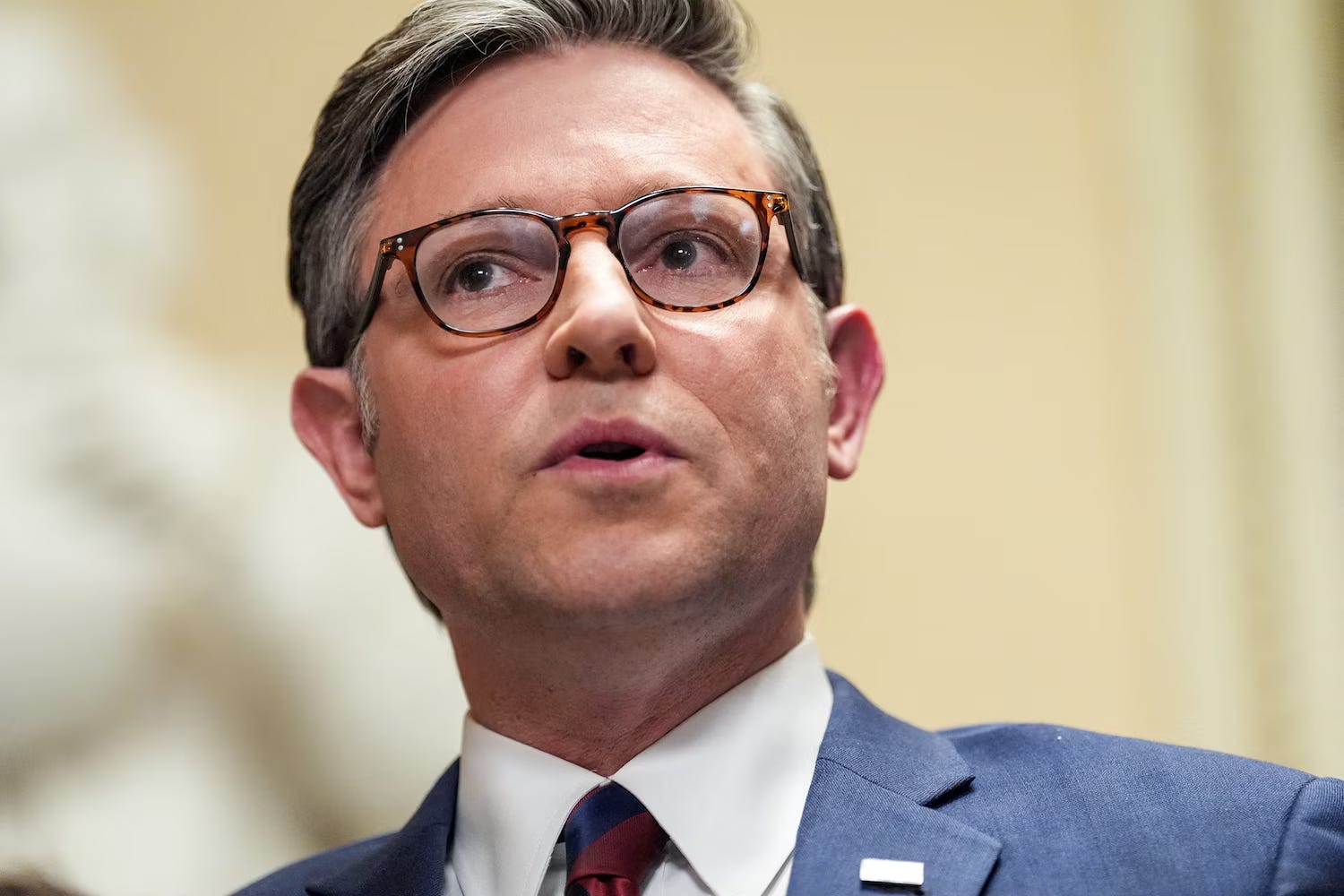
President Donald Trump undercut one of the Republicans’ main pressure points by directing new DHS Secretary Markwayne Mullin to ensure TSA workers were paid, easing concerns about airport disruptions. At the same time, Speaker Mike Johnson (R-La.) faced a narrow and politically fraught path forward.
The bind: Johnson had two options, both risky.
Bring up the Senate deal and rely on Democratic votes to pass it. House Democrats signaled openness, with Leader Hakeem Jeffries (D-N.Y.) indicating his caucus might even support the rule needed to advance the bill—a rare move given that rules are typically party-line votes.
But hardline conservatives, especially in the House Freedom Caucus, revolted. They argued the deal weakened immigration enforcement and excluded voter ID provisions tied to the SAVE America Act. With multiple conservatives on the House Rules Committee, it wasn’t even clear a rule could make it to the floor.
Johnson also bristled at how the deal arrived. Senate Majority Leader John Thune (R-S.D.) pushed it through quickly, leaving House leaders little time to shape it in what Johnson viewed as an attempt to jam the chamber.Reject the deal and extend the shutdown. That route avoided a conservative backlash but left Johnson politically exposed as the lone leader unwilling to accept a compromise all sides viewed as imperfect but workable.
The move: Johnson chose the second option. He pivoted to a 60-day continuing resolution to fully fund DHS, despite consistent Democratic opposition to similar proposals.
To get it through, House Republicans used a deem-and-pass rule, allowing the chamber to approve the funding measure by adopting the rule itself rather than holding a separate vote on the bill. The maneuver drew scrutiny, given GOP complaints about the Senate rushing its own deal.
The House approved the CR in a 213–203 vote, with three Democrats joining Republicans.
What to watch: The Senate remains at an impasse. Thune is exploring whether a new agreement with Senate Minority Leader Chuck Schumer (D-N.Y.) is possible, but Democrats say they will only accept the bipartisan deal the Senate already passed.
A pro forma session this afternoon could offer Republicans a chance to advance the House bill by unanimous consent, but Democrats are expected to block it—leaving the shutdown likely to stretch deeper into April.
ICYMI: House Oversight Republicans are increasingly leaning on informal roundtables instead of formal hearings—a shift that Democrats and procedural experts say limits the minority’s ability to force subpoenas, votes and other accountability measures. The move follows a string of bipartisan defections that exposed fractures within GOP ranks, raising new questions about how far leadership will go to control the committee’s work. Read more in the most recent edition of Congress Nerd Sunset.
WAR IN IRAN
TRUMP’S IRAN ESCALATION RISK • The war is about a month in and still expanding. It started with U.S.–Israeli strikes on Iran in late February, and it’s now a regional conflict pulling in proxies and threatening global energy supply.
The biggest question right now is whether this becomes a ground war. The Pentagon is actively preparing options, including possible special operations, and has surged thousands of additional troops into the region. Iran is warning that any U.S. ground presence would trigger direct retaliation against American forces.
Ground troops would mean direct, sustained combat, not just limited airstrikes, which would put U.S. forces in closer, more vulnerable contact with the enemy. If Trump went this route, it would signal a shift from a contained operation to a potentially open-ended war with higher risks, costs and casualties.
Regional spillover: The conflict is no longer contained to Iran. Iran-aligned groups—including the Houthis—are launching attacks that are widening the war across the Middle East and hitting key shipping routes.
The energy angle: Oil prices have surged to levels not seen in decades, driven by disruptions around the Strait of Hormuz, which carries a huge share of global oil. Gas prices continue to rise and governments are tapping reserves to stabilize markets.
Diplomacy (or lack of it): There are early attempts to broker talks—Pakistan is trying to mediate—but there’s no real sign of a breakthrough. Iran is signaling it won’t negotiate under pressure, while the U.S. is keeping military options on the table.
THE COURTS
SCOTUS WEIGHS BIG TECH FOREIGN SPYING • The Supreme Court will hear oral arguments this morning on a federal appeals case that upheld the conviction of former Twitter employee Ahmad Abouammo for secretly helping Saudi Arabia access private data of government critics using his position at the company.
The case—Abouammo v. United States—sits at the intersection of national security, tech platforms and free speech, especially the vulnerability of users who rely on U.S. companies for protection from foreign surveillance.
The justices will also examine birthright citizenship on Wednesday in a case that will determine whether kids born to undocumented or temporarily present immigrants on American soil are U.S. citizens. I’ll have more on this case in Wednesday’s edition of Sunrise.
HEALTH CARE
TRUMP REOPENS HEALTH CARE FRONT • President Trump on Sunday revived his long-running push to repeal and replace the Affordable Care Act.
In a Truth Social post, Trump blasted Obamacare as unsustainable and floated a familiar alternative: direct payments to individuals to purchase coverage, rather than routing funds through insurers.
The timing is notable as Republicans prepare a second major reconciliation bill after recess that’s expected to fund immigration enforcement, a potential war supplemental tied to Iran and elements of the SAVE America Act. Those priorities will likely require offsets, and once again, health care programs are on the table. That puts Medicaid and ACA spending back in play.
Democrats argue that the GOP struggles to square tax cuts and new spending priorities without cutting into the social safety net. Trump re-centering health care sharpens that contrast and gives Democrats a familiar, potent line of attack heading into the midterms. Instead of abstract debates over reconciliation rules or topline numbers, Democrats can point to a concrete risk: coverage losses and higher costs if ACA supports are rolled back to finance other priorities.
DEMOCRACY
THE REAL TEST COMES NEXT • The scale of the No Kings 3 protests this weekend suggests there’s no shortage of opposition to President Trump. Millions showed up. The crowds were national, not just coastal. The energy is real. But the question now is whether that energy can be converted into electoral power.
Grassroots mobilization has limits if it isn’t paired with institutional trust and political clarity. Marching against Trump is one thing. Believing Democrats can meaningfully check his agenda is another. That’s the gap the party has to close.
Democratic leaders will need to persuade those same voters that they’re not just an outlet for frustration, but a credible governing alternative that can constrain executive overreach, lower costs and offer a clearer posture on a conflict that’s beginning to stretch U.S. involvement abroad.
There are early signs that the party understands the assignment. Messaging around affordability has sharpened. Lawmakers are increasingly framing oversight of the administration as a core midterm argument. And the protests themselves give Democrats a visible base to point to.
HAPPENINGS
The Senate will hold a non-voting session at 10:30 a.m.
The House will hold a non-voting session at 12:30 p.m.
President Trump will participate in a White House internship program class photo at 10:15 a.m., a policy meeting at 1:30 p.m. and in signing time at 4 p.m.
READ ALL ABOUT IT
“What was behind the TSA meltdown?” by Benjamin Wallace-Wells: “The present mess has roots in two entangled, defining White House projects: DOGE and the mind-bending expansion of ICE.”
“Trump’s first surgeon general tries to stop nominee from becoming his second” by Dan Diamond: “Jerome Adams, who served at the height of the coronavirus pandemic, says Casey Means is unqualified to hold the job. Means’s nomination is stalled in the Senate.”
“Everyone hates iPhone autocorrect. An update fixes one of the biggest problems.” by Nicole Nguyen: “Here’s what iOS 26.4 does to improve your typing, plus tips to help you reclaim your keyboard.”