

First Things First
👋🏾 Hi, hey, hello! Good Tuesday morning. Welcome to Day 21 of the government shutdown, now tied for the second longest in U.S. history. House Speaker Mike Johnson (R-La.) made a point to mention during his daily shutdown press conference on Monday morning that the current funding lapse is the longest full shutdown ever. The 1995–1996 (21 days) and 2018–2019 (35 days) lapses only affected some agencies since Congress passed bills to fund others.
The Senate failed for the 11th time to advance a House-passed short-term funding extension on Monday evening. Senate Majority Leader John Thune (R-S.D.) has yet to set up a vote later this week on legislation sponsored by Sen. Ron Johnson (R-Wisc.) to the floor this week to provide back pay to furloughed federal employees and military servicemembers. Speaker Johnson told reporters he would call the House back to pass the bill, but House Minority Leader Hakeem Jeffries (D-N.Y.) said he opposed the bill because it would enable President Donald Trump to pick and choose whom he wanted to pay. (Senate Democrats are expected to block the bill, but the House is on a 48-hour notice to return to Washington, just in case.)
Thune scheduled votes on several judicial nominees today and set up another vote for the House-passed bill for as soon as tomorrow.
“We’ll see,” Thune told reporters when asked if he plans to keep voting on the House-passed bill. He told reporters that it was time for the House to consider returning to pass a new bill to extend the mid-November deadline in the measure that’s stalled in the Senate.
“Every week that drives by, it’s gonna become harder and harder to actually have a normal appropriations process, which pushes us into a long-term [continuing resolution] mode,” Thune said. “And I just don’t think that’s the way that we ought to be funding the government around here.”
The top Senate Republican said he would reconsider bringing up the full-year Defense funding bill that Senate Democrats tanked last week if they’re willing to advance it this week.
“But if they’re going to vote it down again, I’m not sure there’s a lot of value in reconsidering it.”
President Trump will host a lunch this afternoon for Senate Republicans in the Rose Garden to express appreciation for remaining unified during the shutdown fight and changing the Senate rules to clear the backlog of his nominees that Democrats had been blocking.
Hill Republicans spent the weeks leading up to this past Saturday’s No Kings Rally accusing Senate Minority Leader Chuck Schumer (D-N.Y.) and House Minority Leader Hakeem Jeffries (D-N.Y.) of shutting down the government to express solidarity with the anti-Trump wing of the Democratic Party and generate goodwill from voters skeptical of their leadership.
It’s a more convenient excuse than Democrats demanding Republicans extend the Affordable Care Act’s enhanced premium tax credits in exchange for votes to reopen the government before open enrollment starts in less than two weeks and the subsidies expire at the end of the year.
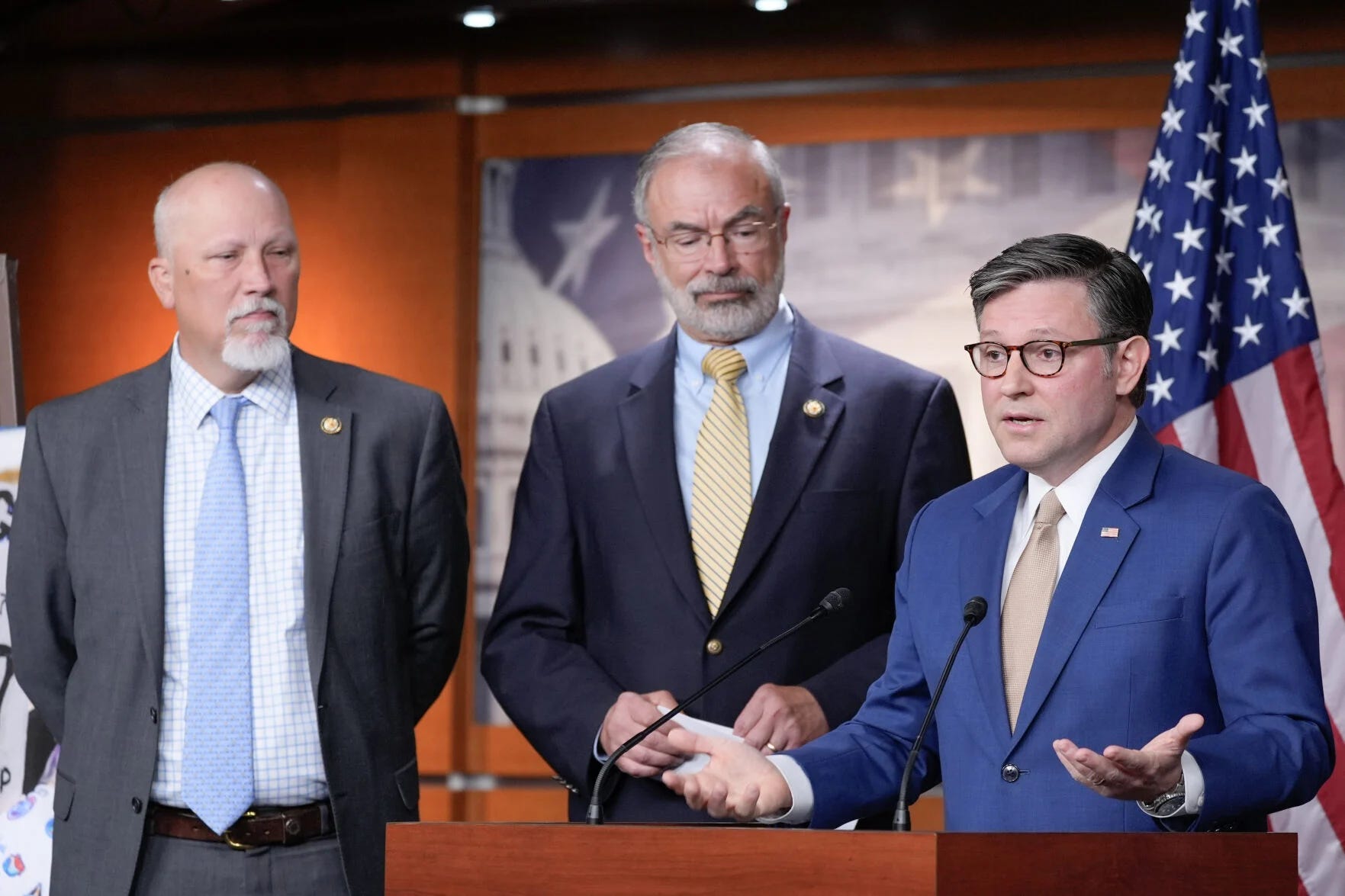
But it’s also ironic since Johnson appeared for the event alongside Freedom Caucus Chair Andy Harris (R-Md.) and Policy Chair Chip Roy (R-Texas)—two of the most hardline members of the House Republican Conference, whose positions have driven the shutdown strategy and hardened Republican opposition to Democratic demands.
The speaker’s embrace of Freedom Caucus leadership marks a sharp break from his predecessors. It underscores just how much the group’s rhetoric and ideology have migrated from the fringes to the center of Republican power—even as Johnson insists Democrats are being held hostage by their ideological extremes.
But Democratic leaders, in general, have avoided embracing their party’s most progressive priorities—from Medicare for All to Green New Deal–style proposals—opting instead for incremental governing and a focus on protecting existing benefits like the ACA subsidies.
“The Republican argument coming from the House has changed every week. It literally has changed every week. Now it’s because of the No Kings Day peaceful, patriotic and powerful protest that occurred this weekend,” Jeffries told me. “In a few days, it’ll be about something else. Democrats, from the very beginning, have been crystal clear and consistent: Cancel the cuts, lower the cost, save health care.”
A spokesperson for Schumer referred me to remarks he delivered from the Senate floor on Thursday morning and a pair of tweets from the weekend defending the No Kings rallies as peaceful expressions of free speech. The spokesperson said Schumer stood behind those comments.
A spokesperson for Johnson did not respond to a request for additional comment.
The House Freedom Caucus was born out of rebellion. Formed in early 2015 by a band of hardline conservatives frustrated by what they saw as the establishment timidity of then–Speaker John Boehner (R-Ohio), the group’s founding members—including Jim Jordan (R-Ohio), Mark Meadows (R-N.C.), Raúl Labrador (R-Idaho), and Mick Mulvaney (R-S.C.)—sought to pull the Republican conference sharply to the right on fiscal, social and procedural grounds. Their animating mission was to discipline GOP leaders they viewed as too willing to compromise with Democrats and too reluctant to use the leverage of the majority to force confrontation.
From its inception, the Freedom Caucus specialized in brinkmanship. The group’s pressure campaigns helped drive Boehner from the speakership later that same year, after he pushed through a short-term government funding measure over their objections. His successor, Paul Ryan (R-Wis.), fared little better. Freedom Caucus members frequently blocked or watered down major legislation, from budget agreements to immigration reforms, forcing Ryan to choose between governing and keeping his right flank happy.
The group’s influence peaked during the Trump years, when Meadows became White House chief of staff and Freedom Caucus members gained unprecedented access to executive power. But even then, their appetite for confrontation often clashed with the practical demands of governance. The 35-day partial government shutdown in 2018–19—sparked by Trump’s insistence on border wall funding—bore the fingerprints of Freedom Caucus pressure. The same dynamic recurred in countless debt ceiling and appropriations fights, where the group’s maximalist demands repeatedly boxed in Republican leadership and eroded trust with rank-and-file members.
After years of operating as an insurgency, the Freedom Caucus finally got a speaker willing to align with its instincts in Johnson—a longtime ally and ideological kindred spirit who shares the group’s skepticism of government spending, hostility to the Affordable Care Act and social conservatism rooted in evangelical politics. Johnson’s speakership marks the culmination of the Freedom Caucus’s long project of moving from the perimeter of Republican power to its center. Yet the result has been the same tension that has defined the GOP for a decade: A party that governs from the majority but behaves like an opposition movement.
In each shutdown since the group’s creation, the Freedom Caucus has framed confrontation as a virtue of their commitment to principle over compromise. Now, with Johnson echoing their language and standing alongside their leaders, the once-outsider faction has become the Republican establishment—and the consequences are being felt across the Capitol.
Democrats have hardly been restrained in their own language toward the right.
After years of trying to “go high” while Republicans went lower, many in the party say they’ve recalibrated to match the tenor of Trump-era politics. Jeffries offered the latest example last Friday, describing White House Press Secretary Karoline Leavitt as “sick” in response to comments following an interview on Fox News with New York City Democratic nominee for mayor Zohran Mamdani, when she claimed the Democratic Party “is made up of Hamas terrorists, illegal aliens, and violent criminals.”
“She’s out of control, and I’m not sure whether she’s just demented, ignorant, a stone-cold liar, or all of the above,” Jeffries added. “But the notion that an official White House spokesperson would say that the Democratic Party consists of terrorists, violent criminals and undocumented immigrants? This makes no sense that this is what the American people are getting from the Trump administration in the middle of a shutdown.”
Democrats argue the sharper tone reflects hard lessons learned since 2016 that moral restraint has done little to blunt the right’s attacks or protect democratic norms. Still, the current political environment underscores how both parties are now fluent in the language of outrage, even as each insists the other is dragging political discourse into the gutter.
Freedom Caucus conservatives make no secret of wanting the ACA subsidies to expire, calling them an unsustainable extension of the welfare state. But Democrats say Republicans’ choice to frame the issue as a fight against the “far left”—rather than a debate over health care coverage—is telling. It reflects an understanding that the politics of taking away health care remain perilous, even for a party comfortable picking almost any other fight.
“Costs are going up. Electricity prices are through the roof. Housing costs? Too expensive. Child care costs? Too expensive. Groceries? Too expensive,” Jeffries told me. “And now, because of Republican refusal to extend the Affordable Care Act tax credits, tens of millions of Americans are about to experience these dramatically increased health care premiums. This is about the health care of the American people, and this is about driving down the high cost of living, no matter what lies or disinformation Republicans continue to try to put out there in the public domain.”

In the Know
— Schumer, Senate Appropriations Committee Vice Chair Patty Murray (D-Wash.), Senate HELP Committee Ranking Member Bernie Sanders (I-Vt.), and Senate Appropriations Subcommittee on Labor, Health and Human Services and Education Ranking Member Tammy Baldwin sent a letter to Education Secretary Linda McMahon slamming the Education Department’s mass firings and underscoring their nationwide impact on students. The lawmakers noted that the latest mass firings mean several essential offices will be almost entirely hollowed out, including the Office of Special Education Programs, the Office of Higher Education Programs and the Rehabilitation Services Administration. Read the full letter.
— House Homeland Security Committee Ranking Member Bennie Thompson (D-Miss.) and House Oversight Committee Ranking Member Robert Garcia (D-Calif.) sent a letter to President Trump demanding he withdraw the nomination of Paul Ingrassia to lead the Office of Special Counsel following reports of sexual harassment against a female colleague, the exchange of racist text messages and associations with extremist figures while serving as the White House liaison to the Department of Homeland Security. Senate Majority Leader Thune says Ingrassia lacks the Republican support to be confirmed, but the White House has not publicly announced if it will pull his nomination. Read the full letter.
— Sen. Tammy Duckworth (D-Ill.) called for a federal investigation into the use of force by federal agents involved in President Trump’s federal takeover of Chicago. Duckworth asked the Justice Department and Homeland Security Department’s Offices of Inspector General to establish a joint task force for investigation after agents reportedly deployed tear gas, pepper balls and flash-bang grenades against peaceful protestors, made excessively violent arrests, wrongfully detained U.S. citizens and used deadly force during a traffic stop. Read the full letter.
— House Foreign Affairs Committee Ranking Member Greg Meeks (D-N.Y.) sent a second letter to Secretary of State Marco Rubio for an explanation of his claim before Congress that no deaths have resulted from the Trump administration’s dismantling of USAID and deep cuts to U.S. foreign assistance. This letter follows one Meeks sent to Rubio in June, after the State Department had dismissed initial reports of deaths related to the Trump Administration’s foreign aid cuts. Read the full letter.
— The Democratic Congressional Campaign Committee announced it raised $26.2 million for the third quarter, which surpassed the total raised over the same period in 2023. The National Republican Campaign Committee outraised the DCCC in September ($14 million to $11.5 million), but Democrats outraised Republicans ($24 million) for the quarter.
— Democracy Forward sued the Federal Housing Finance Agency to force it to comply with a records request and disclose information related to the politicization of the justice system. The suit comes as FHFA Director Bill Pulte has made high-profile criminal referrals to the Justice Department against several prominent public officials, including Sen. Adam Schiff (D-Calif.), Federal Reserve Governor Lisa Cook and New York Attorney General Letitia James. Read the complaint.
— The 314 Action Fund announced that Democratic doctors and scientists raised over $10 million last quarter to support 49 STEM candidates running in federal or statewide races in 2026 across 26 states. The group is the nation’s only organization working to recruit, train and elect doctors and scientists to public service.
— The Congressional Budget Office now projects that changes in the 2025 Reconciliation Act expanding exemptions for certain orphan drugs from Medicare price negotiations will cost $8.8 billion over 10 years—nearly double its earlier estimate. The revised figure reflects added costs from drugs like Darzalex, Keytruda, and Opdivo, with total spending potentially reaching as high as $10.9 billion depending on how Medicare applies the rules. Read the full report.
— Vice President JD Vance departed for Israel on Monday afternoon to shore up a Gaza peace deal that hangs in the balance. The traveling press had not received a schedule or any details about his plans in Israel by the time of publication.

Read All About It
“Inside the Chicago resistance” by Sarah Conaway: “Civilians are tailing officers, guarding Home Depots, and patrolling their neighborhoods. A week fighting ICE.”
“How China weaponized soybeans to squeeze U.S. farmers—and spite Trump” by Christian Shepherd and Lyric Li: “China, the world’s biggest importer of soybeans, has stopped buying U.S. crops to put pressure on Trump ahead of his trade-focused meeting with Xi Jinping.”
“Ozempic for all” by Emily Oster: “Ensuring GLP-1s are covered by Medicaid in all states would save lives—and not be as costly as some people fear.”
“The wife trap” by Sarah Jones: “Liberalism is weakened and the right is ascendant. Two recent books ask where that leaves women.”
“The cities where home prices have changed the most (and least) over the past 130 years” by Andrew Van Dam: “Did your grandparents and great-grandparents really pay less for their homes than you did, even after inflation? The Department of Data might have the answer.”
“Wikipedia seems pretty worried about AI” by John Hermann: “The free encyclopedia took a look at the numbers and they aren’t adding up.”
“Smucker vs. Trader Joe’s, Lululemon vs. Costco: Fight over brands goes to court” by Christopher Kuo and Jesse Newman: “Frozen PB&J products square off, latest in battle between big-name brands and retailers’ private-label products.”
“The ‘six seven’ panic by Ryu Spaeth: “Adolescent slang has always been impenetrable to adults. That’s the point.”