

👋🏾 Hi, hey, hello! Welcome to Day 20 of the shutdown, one away from tying the second-longest in U.S. history. The Senate will vote for the 11th time this evening on the House-passed temporary spending bill to reopen the government through mid-November. Nothing emerged over the weekend to indicate the vote will produce a different result than the previous 10 attempts.
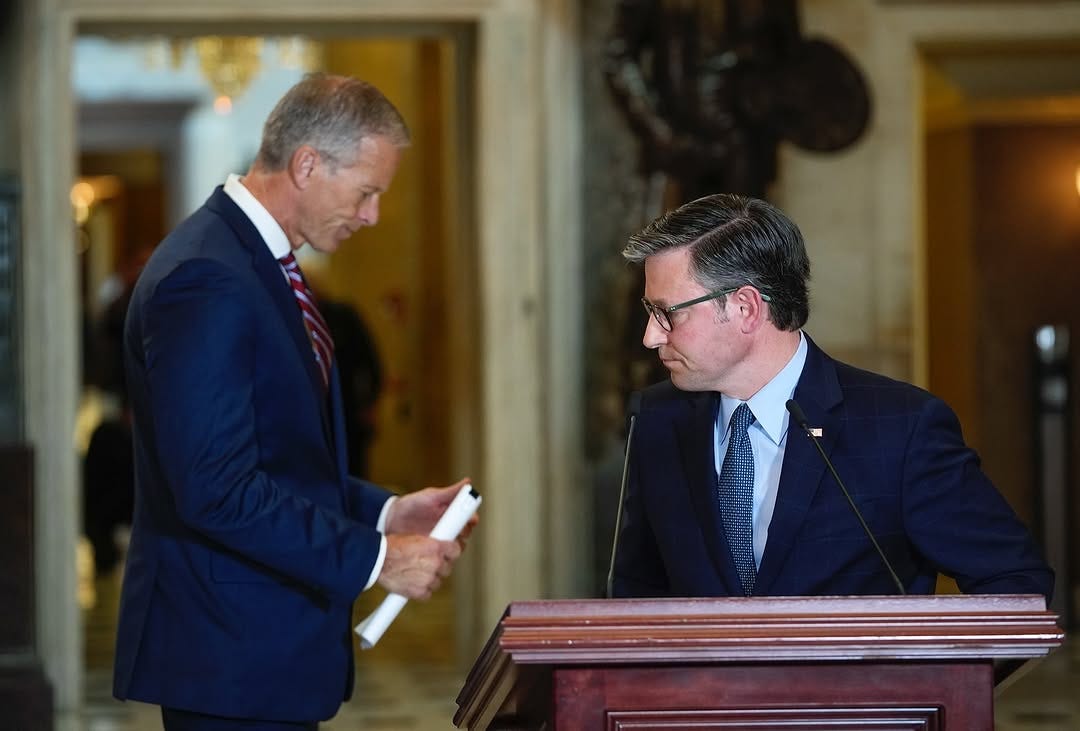
As the funding lapse grinds into its fourth week, the Republican leadership’s composure is beginning to fray. Senate Majority Leader John Thune (R-S.D.) and House Speaker Mike Johnson (R-La.)—typically disciplined and measured—have grown openly frustrated with Democrats, using the floor and the cameras to vent their exasperation and shift blame. Their remarks reflect a party under pressure to show its governing in good faith, even as the stalemate drags on and patience on both sides wears thin. Much more on this dynamic below.
But let’s start with the current state of play.
The House is out after Speaker Mike Johnson (R-La.) canceled votes for the fourth consecutive week. It’s been more than one month since the House last voted—ironically enough, on the bill that keeps failing in the Senate—and Johnson said as recently as Sunday morning that it’s likely to remain that way.
“I refuse to allow us to come back and engage in anything until the government’s reopened, when the Democrats do the right thing for the people,” he told Jonathan Karl on ABC’s This Week. “They’re playing politics and we have to use every ounce of leverage we have to make sure they do the right thing.”
Viet Shelton, a spokesperson for the House Democrats’ campaign arm, predicted Johnson’s decision would cost Republicans at the ballot box in 2026.
“Rather than deal with the problem they created, they have now officially been on paid vacation for a month,” Shelton said in a statement. “In any other job, you’d get fired and that’s exactly what voters will do next November.”
House Democrats were not asked to return to Washington this week but were encouraged by leadership during a virtual caucus call on Friday to hold health-care-focused events in their districts. A member on the call told me leaders emphasized message discipline and party unity as the focal points of the Democratic strategy to extract an extension of the Affordable Care Act’s enhanced premium tax credits, among other demands, in exchange for the votes to reopen the government.
“We have been effective so far,” the member said. “And the ask is to keep it up.”
House Democrats have picked three major fights with Republicans this year.
The first was in March, ahead of the first funding deadline of Trump’s second term, when all but one House Democrat voted against a Republican spending bill that was crafted without Democratic consultation. Senate Majority Leader Chuck Schumer (D-N.Y.) and a handful of leadership-aligned Senate Democrats voted to advance the bill to final passage in a move that infuriated the party base and led to calls for Schumer’s resignation.
The second was this summer in the run-up to Republicans passing President Donald Trump’s signature tax, defense, immigration and energy law. Though the bill added over $3 trillion in deficit spending, GOP lawmakers offset some of the cost with steep cuts to Medicaid, SNAP and other aspects of the social safety net. All congressional Democrats opposed the bill.
And last month, Jeffries once again led an almost unanimous opposition to a virtual carbon copy of the March bill, as Schumer has kept all but three Senate Democrats from breaking ranks on the current House-passed bill under consideration. (With full attendance, Thune needs eight Democrats to advance the measure.)
I asked House Minority Leader Hakeem Jeffries (D-N.Y.) in his office last week why he thought his Senate Democrats have stuck together with his members in these previous two instances.
“The common denominator, to me, is standing up in defense of the quality of life for everyday Americans related to the high cost of living that they confront in the health care crisis that has been visited upon the American people by Republicans.”
It’s this unity that Democrats say has Republicans so enraged.

In Friday’s edition, I wrote about Thune’s impassioned floor speech after Democrats blocked the Senate from advancing a stand-alone spending bill to fund the Pentagon through the end of next September.
“The fact of the matter is they didn’t have to block us from even moving to the bill, because there are multiple opportunities—60-vote threshold opportunities—for them to block it later on if they don’t like what happens,” Thune said. “This is politics.”
Hours earlier, Johnson went viral during his daily shutdown press conference for his frustration toward Schumer, whom he blames for the shutdown and his unwillingness to bring the House back into session.
“I don’t like being Mad Mike. I want to be Happy Mike,” he said. “I want to be the happy warrior, but I am so upset about this. God bless America.”
Sen. Brian Schatz (D-Hawaii) said earlier this month that Republicans miscalculated that the September funding fight would simply follow the March rubric.
“They were perfectly reasonable to test our resolve,” Schatz, who’s in line to become the number-two House Democrat after next year’s midterms, added. “They really were given what happened in the spring. But now that they’ve done so, just asking over and over again, it’s not going to get them a different result.”
Another factor in the GOP anger: Republicans didn’t need Democratic votes to pass Trump’s megabill, claw back at the request of the Trump administration funding that Congress previously approved or change the rules to confirm blocs of Trump nominees whom Democrats didn’t approve of.
Then there’s the issue Democrats decided to make this shutdown showdown about: health care. It’s one of the few that the American people are on their side.
“They thought we picked this issue out of the hat,” Schatz, who also serves on the Senate Appropriations Committee, said. “They had no idea how steep these premium increases were about to be.”

Trump has maintained he won’t yield to the Democrats’ demands, which he claims would fund health care for undocumented immigrants.
“The Republican Party is not going to pay a trillion and a half dollars to illegal immigrants coming into our country, coming in for a lot of reasons, coming in from prison, from jails, from all over the place, from Venezuela, many countries,” he said after arriving in Palm Beach for a big-dollar fundraiser at Mar-a-Lago on Friday evening. “We’re not going to do that, so the shutdown continues.”
FWIW, the provision he’s referring to in the Democratic counterproposal wouldn’t expand coverage or create new benefits. It would simply repeal a section of the GOP’s megabill that lowered the payments hospitals receive for treating undocumented patients in emergency rooms—care they’re required by law to provide under the Emergency Medical Treatment and Labor Act (EMTALA). Trump’s argument also rests on a long-debunked claim that states use federal funds to pay for health care for undocumented immigrants, even though federal law explicitly prohibits it. But I digress.
Ultimately, the shutdown won’t end because tempers cooled or talking points changed. It will end the way it always does in Trump-era Washington: when the former president decides the political cost of chaos outweighs its benefits, and gives his lieutenants—Johnson, Thune, and a handful of senior administration officials—permission to cut the deal. The script is familiar by now: the principals emerge declaring victory, the government sputters back to life, and everyone pretends it was all part of the plan.
And when Trump finally is ready, Democrats say they’ll be waiting.
“This isn’t impossible,” Schatz added. “But it’s impossible for them. They just cannot fathom having to deal with us like we matter.”