

FIRST THINGS FIRST
👋🏾 Hi, hey, hello! Welcome back to Congress Nerd Sunday. I hope your weekend was everything for you. The midterm election is in 30 days.
A new NBC News/Telemundo poll suggests Republicans’ 2024 gains with Latino voters may have been far less durable than the party hoped. Democrats lead Republicans 59–35 among registered Latino voters on which party should control Congress, twice their advantage at the same point in 2024. President Donald Trump’s approval stands at just 27%, while 69% disapprove. Even among Latinos who voted for Trump two years ago, 14% now prefer Democratic control of Congress and another 8% are undecided.
Affordability is driving much of the movement. Nearly two-thirds of Latino voters say their family income is falling behind the cost of living, while 78% disapprove of Trump’s handling of prices and 74% disapprove of his handling of the economy. Democrats now hold a 21-point advantage over Republicans on which party voters trust more on the economy after Trump held a four-point edge over former Vice President Kamala Harris in 2024.
But there’s an important warning sign for Democrats: Their own image hasn’t improved. Forty-two percent view the party negatively, four points worse than in 2024, suggesting the current Democratic advantage reflects erosion in support for Trump and Republicans more than a renewed attachment to the party.
LOOKING AHEAD
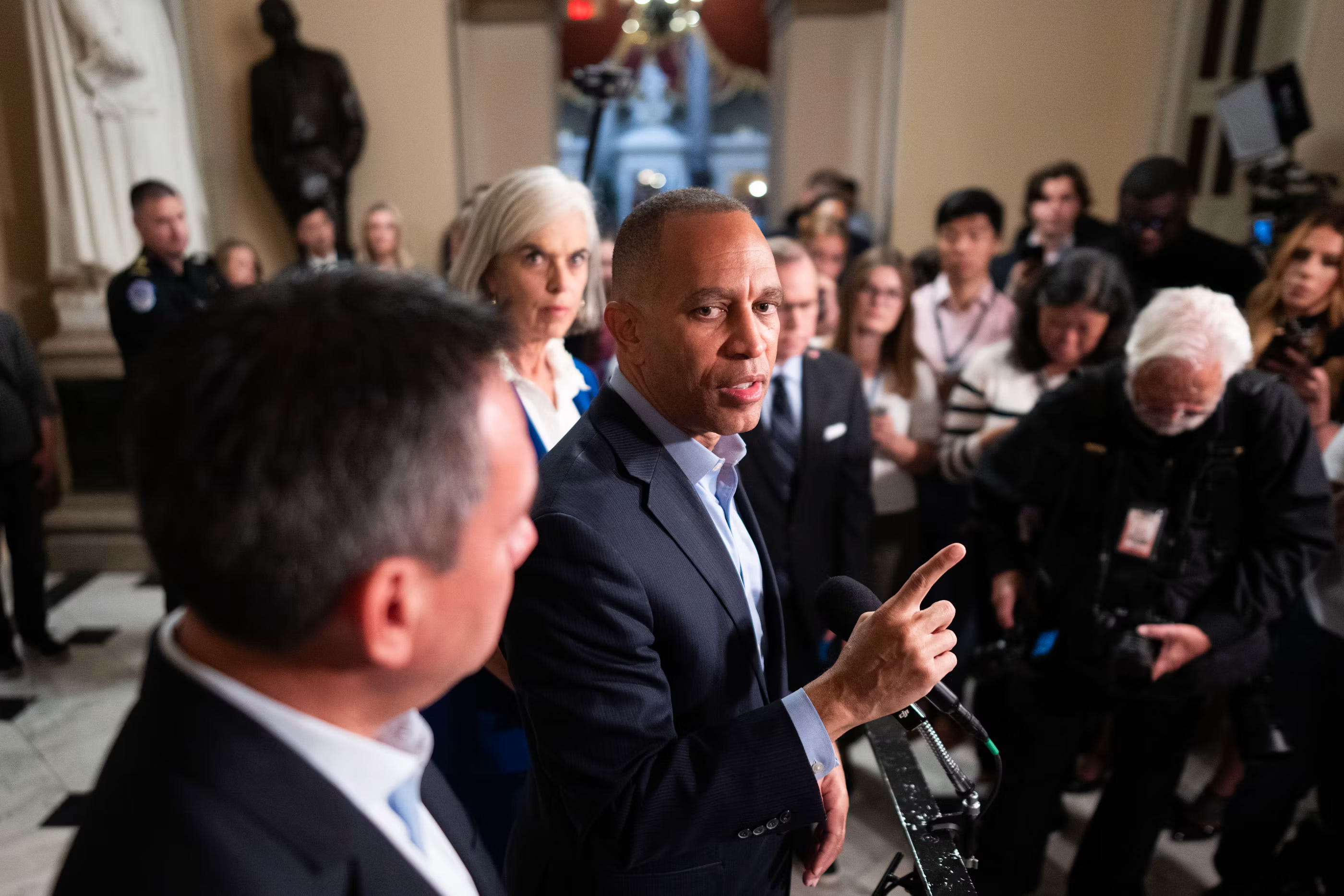
House Minority Leader Hakeem Jeffries (D-N.Y.) predicted Republicans will grow “more and more desperate” over the final month of the midterms as President Trump pairs direct government payments with a promise of $5,000 checks if the GOP keeps Congress.
“Given the graveyard of broken promises that Donald Trump and House Republicans have visited upon the American people over the last 20 or so months, these last-minute desperation pledges are falling on deaf ears,” Jeffries told me this afternoon on a press call Sunday marking 30 days until Election Day. “There’s no indication that it’s moving the needle at all.”
The Democratic leader pointed to Trump’s promises to lower the cost of living, protect Medicaid and keep the United States out of new wars—commitments that have collided with the governing record Republicans will take into November.
Trump promised Americans lower prices after returning to office, but affordability remains a political vulnerability heading into the midterms. His signature 2025 reconciliation law also made sweeping changes to Medicaid after Trump pledged not to cut the program. And the president who campaigned against new wars launched a U.S. war against Iran this year, later disputing that he had ever guaranteed there would be no war.
Now Trump is making a different kind of promise, one voters can see in their bank accounts before they cast their ballots.
The president announced Friday that more than 20 million Medicare Part B enrollees will receive one-time $90 payments beginning this month, funded with roughly $2 billion from the congressionally created Medicare Improvement Fund. The payments cover less than half of the standard $202.90 monthly Part B premium.
They follow $500 checks the administration is sending to nearly one million unsubsidized Affordable Care Act marketplace enrollees. And on the campaign trail this weekend, Trump reiterated his pledge to send every U.S. adult $5,000 if voters keep Republicans in control of the House and Senate—a promise the White House reinforced with a straight-to-camera video from the president.
The emerging strategy puts something tangible behind an affordability message that has struggled to break through as voters remain frustrated with the economy. It also raises a potentially consequential question for Democrats with four weeks remaining: whether actual checks arriving before Election Day—combined with the promise of a much larger one afterward—could motivate older and lower-propensity voters Republicans need to turn out.
I asked Jeffries whether he was concerned about precisely that possibility and whether Democrats needed something equally tangible to compete.
“No one is buying Donald Trump’s promise to hand out taxpayer dollars to everyday Americans,” Jeffries said, arguing that Trump has repeatedly made similar promises without delivering.
Then he offered his prediction for the closing stretch.
“Over the next few weeks, we’ll see Republicans become more and more desperate,” Jeffries said. “But the American people have clearly concluded that they’ve had enough.”
Meanwhile, Jeffries also offered a little more detail on what Democrats would do if they win the House.
He said the caucus’s five affordability working groups—focused on housing, health care, groceries and goods, gas and utilities, and caregiving—are working with prospective committee chairs on recommendations for the first 100 days and first year of a Democratic majority. The specific bills and sequencing still have not been decided, but Jeffries said Democrats would also move to end the war in Iran and stop Trump’s tariffs.
On the campaign itself, Jeffries said Democrats believe strong frontline incumbents are allowing the party to push deeper into districts Trump carried in 2024. He pointed to South Texas, Pennsylvania, Arizona, Virginia and Iowa among the places where Democrats see opportunities, and said he expects to spend the final month campaigning across New York and New Jersey, the Midwest and potentially Florida and Texas. Jeffries also said former President Barack Obama and former Vice President Harris will remain part of what he called an “all hands on deck” push through Election Day.
Trump builds out his “super intelligence” push: President Trump announced the creation of a new “Super Intelligence Force” to coordinate the federal government’s work on advanced artificial intelligence and maintain U.S. leadership in the technology, less than a week after the White House unveiled an accord on super intelligence signed by major tech companies.
The new group is also charged with protecting Americans’ interests and improving their lives while consulting consumers, public-interest and religious groups, critical-infrastructure providers and AI companies. Its leadership will include Director of National Intelligence Jay Clayton, Federal Trade Commission Chair Andrew Ferguson, Pentagon technology chief Emil Michael and Office of Personnel Management Director Scott Kupor.
The announcement adds some bureaucratic structure to an initiative that was still largely aspirational when Trump and industry leaders signed the accord Monday. But the administration has yet to spell out the force’s formal authorities, how it will interact with existing agencies or what concrete policy actions will flow from its mandate.
El-Sayed bets on persuasion to overcome the money gap: One month out from Election Day, Abdul El-Sayed’s campaign has positioned the Michigan Senate race as a test of whether its grassroots operation can withstand a major Republican spending advantage. Campaign manager Alia Kapasi says pro-Mike Rogers groups are outspending El-Sayed allies roughly 2-to-1, with Trump- and Elon Musk-aligned super PACs pouring tens of millions more into the race.
Rather than relying only on Democratic turnout, El-Sayed is increasingly targeting 2024 Trump voters frustrated with prices, the Iran war and what the campaign describes as the administration’s failure to deliver on an “America First” agenda. The final-month plan includes a statewide bus tour, events with Sens. Elizabeth Warren (D-Mass.), Mark Kelly (D-Ariz.) and Lisa Blunt Rochester (D-Del.) , and a continued focus on health care, affordability and corruption. The campaign says more than 21,000 volunteers are now involved and acknowledges the financial imbalance could still produce a razor-thin finish.
The jobs slowdown is landing unevenly: Friday’s September jobs report showed the economy added just 29,000 jobs last month, far below expectations, while the unemployment rate ticked up to 4.2%. But the sharper warning sign was underneath the headline number: Black unemployment jumped a full percentage point, from 6% to 7%, even as the overall rate barely moved. Black women saw an especially steep increase, from 5.6% to 6.8%, while the Black-white unemployment gap widened to nearly two-to-one.
That doesn’t mean Black workers suddenly lost jobs en masse. Black employment actually rose modestly in September, while labor-force participation climbed from 61.6% to 62.5%, meaning more Black Americans entered the labor market than employers absorbed. Still, the disparity is worth watching because Black workers have historically been among the first to feel a weakening labor market.
With hiring now averaging just 45,000 jobs a month over the past year and affordability already dominating the closing stretch of the midterms, Friday’s report gives Democrats another data point for their argument that economic strain is reaching well beyond the topline unemployment rate—and raises the stakes for whether the slowdown deepens before voters head to the polls.
🔓 The Sunday edition is free. But if you want Once Upon a Hill in your inbox each evening, upgrade your subscription for full access to every edition and the complete archive. Whether you’re taking the votes, writing the bills, running the campaigns, shaping the message or trying to influence any of the above, Congress Nerd Daily helps you see around corners before everyone else catches up.
IN THE KNOW
— Iranian parliament speaker and top negotiator Mohammad Bagher Ghalibaf said Sunday that Tehran will not reopen the Strait of Hormuz until Washington satisfies seven conditions contained in the June Islamabad memorandum. The statement comes after Iran reviewed the U.S. response delivered through Qatari intermediaries last week. Read more from Reuters »
— U.S. intelligence agencies are tracking efforts by Russia and other foreign adversaries to influence the midterms, with Russia assessed as the most active actor and focused largely on digital disinformation designed to deepen divisions and undermine confidence in the results. State election officials say the administration’s cuts to the Cybersecurity and Infrastructure Security Agency, reduced information-sharing and delayed election-security planning have left them with less federal support than in recent election cycles, even as generative AI makes influence operations cheaper and more convincing. CISA released its election-infrastructure plan only last month. Read more in The Washington Post »
— With the Supreme Court of the United States beginning its new term Monday, three business cases getting fresh attention this weekend cut directly across your policy lanes. In Suncor v. Boulder, the justices will consider whether state and local climate-damages suits against fossil-fuel companies are displaced by federal law. The answer could determine whether a growing wave of local climate litigation survives. Apple v. Epic Games puts the App Store back before the Court, this time over whether Apple violated an injunction requiring greater freedom for developers to steer users toward outside payment systems. Anderson v. Intel concerns the pleading standard for workers challenging allegedly imprudent 401(k) investments, with implications for employers considering private equity and other alternative assets in retirement plans. Read more at Barron’s »
📬 The best stories often start with a conversation. If you’ve got insight, context or something others are missing, my inbox is open. Send me tips, scoops or just say hi: michael@onceuponahill.com.
READ ALL ABOUT IT
“How ketamine, kratom and other drugs are changing Cornell and other schools” by Susan Svrluga: “Recreational use of dangerous substances has led to calls for widely available overdose-reversal medication and drug-testing strips.”
”Rural data centers are in for a big federal tax break” by Molly Taft: “Under the One Big Beautiful Bill Act, data center projects in rural areas could be eligible for major tax benefits starting next year. Some hyperscalers do not seem eager to take the free cash.”
“The layoff announcements keep coming, but no one knows who, where or when” by Chip Cutter and Ray A. Smith: “From Nike to Meta, companies are telegraphing broad cuts in advance, leaving workers in limbo over the details.”