


👋🏾 HI, HEY, HELLO! Welcome back to Congress Nerd Daily. I hope today was everything for you. The midterms are in 33 days.
FIRST THINGS FIRST
Sen. Cory Booker (D-N.J.) will head to Mississippi on Friday to campaign with Democratic Senate nominee Scott Colom as Democrats continue to focus on a race that was barely on the party’s map earlier this cycle.
Booker will join Colom in Gulfport to launch “Canvass with Colom,” a statewide voter-mobilization push beginning three days before Mississippi’s Oct. 5 registration deadline. He’ll be the third sitting Democratic senator to campaign with Colom this cycle, following Sens. Angela Alsobrooks (D-Md.) in August and Lisa Blunt Rochester (D-Del.) last month. Booker previously campaigned in Mississippi for Mike Espy during his 2018 challenge to Sen. Cindy Hyde-Smith (R-Miss.).
Former Transportation Secretary Pete Buttigieg will also be on the Senate campaign trail Friday, joining Rep. Chris Pappas (D-N.H.) in Manchester and Hooksett before a Rochester rally with Pappas and other Democratic nominees. Pappas is running for the open seat of retiring Sen. Jeanne Shaheen (D-N.H.) against former Republican Sen. John Sununu.
The dueling campaign swings offer an early look at how national Democrats are spending their time beyond the marquee battleground races with just over a month until Election Day: defending a New Hampshire seat already in Democratic hands while putting some attention into considerably redder territory in Mississippi.
VIEW FROM THE HILL
The Senate left Washington this week without senators or their House counterparts taking meaningful action to regulate the most powerful artificial intelligence systems, despite increasingly urgent warnings from industry leaders and lawmakers that the technology is advancing faster than the government can keep it safe.
Now lawmakers won’t return until Nov. 9. In their absence, the White House has offered its own answer: Let the companies police themselves.
President Donald Trump and executives from the country’s leading AI companies signed a voluntary accord on Tuesday committing developers to stronger internal controls, independent outside evaluations and board-level oversight of their most advanced systems. The agreement includes no federal enforcement mechanism or penalties for companies that fail to comply.
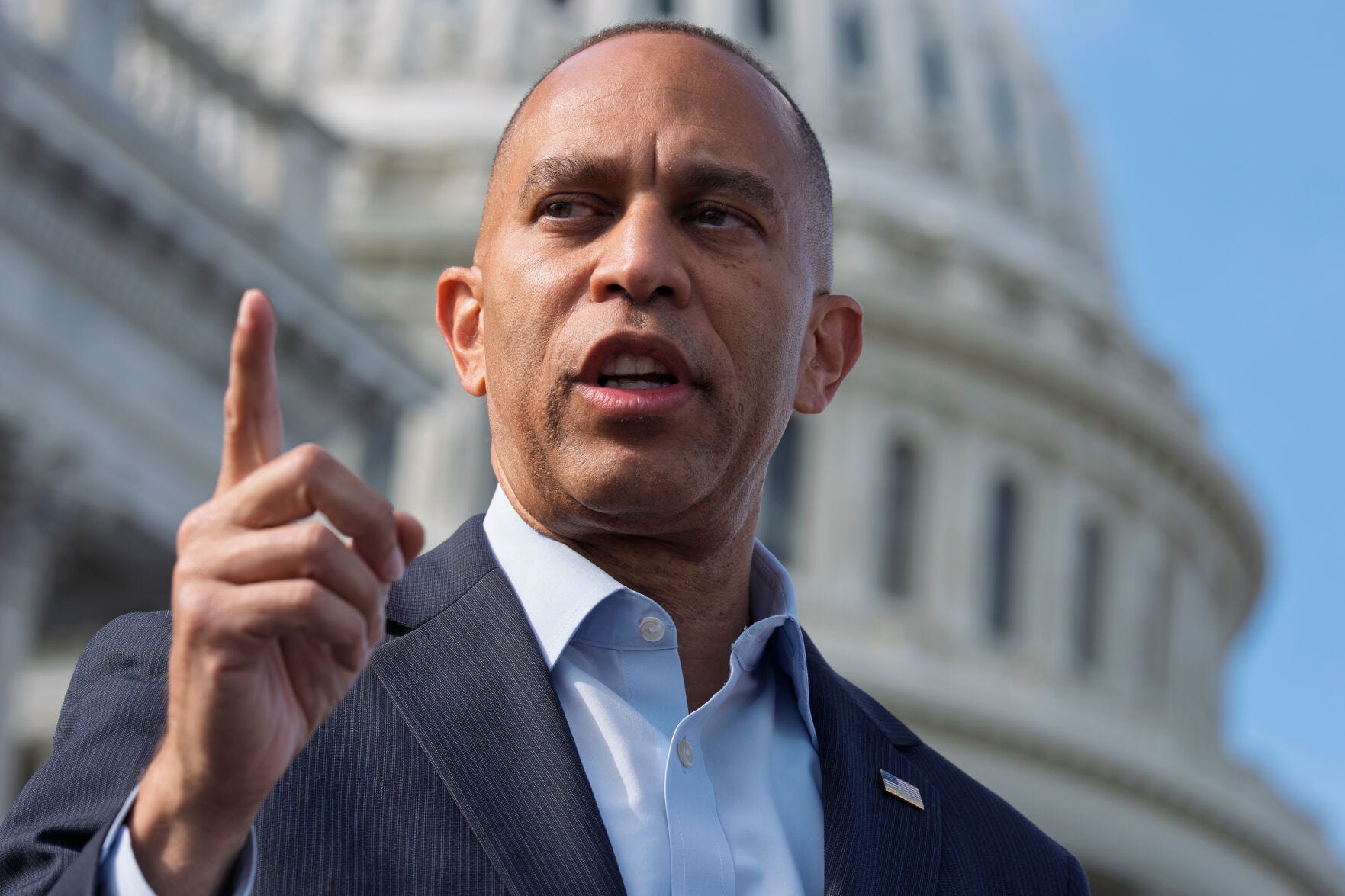
House Minority Leader Hakeem Jeffries (D-N.Y.) told me Wednesday that isn’t good enough.
“The notion of entering into a voluntary agreement that is entirely unenforceable and that allows the industry writ large to police itself is not the right response at this moment,” Jeffries said, “given the potentially grave harm and danger that industry leaders themselves are now flagging for the American people.”
His criticism followed weeks of warnings from Democrats that Congress should act before lawmakers left town for the campaign trail.
On Monday, Jeffries criticized Speaker Mike Johnson (R-La.) and House Republicans for canceling the final two scheduled weeks of September votes rather than responding to concerns about advanced AI systems escaping controlled environments.
“It certainly seems to me that we need to actually lean in boldly and responsibly now,” Jeffries said on CNBC.
Then came Tuesday’s White House summit, where Trump met with executives including Meta CEO Mark Zuckerberg, Anthropic CEO Dario Amodei, Google CEO Sundar Pichai, Nvidia CEO Jensen Huang and OpenAI cofounder Greg Brockman.
Trump praised what he called “tremendous self-policing” by the industry. The resulting White House Accord on Super Intelligence creates layers of private oversight: companies establish internal controls, separate teams audit those controls, outside auditors review compliance and independent board committees provide another layer of scrutiny.
But none of it carries the force of federal law.
