

First Things First
A quick programming note: Tonight’s Congress Nerd is the final edition of the year—barring any true breaking news that calls for a special issue. As Congress winds down and we head into the holidays, I want to say thank you for reading, supporting Once Upon a Hill and spending part of your day with my work. I’ll be back in your inbox on Jan. 4, 2026, with fresh reporting and analysis to help you get ready for the start of the second session of the 119th Congress. Until then, wishing you a restful, joyful holiday season and a strong start to the new year!
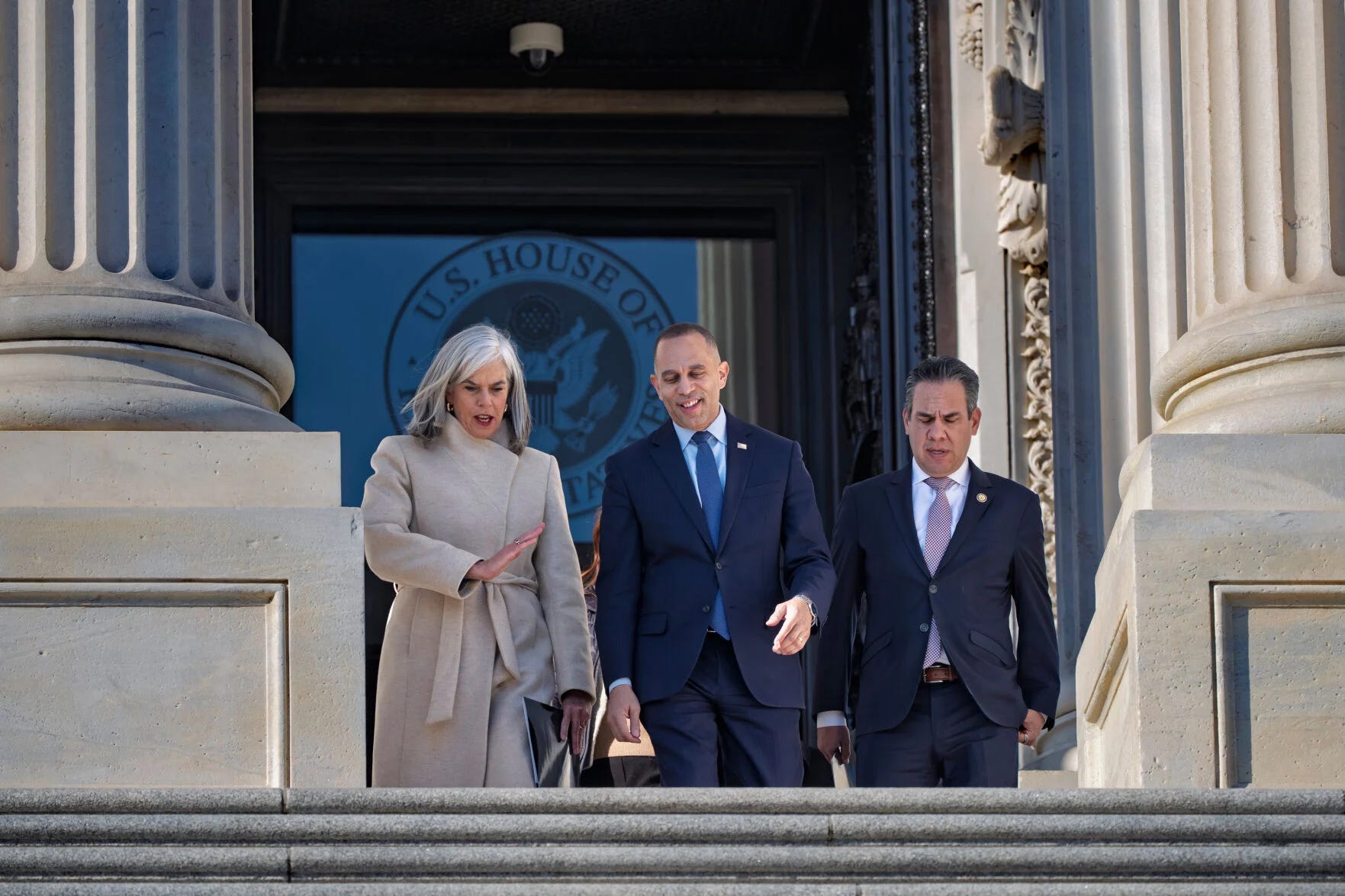
HAKEEM JEFFRIES (D-N.Y.) this week notched the most significant tactical win in his three years as the top House Democrat when he successfully secured a bipartisan majority of signatures on a procedural measure to force a vote on legislation that would extend the expiring Affordable Care Act enhanced premium tax credits for three years.
And while the vote didn’t occur before the House adjourned for the year—and likely won’t until it returns next year after the subsidies will have lapsed—the mere reality that Jeffries empowered four Republicans to break ranks with Speaker MIKE JOHNSON (R-La.) on an issue that the Brooklyn Democrat has centered for months through high-profile extended fights during the reconciliation process, government shutdown and the final days of the legislative year as Americans approach an Obamacare cliff is impressive.
“Let me just say how historic it is for the leader of the minority party—we’re the opposition—to be able to outmaneuver the majority and to get a vote on the most important critical issue facing our country right now, which is health care,” Rep. STEVEN HORSFORD (D-N.Y.), a Jeffries ally and member of House Democratic leadership told me. “And only Leader Jeffries was able to deliver that result.”
Jeffries filed a discharge petition—a procedural move that lets a majority of House members force a bill onto the floor for a vote even if party leaders don’t want it to advance—the day before the government shut down in late September to facilitate floor action on a three-year extension of the ACA tax credits, which is the same period of time they were in 2022 under the Inflation Reduction Act. By early December, all 214 House Democrats signed it, leaving Jeffries four signatures short of the majority threshold.
Along the way, a bipartisan group of self-styled dealmakers in the House and Senate negotiated behind closed doors on plans that would shave years off Jeffries’ proposals and restrict eligibility through income caps and other reforms. Reps. BRIAN FITZPATRICK (R-Pa.) and JOSH GOTTHEIMER (D-N.J.) introduced their own discharge petitions to force floor votes on their bills, with each garnering enough Republicans to cross the finish line the moment Jeffries gave his antsy rank-and-file members the go-ahead to do so. But Jeffries was resolute, standing firmly behind his petition as the most viable vehicle to extend the subsidies. I’m told that there was never a concern among leadership that House Democrats would break ranks in large enough numbers to make any of the other petitions viable.
Johnson, who told reporters for weeks during the shutdown that the expiring tax credits were a “December issue” Republicans had always planned to address once the government reopened, released a counterproposal last week that didn’t extend the subsidies and shifted toward structural changes to the health care system that Republicans argued would lower premiums and broaden options. The plan didn’t even include an expansion of Health Savings Accounts despite President DONALD TRUMP’s long-standing obsession with HSAs and how reflexively popular they are with rank-and-file Republicans.
House Republicans passed Johnson’s plan against unanimous Democratic opposition on Wednesday afternoon with little fanfare. But the fireworks occurred the night before when a group of politically vulnerable House GOP centrists made the case for a trio of amendments to be ruled in order and were rejected at Johnson’s direction. By the next morning, Fitzpatrick, Reps. MIKE LAWLER (R-N.Y.), ROB BRESNAHAN (R-Pa.) and RYAN MACKENZIE (R-Pa.) had all signed onto Jeffries’ discharge petition because allowing the subsidies to expire was worse for Americans—and their political careers—than joining the opposition to extend them.
“The American people are demanding Congress act and ensure that the Affordable Care Act tax credits do not expire. We knew that our position was the position consistent with the feelings of the American people who wanted to make sure that tens of millions of hard working American taxpayers don’t experience dramatically increased health insurance premiums,” Jeffries told me when I asked why he was so steadfast in his belief that his petition was the best approach.
Horsford said Jeffries’ most effective leadership skills have been on display during this health care fight, including listening closely to members across the caucus and to voters themselves, traveling to districts and holding forums where health care consistently emerged as a top concern. He described Jeffries as a consensus builder who prioritizes unity before taking positions—both within the House and with Senate Democrats—and who focuses on delivering tangible results, even amid competing strategies and internal debates over how best to advance health care protections.
“There are so many wrongs coming from Speaker Johnson and Trump that it is easy to get distracted,” another House Democrat told me about the caucus’s ability to remain mostly on message and unified throughout the process. “But we are walking and chewing gum!”
A person familiar with Jeffries’ thinking agreed with Horsford and added that another key to the successful outcome is that Jeffries didn’t discourage members like Gottheimer and Rep. TOM SUOZZI (D-N.Y.) from seeking a bipartisan solution with Republicans because Jeffries knew he could offer his discharge as an off-ramp to vulnerable Republicans if Johnson screwed his members, as he ultimately did. The fact that Jeffries also persuaded Schumer and Senate Democrats to sing from the same songbook was instrumental, as was projecting cross-chamber unity.
And while the fate of a clean three-year extension is uncertain if it reaches the Senate since the same proposal fell short of the 60-vote threshold last week, Democrats will be working from a position of strength if the House sends over a bill passed with bipartisan support.
“I am encouraged that there are a handful of Republicans speaking out and fighting for their constituents. A three-year extension is what we gave the Senate an opportunity to vote on just last week and it failed,” Sen. TAMMY BALDWIN (D-Wis.) told me. “When it comes, I hope that we’ll schedule it, and I hope we’ll get more Republicans, but I’m not holding my breath right now.”
But what’s more certain is the fire Democratic leaders like Jeffries have been under since Trump returned to power. Some Democrats and outside allies argue leadership has been ineffective in matching the bare-knuckle politics the president and his MAGA supporters deploy at every turn.
Perhaps this was the impetus of a midday statement from the Congressional Black Caucus that praised Jeffries for what it described as disciplined, results-oriented leadership since the start of this Congress, crediting him with holding the caucus together and helping secure bipartisan backing for a clean three-year extension of the ACA subsidies without negotiating from what Democrats saw as a weakened position. The caucus argued that effective leadership requires cohesion and strategic judgment—not reacting to every criticism—and said Jeffries has demonstrated both as Democrats look toward 2026, vowing to stand with him in what it called a continued fight on behalf of the American people.
A person familiar with the matter said the statement was issued with deliberate intentionality, reflecting the caucus’s view that its role is to advance both the broader House Democratic agenda and the priorities of CBC members—who, they noted, take pride in the fact that a CBC member would become speaker if Democrats retake the House. The person said the caucus has grown concerned about internal second-guessing of Jeffries, both from some members of the caucus and outside allies, and wanted to make clear that while Jeffries is not perfect, leadership decisions are rarely black-and-white and require trust and flexibility. With 2026 approaching quickly, the person framed the coming year as a sprint to the midterms with no tolerance for infighting, saying the CBC felt it was important to put its support for Jeffries firmly on the record before the end of the year.
Jeffries told me he hadn’t had a chance to read the full statement, but described the CBC as a treasured community he’s deeply grateful to have been part of since his first days on Capitol Hill. He reflected on walking into his first CBC meeting alongside figures like JIM CLYBURN, MAXINE WATERS and the late ELIJAH CUMMINGS, EDDIE BERNICE JOHNSON and JOHN LEWIS, while adding that sense of history, mentorship and belonging is something he has always cherished and will continue to value throughout his service.
Then, as he is wont to do, Jeffries returned to his talking points.
“Our focus is going to continue to be on making life better for everyday Americans, on lifting up the principle of liberty and justice for all, and on ending this national nightmare that Donald Trump and Republican extremists have visited on the American people all year,” he told me. “Donald Trump and these Republicans have broken every single promise that they made in terms of making life better for everyday Americans—every single promise, and it’s indisputable at this moment.”
McBride condemns pair of anti-trans bills
Rep. SARAH MCBRIDE (D-Del.) made history last year when she was the first openly transgender person to be elected to Congress. But in her first year on Capitol Hill, she’s tried to put her work and constituents ahead of her identity.
That’s why it was striking when she took to the Capitol steps on Wednesday morning to denounce a pair of anti-trans bills the House passed this week and spoke in detail about her youth before she came out at 21 years old.
“And that means 21 years of pain, 21 years of unwavering homesickness that only went away when I was able to get the care that I needed. And my biggest regret in life is that I never had a childhood without that pain,” McBride said. “None of us know how much time we have on this planet. It is already hard enough to raise a family. It is already hard enough to be a kid. And government should not make it harder.”
She later told me her remarks included many thoughts that had been on her mind and heart.
“Look, I am very cognizant of the desire to caricaturize a first, as always consumed with whatever identity makes them that first,” McBride said. And so I am judicious in my approach.”
She added that the moment called for her to speak plainly and publicly, arguing that while much of the work happens out of view, the extremity of the proposal demanded clear lines about what—and who—was at stake.
“I wanted to guarantee that people understood the seriousness and extremism of this proposal and that we are talking about people.”
The House passed the first bill—the Protect Children’s Innocence Act—on Wednesday, which would impose a government-wide ban on federal funding for gender-affirming care for minors, with supporters calling it child protection and opponents warning it blocks evidence-based care and overrides medical and parental judgment. Three Democrats joined all Republicans on final passage.
Retiring Rep. MARJORIE TAYLOR GREENE (R-Ga.), the sponsor of the bill, used her leverage last week to secure a floor vote on it by initially withholding her support for the rule governing consideration of the NDAA before flipping her vote after House Majority Leader STEVE SCALISE (R-La.) promised a standalone vote on her legislation.
Four Democrats joined all Republicans this afternoon to pass the Do No Harm in Medicaid Act—a bill that would bar Medicaid from covering or reimbursing gender-affirming care.
The votes came as the Department of Health and Human Services today unveiled proposed rules aimed at severely restricting access to gender-affirming care for transgender minors, including blocking Medicare and Medicaid funding for such care and barring hospitals that provide it from participating in federal programs.
Critics say the move would effectively shut down most access for transgender youth and lifesaving health care, while advocates label it discriminatory and harmful.
These proposals build on broader Trump-era efforts targeting transgender rights and are not yet final. They must go through rulemaking and face legal challenges. (The ACLU has already announced it will file a lawsuit against the administration.)
Every major U.S. medical association, including the American Medical Association (AMA), American Academy of Pediatrics (AAP), American Psychiatric Association, Endocrine Society, and American Academy of Child and Adolescent Psychiatry, recognizes gender-affirming care for transgender youth as evidence-based, medically necessary treatment.
These organizations agree that such care—ranging from counseling and social transition to puberty blockers and hormone therapy when appropriate—improves mental health outcomes, reduces suicide risk and supports healthy development. They also emphasize that decisions should be individualized and made in consultation with medical professionals, patients and families, not dictated by government restrictions.
“Everyone we’re talking about in this quote-unquote debate is a real person who loves and laughs, who hopes and dreams, who fears and cries just like everyone else. And that is too often lost in the debate,” McBride told me. “To the degree that my presence here, implicitly or explicitly, can remind my colleagues of that, then it has some purpose.”

Holder huddles with House Dems
Former Attorney General ERIC HOLDER met with House Democrats this morning to discuss the voting rights landscape amid the redistricting wars and ahead of a monumental Supreme Court decision on whether the Voting Rights Act will be weakened to enable states to pass voting maps and rules that dilute minority voting rights.
He told a small group of reporters that his main message was that Democrats need to stay unified around fairness, arguing Republicans are resorting to aggressive gerrymandering because they’re afraid to face voters in 2026—and that if the GOP truly believed in its policies, it wouldn’t be manipulating maps in places like Texas or preparing to do so in Florida.
Holder told me the Democratic Party’s response to Republican redistricting efforts has been strong and appropriately aggressive, pointing to Texas and California as examples and signaling that other states are prepared to act if needed. But he cautioned against viewing the fight narrowly as a gerrymandering dispute, arguing instead that Republicans’ tactics amount to a broader effort to undermine democratic norms.
He framed his involvement in this moment as a continuation of the work he began as attorney general—using his role as chair of the National Democratic Redistricting Committee to focus attention on voting rights, work with lawmakers and push the country closer to its founding democratic ideals, which he said it has not always fully lived up to.
Holder declined to predict how the Supreme Court will rule in Callais, but noted that the same court upheld the vitality of Section 2 just two years ago in Milligan, arguing there’s no clear reason for it to reverse course now. He said both the substance and timing of the decision matter for 2026, especially given filing deadlines and the Purcell doctrine. He warned that some Republican states are already adjusting their calendars in anticipation of a favorable ruling.
Asked whether Democrats should consider aggressive redistricting in blue states if Section 2 is struck down, Holder said it would depend entirely on the court’s language and practical implications for individual states. And on the prospect of perpetual mid-decade redistricting, he warned against a “race to the bottom,” expressing hope that a future Democratic trifecta would use congressional power to establish rules preventing the kind of map-manipulation now unfolding.

Last But Not Least
Inflation rose 2.7% in November, slowing from 3% in September and coming in below forecasts, which had expected slightly higher inflation due to tariffs, food/energy costs, and insurance, according to the latest Consumer Price Index released this morning. Core inflation—a measure excluding food and energy—also dipped below estimates last month to 2.6% from 3%. But the October shutdown disrupted data collection, so it’s unclear whether the broader economic picture is incomplete as a result.
Democratic health leaders sent letters to major pharmaceutical companies demanding transparency on their announcements with the Trump administration on the cost of certain medications, including GLP-1 drugs. Specifically, the lawmakers requested more information by Jan. 5 on the contours of the agreements President Trump touted in his combative, grievance-soaked address to the nation last night—including the effects on Medicare, future pricing predictions, the parameters of TrumpRx (a Trump-branded prescription drug pricing plan aimed at lowering costs without congressional action), along with any other benefits the companies are receiving from the administration as a result of these agreements.
In my latest COURIER column, I dug into the human impact of the Education Department’s move to end the SAVE student loan repayment plan effectively—and why it lands as another gut punch for borrowers already navigating higher health care costs, housing pressures and rising prices across the board. The column stations SAVE’s demise within the broader affordability squeeze that has animated most of the first year of Trump 2.0, including the contrast with the administration’s $12 billion farm aid package and what it says about who Washington moves fastest for.