

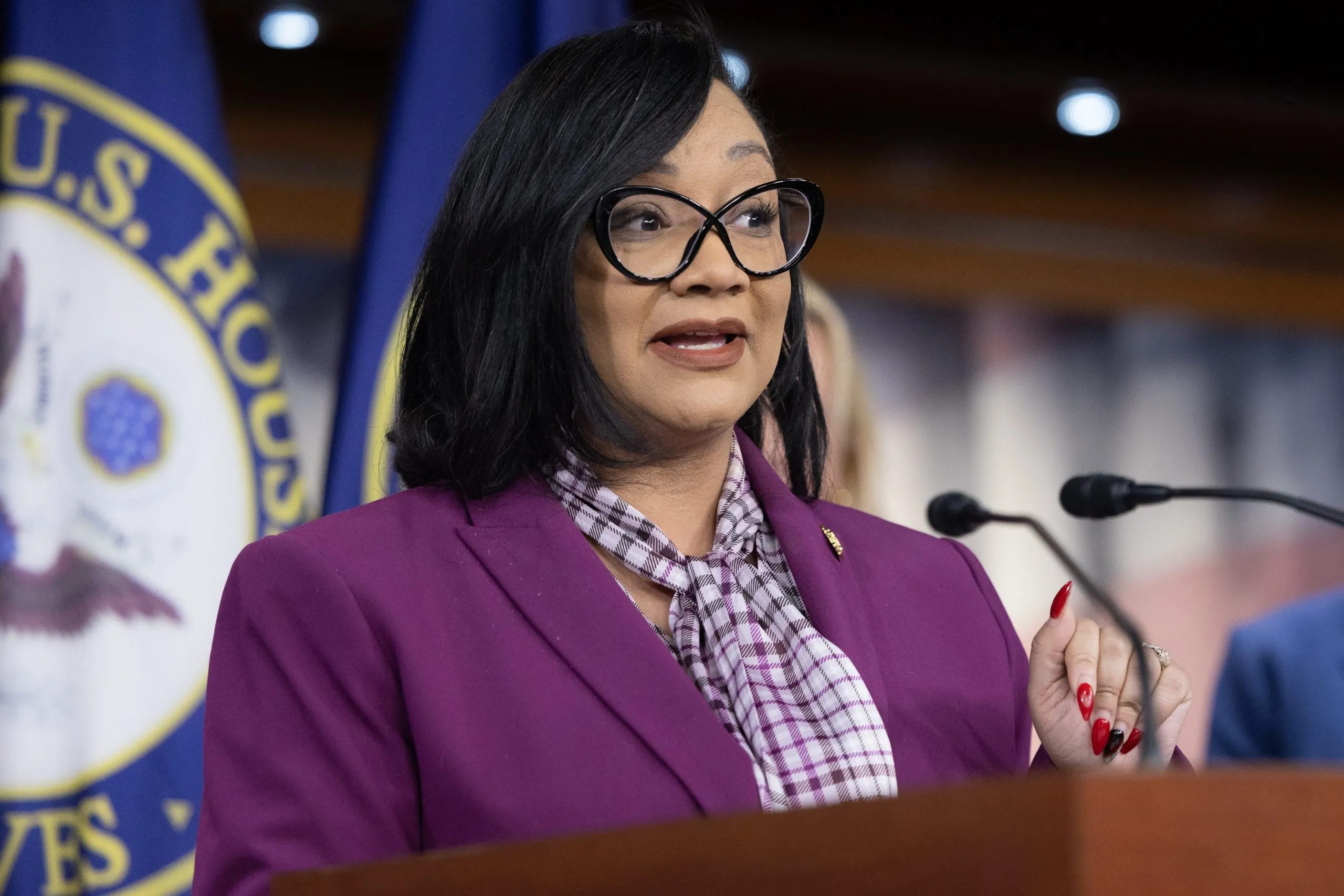
Nikema Williams was surprised to learn last week that President Donald Trump had announced his administration was taking steps to ban large institutional investors from buying more single-family homes—a move he said would curb Wall Street’s role in the housing market so more ordinary buyers could have a fair shot at owning a home.
After all, it was just three years ago when the Georgia Democrat introduced a bill to require hedge funds to sell at least 10% of the total number of single-family homes they currently own to families per year over a decade. The legislation, which Williams, who serves on the House Financial Services housing subcommittee, co-led with Reps. Linda Sánchez (D-Calif.) and Adam Smith (D-Wash.), would completely ban all hedge funds from owning any single-family homes after a 10-year full phase-out.
“It would be great if he would say, ‘Congresswoman Williams has a bill for this. Let’s elevate it and get it passed’,” she told me on Friday morning. “But what happens is we have solutions for many of the problems that we’re hearing our constituents face in the housing supply.”
Those solutions collect dust in committee, often without a vote or discussion, which Williams argued allows Trump to take credit for ideas lawmakers have been proposing on Capitol Hill for years.
“All of a sudden, it’s like someone reinvented the wheel and found this problem,” she added. “But instead of doing an executive order, how about we make these policies into law and pass the legislation that has already been sitting there waiting to address the needs of the American people?”
Trump’s announcement came during a flurry of news that signals Washington is finally treating the affordable housing crisis with the urgency Americans have been pleading for in recent years.
On the same day of Trump’s proposal, Senate Democrats last Wednesday released a report making the case that Americans can’t afford to rent or buy a home in Trump’s economy.
It featured some frightful findings, including that the median age of first-time homebuyers is 40, a record high. Foreclosures ballooned 21% last year, and mortgage delinquencies are at a four-year high. More than 22 million families are paying more than 30% of their income on rent. Five-plus million households are behind on rent. Filed evictions eclipsed one million last year.
The report was released hours before Senate Banking Committee Democrats and Senate Minority Leader Chuck Schumer (D-N.Y.) held a roundtable with groups working on housing affordability and accountability—the first event in the Democrats’ broader initiative to lower costs and address the economic pressures working families face.
“Housing is the single biggest cost for American families and the single biggest lost opportunity when people don’t have a chance to buy a home and build more economic security,” Warren told me when I asked why Senate Democrats kicked off their affordability campaign with housing.
Days later, Federal Housing Finance Agency Director Bill Pulte walked back Trump’s unpopular idea of 50-year mortgages, which would result in even higher total interest paid and slower equity build-up than the common 30-year fixed term.
“I think we have other priorities,” Pulte told reporters at the White House on Friday when asked if the idea was still under consideration within the administration.
Instead, Trump is reviewing a list of 30 to 50 housing affordability solutions compiled by himself and other top administration officials, an ironic outcome given that the president has dismissed the cost-of-living concerns Democrats have prioritized over the last year as a “hoax.”
Sen. Elissa Slotkin (D-Mich.) introduced a bill last week that would require the president to declare a national housing emergency and invoke the Defense Production Act to spur domestic production of building materials and accelerate the construction or rehabilitation of four million new homes.
Warren, Schumer, and most Senate Democrats back the ROAD to Housing Act, the first bipartisan, comprehensive housing package to advance out of the Banking Committee in over a decade, before it was stripped from the annual defense policy bill late last year. So I was curious why she felt her approach was superior.
“Think about all the things that the president has declared an emergency on. I mean, he’s declared an emergency vis-à-vis Canada, and we haven’t declared a housing emergency, which is much, much more relevant to the average Michigander,” she told me. “So I’m interested in these other pieces, including what Trump did, which is really what [former Vice President Kamala] Harris did, but that’s too small. They’re thinking too small.”
Unsurprisingly, 2026 has opened with housing front and center in Washington, given how central the issue will be to voters ahead of the November midterm elections. Polling and political reporting have shown that affordability concerns—including rents and home pricing—helped fuel Democratic wins in some state and local elections in 2025. That dynamic hasn’t faded, and both parties are fine-tuning their messages to persuade voters they have the better plan for affordability.
Other Democrats underscored how deeply housing policy is tied to racial wealth gaps. In Boston, Rep. Ayanna Pressley (D-Mass.), another member of the HFSC’s housing panel, noted that the median net worth of a Black family is just $8, compared with $247,500 for a white family—a disparity she said is inseparable from who has access to stable, affordable housing and who does not.
Pressley argued that Trump’s moves to cut funding for programs like Continuum of Care and Section 8 would only widen that divide, even as Democrats are pushing to expand paths to homeownership and protect families from eviction. She also drew a contrast on oversight, pointing out that when Rep. Maxine Waters (D-Calif.) last chaired the Financial Services Committee, Democrats held 25 housing-focused hearings during the 117th Congress, compared with just seven held by Republicans so far—evidence, she said, that housing has been deprioritized despite being top of mind for many constituents.
“Housing isn’t just a roof over your head—it is stability, security, dignity, and a human right. It’s the first, second, and third issue I hear from people in my district,” Pressley told me in a statement. “I am hopeful as we continue working together with Republicans to pass a much-needed housing package, but we also need to continue doing more to protect consumers and fund critical housing programs.”
Democrats will likely continue to emphasize supply solutions, tenant protections, and direct financial support, which resonate especially with younger, urban, and working-class voters who see housing costs as a barrier to economic stability and family formation. For Republicans, messaging has leaned on homeowner-friendly moves (like blocking corporate investors) and economic framing (blaming inflation or past policies) to connect with suburban and middle-income homeowners who are also squeezed. But it remains to be seen whether either party sees any political upside to compromising enough of their policy prescriptions to cut a deal before folks head to the polls.
After successfully forcing floor votes in recent months to compel the release of the Epstein files, restore federal workers’ collective bargaining rights and extend the expired Affordable Care Act enhanced premium tax credits, House Minority Leader Hakeem Jeffries (D-N.J.) told me that housing would be among the legislative priorities House Democrats would focus on next.
“We’re just getting started. And at the beginning of the Congress, we all said, listen, we’ll work with our Republican colleagues in good faith if they’re interested in solving problems for everyday Americans and addressing the high cost of living,” he told me. And we’ll continue to operate from the principle that life has gotten far too expensive in this country. Donald Trump has made it worse. Republican policies are a complete and total disaster, and this Congress should start acting to make life better for the American people, as opposed to focusing on subsidizing the lifestyles of the rich and shameless, which has been the GOP’s objective from Day One.”
Looking Ahead
House GOP leadership could call up another package of fiscal year 2026 appropriations bills as lawmakers race to fully fund the government ahead of the Jan. 30 deadline.
The expectation heading into the weekend was that leaders would combine the bills for national security and financial regulation with the Homeland Security measure to create the third of four trios. But ace budget reporters Aris Folley and Aidan Quigley at Roll Call scooped earlier today that lawmakers are no longer planning to include the DHS bill in the package. This was a foreseeable outcome after Renee Nicole Good was fatally shot by an ICE agent last week in Minnesota, which has inflamed partisan tensions over immigration enforcement and made funding for Homeland Security a much harder sell in negotiations right now.
Members are back on Monday evening to consider several bills under suspension of the rules. The House will also take up several bills to tilt federal labor and workplace rules in favor of employers, including measures to narrow when training time counts as paid work, keep child-care benefits out of overtime calculations, loosen how tipped wages are defined, limit the ability of retirement plans to consider non-financial factors and sharply restrict when companies can be held jointly responsible for workers’ pay and conditions.
Supporters of the legislation argue it reduces red tape, lowers costs, and provides businesses with the flexibility to offer benefits without legal risk. Expect labor-aligned Democrats to blast the bills as part of a pattern of chipping away at wage protections, overtime pay, collective bargaining leverage and worker power at a moment when affordability and job quality are already under strain.
The House Rules Committee will meet at 4 p.m. on Monday to prepare the bills for floor consideration.
The Senate is also back tomorrow afternoon, with a vote to cut off a filibuster on taking up the three-bill minibus that the House passed last week to fund core justice, infrastructure, energy and environmental priorities.
Senators are also expected to resume consideration of a war powers resolution led by Sens. Tim Kaine (D-Va.) and Rand Paul (R-Ky.) to restrict President Trump from conducting further military action in Venezuela without congressional approval.
The resolution was discharged from the Senate Foreign Relations Committee last week in a 52–47 vote after four Republicans joined Paul and all Senate Democrats to advance it to the floor. The next vote will likely be on a motion to proceed, which will be decided by a simple majority. Then a debate and possibly an amendment process before final passage.
Senate GOP leaders planned to dedicate this week’s floor time to passing the second minibus, with the Senate scheduled to be on recess next week for the Dr. Martin Luther King Jr. holiday, followed by just one more legislative week in January to pass the remaining half-dozen bills. There were even warnings that the war powers resolution could disrupt the appropriations process to the point that it increases the likelihood of another continuing resolution since the WPR will require a week of floor time without a unanimous consent agreement.
Schumer told me last week that he was “absolutely” confident the Senate could stay on schedule.
“We will work with Sen. Kaine so we can do both,” he said of the resolution and minibus.
Below are the committee meetings and hearings I’ll be watching:
— Tuesday, January 13:
The Senate Armed Services Committee will receive a closed briefing on the military operation President Trump ordered last weekend to capture former Venezuelan President Nicolás Maduro and his wife (9:30 a.m.).
The House Financial Services Subcommittee on Digital Assets, Financial Technology, and Artificial Intelligence will hold a hearing on financial technology innovations and regulations (10 a.m.).
The House Education and the Workforce Subcommittee on Early Childhood, Elementary, and Secondary Education will hold a hearing on how employers, educators and parents are solving America’s child-care crunch (10:15 a.m.)
The House Ways and Means Subcommittee on Trade will hold a hearing on maintaining American innovation and technology leadership (2 p.m.).
The House Oversight Subcommittee on Government Operations will hold a hearing to examine innovative tools to direct and prevent fraud in federal programs (2 p.m.)
— Wednesday, January 14:
The House Foreign Affairs Committee will hold a hearing on winning the AI arms race against China (9:30 a.m.).
The House Science Subcommittee on National Security, Illicit Finance, and International Financial Institutions will hold a hearing to evaluate the operations of the Committee on Foreign Investment in the United States (CFIUS) (10 a.m.).
The Senate Health, Education, Labor, and Pensions Committee will hold a hearing on medication abortion (10 a.m.).
The House Education and the Workforce Committee will hold a hearing on building an AI-ready America (10:15 a.m.).
The House Energy and Commerce Subcommittee on Communications and Technology will hold a hearing on the Federal Communications Commission (10:15 a.m.).
The House Select Subcommittee to Investigate the Remaining Questions Surrounding January 6, 2021, will hold a hearing to examine the investigation into the DNC and RNC pipe bombs (2 p.m.).
— Thursday, January 15:
The Senate Commerce Committee will hold a hearing on the impact of technology on America’s youth (10 a.m.).
And mark your calendars because the 2026 primary season is on the horizon:
52 days until the Arkansas, North Carolina and Texas primaries
59 days until the Mississippi primary
66 days until the Illinois primary
What you may have missed last week
Why Democrats distrust Trump’s Venezuela briefers: A look inside classified briefings that left Democrats skeptical of the administration’s credibility — and why Venezuela is emerging as an early test of congressional oversight in Trump’s second term.
How Congress marked five years since Jan. 6: From a somber House Democratic hearing to raw, emotional recollections from members who lived through the attack, lawmakers reflected on Jan. 6 amid renewed tension over Trump’s pardons and history itself.
Democrats brush off Trump’s impeachment warning: House Democratic leaders make clear they’re focused on oversight, not impeachment theatrics—and explain why bread-and-butter issues matter more to swing-district voters heading into 2026.
GOP cries fraud as ACA subsidies head to the Senate: Republicans leaned into fraud claims as Democrats forced a vote to extend ACA subsidies, setting up a high-stakes Senate showdown over health care costs, accountability, and election-year politics.
If you want a daily dose of valuable scoops, sharp analysis and smart context you can’t get anywhere else, join thousands of political professionals and obsessives who trust Congress Nerd to provide the legislative intelligence they need to create the change they want to see.
Your subscription unlocks direct delivery of the evening edition of this newsletter straight to your inbox each Monday–Thursday with the inside track on the political storylines, policy particulars, and power moves shaping the legislative process—before the next day unfolds.
It costs less than 30 cents per day—and not only will you be among the smartest people in the group chat, but you’ll also ensure this scrappy, independent newsroom of one continues to punch above its weight.