


FIRST THINGS FIRST
👋🏾 Hi, hey, hello. Welcome back to Congress Nerd Sunset. The politics of caregiving in Washington has long centered on the experiences of mothers. But now, a growing group of lawmakers says fathers are increasingly confronting the same economic pressures—and they want Congress to treat caregiving as a national policy challenge. This shift will be on display on Tuesday when the Congressional Dads Caucus hosts a national summit on the caregiving crisis at the Library of Congress.
The event comes as Democrats attempt to lay the groundwork now for a potential House majority next January and avoid starting from scratch if the party regains power, as polling suggests and members expect. The day-long program is also a response to the Trump administration’s disinvestments in the care economy, including significant Medicaid cuts in the One Big Beautiful Bill Act, the expiration of pandemic-era funding, and the president’s tariff-driven trade agenda—all of which have exacerbated challenges across the sector.
“Affordability is still a big deal. Job creation is anemic. Inflation hasn’t really gone down,” Gomez told me ahead of Trump’s State of the Union address last month. “All of that is just adding to the stress that dads feel. They think that no matter how hard they work, it’s just getting harder and harder.”
The event will feature five policy panels moderated by Dads Caucus members. Gomez will kick off the programming with a conversation about the challenges families face and the policy solutions that can make the economy work for caregivers. Rep. Derek Tran (D-Calif.) will lead a discussion about expanding access to high-quality early childhood education and lowering costs for families.
The panel that Rep. Brittany Pettersen (D-Colo.) will preside over on establishing a national paid family and medical leave program is personal for the second-term congresswoman. About a month after giving birth to her second son last year, Pettersen flew back to Washington to vote against a budget resolution for the OBBBA because she wasn’t allowed to vote by proxy. She is currently working to pass a House measure to allow proxy voting for up to 12 weeks for congressional members who have given birth or whose spouse has given birth.
Rep. Steven Horsford’s (D-Nev.) panel will focus on expanding access to home- and community-based services so older adults and people with disabilities can live with dignity in their communities. A session on improving pay, benefits, and career pathways for caregivers across child care and home care is also on the agenda.
Sen. Andy Kim (D-N.J.), an inaugural member of the Dads Caucus dating back to his service in the House, will deliver keynote remarks. And Gomez will be joined by two of the House Democratic Caucus’s fiercest care economy advocates—Whip Katherine Clark (D-Mass.) and Appropriations Committee Ranking Member Rosa DeLauro (D-Conn.)—and Dads Caucus members for a midday press conference at the Capitol.
An estimated 63 million Americans provide family caregiving outside of their professional roles—many of whom do so out of necessity rather than choice. The summit purposely extends beyond child care to elder care, caring for people with disabilities and multigenerational caregiving because an aging population and disability care needs have pushed the crisis beyond parenting and require federal investment in multiple care systems, not just child care.
The cost of care has surged due to a combination of low pay, worker burnout, pandemic attrition, and providers raising wages to recruit and retain staff to perform work that can’t be automated or scaled, as in other industries. The aging population and more dual-income households have led to a rising demand for child care and elder care that is outpacing supply.
Long-term care providers rely heavily on Medicaid, which often pays below actual cost and many centers operate close to break-even and pass along costs directly to families. Due to geographic mobility and workforce participation, informal care from extended family is declining. And as the panels will highlight, the lack of a universal child care or long-term care system forces families to absorb these costs directly. In many U.S. regions, child care, elder care, and disability care rival rent or mortgage payments, further squeezing already-strained family budgets.
Since the U.S. safety net was built around a male breadwinner model, it lacks the structural support for caregivers, a role that, for generations, defaulted to women who often paid a “motherhood penalty” of lower lifetime earnings, fewer promotions, and slower career advancement tied to caregiving gaps. And while single mothers remain especially vulnerable due to fewer household income earners and higher care costs relative to earnings, a cultural shift is underway: Younger dads are more engaged in parenting, with caregiving gradually becoming a shared responsibility.
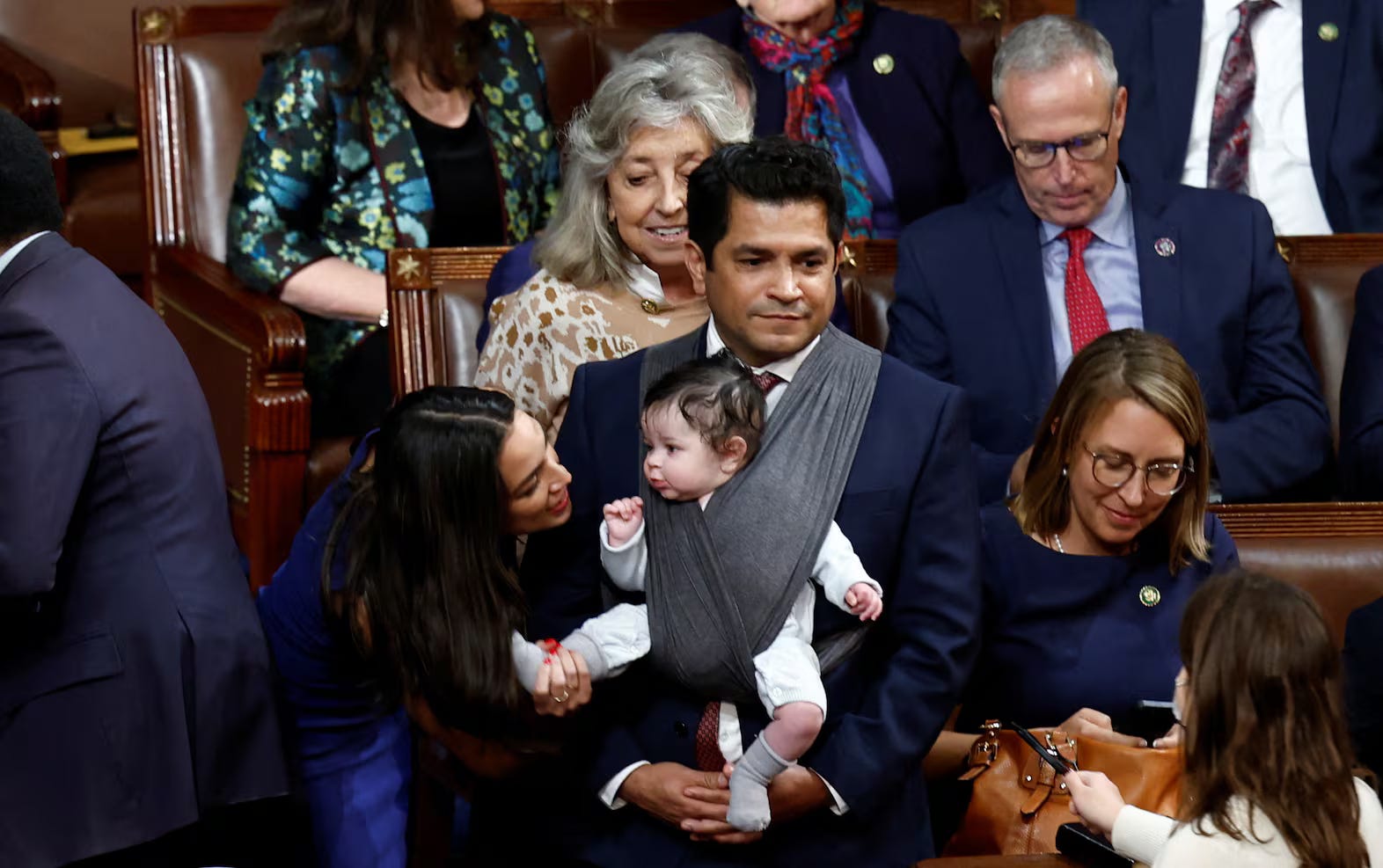
Gomez’s national platform coincides with my strongest bout of baby fever in recent years. During the record-breaking speaker vote in January 2023, the Los Angeles-area Democrat brought his son Hodge on the House floor in a moment that instantly went viral. But Gomez said it also highlighted the double standard that men are praised for bringing their kids to work, while women are often criticized for doing so. The experience reinforced his belief that dads must not only show up at home, but also advocate for their families in Congress. Soon after, he founded the Dads Caucus to bring the perspectives of fathers and caregivers into federal policymaking that helps families balance work and caregiving responsibilities.
The group has grown from 11 dads and one mom (Rep. Rashida Tlaib (D-N.Y.) to 50 members across the Democratic Caucus’s ideological spectrum, including House Minority Leader Hakeem Jeffries (D-N.Y.), New Democrat Coalition Chair Brad Schneider (D-Ill.) and Congressional Progressive Caucus Chair Greg Casar (D-Texas), who welcomed his first child last October. When he announced his paternity leave, Casar reiterated his support for guaranteed paid parental leave to all Americans and Pettersen’s new-parent proxy voting proposal.
Rep. Sydney Kamlager-Dove, a Democrat who serves in California’s congressional delegation alongside Gomez, told me she agreed with the summit’s premise that Congress, in general, and the Democratic Party, in particular, should lean into all the issues challenging new and young families.
“Caregiving is a major issue. Too expensive. Too expansive. Not enough support,” Kamlager-Dove added. “Jimmy takes his role as father seriously and sees the caucus as an opportunity to elevate the challenges parents have raising children in this inhospitable market.”
Know someone else who lives and breathes Congress? A gift subscription is a simple way to keep them in the loop on the strategy, negotiations and leadership politics driving the day on Capitol Hill.
POWER NOTES
— Speaker Mike Johnson (R-La.) faces a new complication in his push to pass a clean reauthorization of the Foreign Intelligence Surveillance Act before next month’s deadline after Reps. Anna Paulina Luna (R-Fla.) and Brandon Gill (R-Texas) said hardline conservatives have the votes to block Senate bills in the House until the Senate approves the SAVE America Act. Luna warned that she is prepared to demand that the election legislation be attached to the must-pass FISA extension if the Senate fails to pass the bill this week, raising the odds that the surveillance renewal could become the next chokepoint in the standoff over the controversial voter ID bill.
— Senate Majority Leader John Thune’s (R-S.D.) office brushed off a jab from Senate Minority Leader Chuck Schumer (D-N.Y.), who claimed he chased Thune off the floor during last week’s debate over DHS funding. “I don’t use it often, but this deserves a hearty ‘lol,’” Thune spokesperson Ryan Wrasse said in response.
— Schumer blasted the SAVE America Act as “one of the most despicable pieces of legislation I’ve come across in the many years I’ve been a legislator,” during a press call with reporters this afternoon and vowed Democrats will block any attempt by Senate Republicans to move the bill. “My caucus really feels strongly that this would be a horror,” Schumer said, adding Senate Democrats are prepared for whatever version of the legislation Thune brings to the floor.
— Leader Jeffries accused the Trump administration of trying to intimidate the press after Federal Communications Commission Chair Brendan Carr warned broadcasters they could lose their licenses over “hoaxes” and “news distortions.” “Trump administration extremists are instead trying to bully the media to lie to the American people,” Jeffries said. “They will all be held accountable.”

READ ALL ABOUT IT
“Inside the dirty, dystopian world of AI data centers” by Matteo Wong: “The race to power AI is remaking the physical world.”
“Why I love movies and how to save them” by Ton Rothman: “The industry is still recovering from the upheavals of the pandemic era. But there’s one simple step to take right now that can ensure a bright future ahead.”
“The $40 billion game of youth sports has only one winner: Dick’s Sporting Goods” by Ben Cohen: “Parents have never spent more time and money on youth sports—or at this sports juggernaut.”