

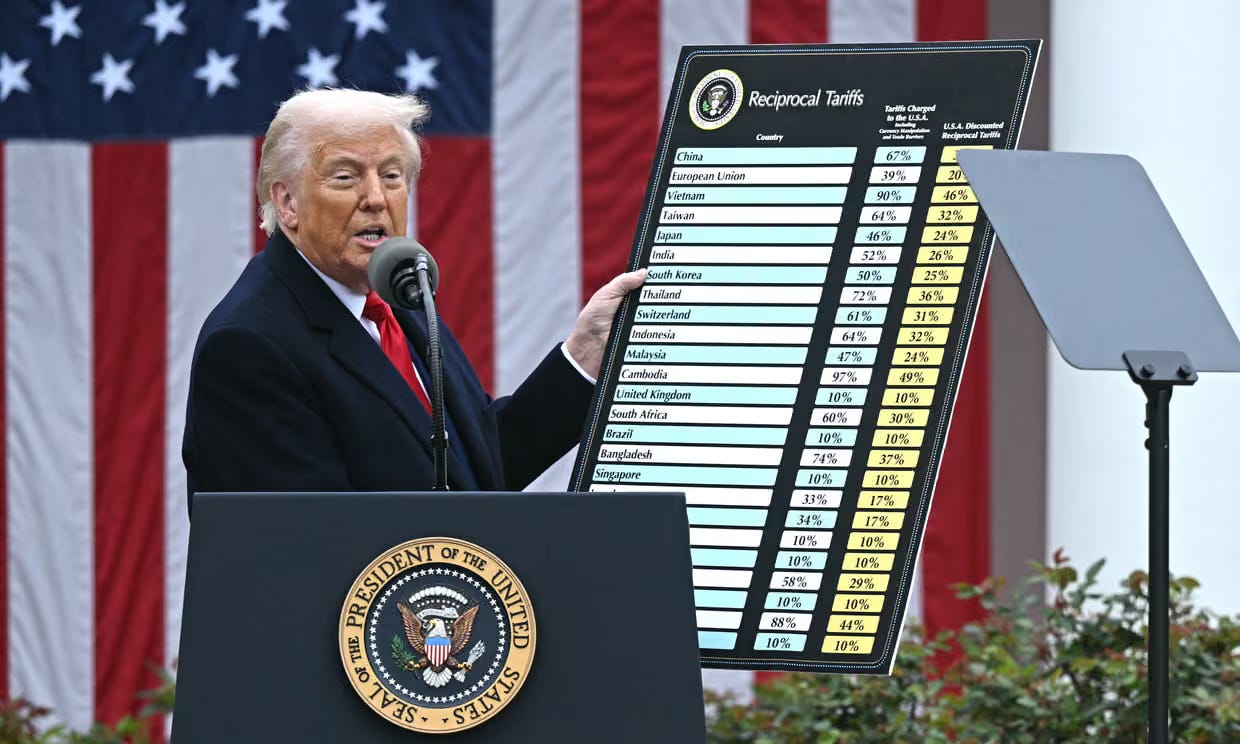

The Supreme Court this morning struck down most of the sweeping tariffs President Donald Trump imposed against dozens of countries last year in a major separation-of-powers ruling that limits presidential trade authority.
In a 6–3 opinion authored by Chief Justice John Roberts, the court ruled that tariffs are a taxing and duty power that the Constitution assigns to Congress, not the executive. It also ruled that while the International Emergency Economic Powers Act (IEEPA) empowers the president to regulate imports and exports in emergencies, the 1977 law doesn’t mention tariffs or duties and doesn’t clearly delegate that taxing power.
As a result, the emergency tariffs Trump imposed under IEEPA—including the reciprocal global tariffs and the drug-related tariffs—are invalidated. Separate national security-related tariffs are unaffected by the ruling.
Roberts was joined in the majority by Justices Sonia Sotomayor, Elena Kagan, Neil Gorsuch, Amy Coney Barrett, and Ketanji Brown Jackson. Justice Clarence Thomas, who was joined by Justices Samuel Alito and Brett Kavanaugh, wrote in dissent.
Senate Minority Leader Chuck Schumer (D-N.Y.) called the decision a win for the pocketbooks of American consumers.
“Trump’s chaotic and illegal tariff tax made life more expensive and our economy more unstable. Families paid more. Small businesses and farmers got squeezed. Markets swung wildly,” Schumer said in a statement. “We’ve said from day one: a president cannot ignore Congress and unilaterally slap tariffs on Americans. That overreach failed. Now Trump should end this reckless trade war for good and finally give families and small businesses the relief they deserve.”
House Minority Leader Hakeem Jeffries (D-N.Y.) slammed congressional Republicans for failing to provide a check on Trump’s aggressive unilateral trade policy before a group of small businesses and a coalition of states asked the Supreme Court to invalidate it.
“The President must refrain from any further unilateral action on tariffs,” Jeffries added. “Donald Trump’s my-way-or-the-highway approach to economic policy has been a complete and total failure. Enough.”
Last year, the Trump administration imposed multiple tariff regimes by executive order while invoking IEEPA, including “trafficking” tariffs tied to fentanyl against China, Canada and Mexico, and baseline higher rates for dozens of countries justified in part by trade deficits framed as an “unusual and extraordinary threat.”
In oral arguments last November, the government contended that IEEPA gave President Trump “major powers” in a genuine emergency to regulate imports, which they said naturally included the authority to impose tariffs. The emergencies cited—fentanyl trafficking and trade deficits—fell within the scope of the statute.
The challengers rejected as “implausible” the argument that Congress silently granted the president the power to upend the entire tariff system via IEEPA—a statute historically used for sanctions and asset freezes, not for across-the-board tariffs.
Most observers walked away from the arguments skeptical of the government’s position. Now we know a majority of the court’s justices were as well.
In its decision, the court invoked the major questions doctrine—a principle that significant economic decisions usually require explicit congressional authorization. The majority also noted that no president had ever used IEEPA to impose tariffs and that the lack of historical precedent undercut the government’s interpretation of the law.

The practical effects of the decision are unclear. The Treasury Department may face calls for refunds from importers who paid the illegal duties. The Trump administration could try to reimpose the tariffs under laws that clearly grant Congress authority. What’s clear is that the ruling limits how a president can use emergency powers to reshape trade policy without Congress.
“We claim no special competence in matters of economics or foreign affairs,” Roberts wrote in the majority opinion. “We claim only, as we must, the limited role assigned to us by Article III of the Constitution. Fulfilling that role, we hold that IEEPA does not authorize the president to impose tariffs.”