


THE LINEUP
The future of Graham’s gavels
Darline Graham Nordone appointed to finish her late brother’s term
Speaker Johnson sets stage for Reconciliation 3.0
ICE shooting reshapes Maine Senate contest
Stevens, El-Sayed earn dueling endorsements in Michigan Senate primary
FIRST THINGS FIRST
The future of Graham’s gavels
👋🏾 Hi, hey, hello! Welcome back to Congress Nerd Daily. I hope today was everything for you.
Trump primetime speech this week: President Donald Trump announced this afternoon that he will address the nation on Thursday at 9 p.m. He didn’t share the topic of the speech.
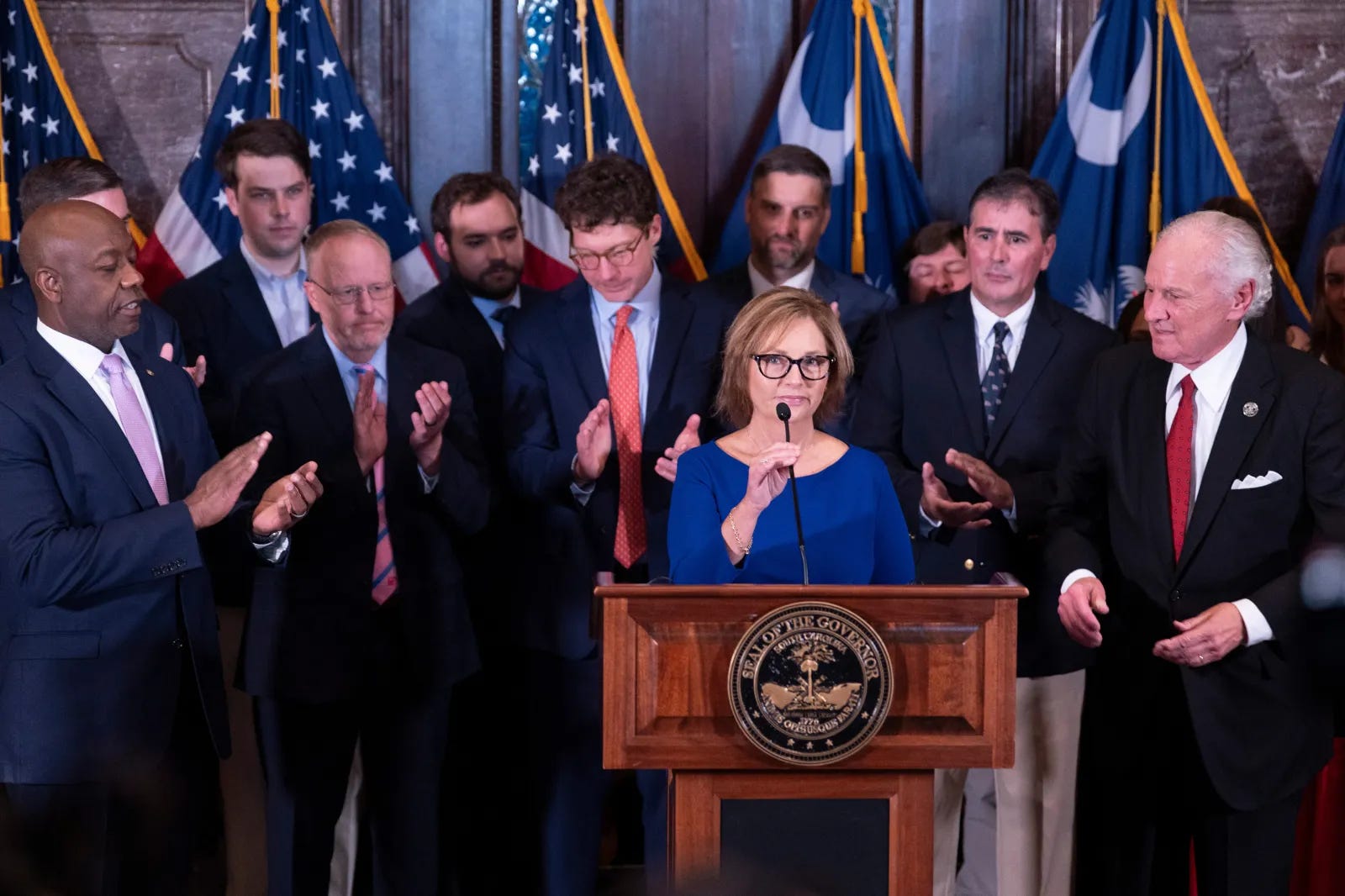
McMaster taps Graham Nordone: South Carolina Gov. Henry McMaster (R) this afternoon appointed Darline Graham Nordone to complete the term of her late brother, Sen. Lindsey Graham (R-S.C.), following his sudden death on Saturday evening.
“Lindsey has always been there for me,” she said. “And now I will be there for him.”
Senate Majority Leader John Thune (R-S.D.) applauded McMaster’s decision.
“Lindsey’s legacy will continue through Darline, and I look forward to welcoming her soon,” he wrote on X.
President Trump announced on Truth Social this morning that he recommended McMaster pick Graham Nordone to serve out the remainder of the term.
“This would be a fabulous tribute to Lindsey, who loved her dearly!” the president wrote.
Graham Nordone and Graham were incredibly close as the late senator cared for his sister when she was a teenager after their parents passed away. Now she will care for the Senate seat her brother held for nearly 25 years while several South Carolina Republicans campaign to replace Graham on the ballot for the November midterm elections.
Graham’s Senate desk is covered with a black cloth and topped with a vase of white roses.
The next power struggle: Beyond filling Graham’s Senate seat, Republicans will eventually have to decide who inherits the committee gavels he leaves behind—a choice that could offer an early window into the conference’s priorities next Congress.
Budget: Sen. Ron Johnson of Wisconsin appears well positioned. He’s the panel’s next-most-senior Republican who doesn’t already chair another committee and has reportedly expressed interest in the job.
In the historically unlikely event Republicans retain unified control of Washington after the midterms, Johnson would be well positioned to shape the GOP’s next reconciliation push. But even under divided government, the Budget Committee would remain a prominent platform for advancing his brand of fiscal conservatism and deficit politics.
Judiciary: This prominent panel presents a more consequential ideological choice.
Sens. Mike Lee of Utah, Ted Cruz of Texas and Josh Hawley of Missouri are next in line by seniority among Republicans on the panel.
A Lee chairmanship would elevate one of the conference’s leading constitutional conservatives, while Cruz’s legal background could make him a natural steward of Trump’s judicial nominees—including any future Supreme Court vacancies. Hawley, meanwhile, would signal a different direction, using the committee to press his populist agenda on Big Tech, online child safety and corporate power.
Lee currently chairs the Energy and Natural Resources Committee, while Cruz chairs the Commerce Committee.
Thune said this afternoon that Graham’s Judiciary replacement has not yet been determined.
Graham’s cause of death: The Washington, D.C. medical examiner said on Sunday evening that Graham died from aortic dissection, a medical emergency where a major blood vessel coming out of his heart suddenly tore. The tear was caused by arteriosclerotic cardiovascular disease, a long-term hardening and narrowing of his arteries. It’s one of the most common forms of heart and vascular disease.
The medical examiner emphasized that these are preliminary findings. The death certificate remains pending while toxicology and microscopic tissue testing are completed, which is standard procedure in many sudden deaths.
The final report will confirm the official cause and manner of death.
FWIW: Within hours of Graham’s sudden death, rampant speculation emerged that the late senator died from a heart attack. But Graham’s preliminary cause of death is different. A heart attack is caused by a blockage in the arteries supplying the heart muscle, while an aortic dissection is a tear in the wall of the body’s main artery. Both can cause sudden collapse and chest pain, but they are different medical conditions.
Iran war latest: President Trump this morning announced the reinstatement of a U.S. naval blockade targeting Iranian shipping through the Strait of Hormuz, declaring the United States the “Guardian of the Hormuz Strait” in a move that further escalates the administration’s confrontation with Tehran and clouds the prospects for near-term diplomacy. Trump also said the U.S. would seek reimbursement equal to 20% of cargo shipped through the strategic waterway to cover the costs of providing security, though he did not explain how such a system would operate.
“Donald Trump promised that he was elected not to start wars in the Middle East, but to stop them,” House Minority Leader Hakeem Jeffries (D-N.Y.) told reporters this afternoon. “He then turned around, along with compliant Republicans, and launched a reckless and costly war of choice in Iran that’s ongoing, and now has been taking place for more than 100 days, with over $100 billion in taxpayer money being wasted, while leaving Iran in a stronger position than they were in before the war, and the American people economically in a weaker position, particularly as it relates to high gas prices.”
Approps watch: Senate Minority Leader Chuck Schumer (D-N.Y.) wrote in a “Dear Colleague” letter this morning that Senate Republicans cannot pursue a partisan appropriations process and then blame Democrats if funding negotiations collapse, insisting Democrats want to avoid a government shutdown and remain ready to negotiate bipartisan spending bills. He also positioned the funding fight as part of a broader battle over affordability, congressional oversight, government corruption and protecting elections from what he called Republican efforts to undermine them.
🔓 This edition is in front of the paywall. But if you want the Tuesday and Thursday editions, plus the Sunday lookahead, upgrade your subscription for full access to every edition and the complete archive. Whether you’re taking the votes, writing the bills, running the campaigns, shaping the message or trying to influence any of the above, Congress Nerd Daily helps you see around corners before everyone else catches up.
GOVERNMENT FUNDING
Johnson sets stage for Reconciliation 3.0
House Speaker Mike Johnson (R-La.) said House Republicans will move this week to adopt a budget resolution that would unlock a third reconciliation bill after meeting for hours Monday at Camp David with House Budget Committee Republicans, House Majority Leader Steve Scalise (R-La.) and White House officials.
While the speaker didn’t outline the package’s contents, Republicans are widely expected to pursue roughly $350 billion in additional defense spending alongside other remaining Trump priorities, potentially including pieces of the SAVE America Act that could face steep procedural hurdles under the Senate’s Byrd Rule.
The announcement comes as Johnson tries to recover from the latest legislative setback of his speakership. Before Republicans can turn to another party-line package, the speaker first has to restore control of the House floor after conservatives sank a procedural rule before the Independence Day recess despite leadership’s attempt to satisfy them by pairing the House-passed SAVE America Act with the annual defense authorization bill.
That failed vote forced House leaders to shelve action on the NDAA, the fiscal 2027 State-Foreign Operations appropriations bill and several bipartisan measures. Assuming Johnson can reunite his conference this week, lawmakers are expected to consider legislation banning payment card companies from assigning merchant category codes that specifically identify firearms retailers, making daylight saving time permanent, advancing the State Department funding bill and approving a bipartisan package of veterans’ health care and benefits reforms.
Even if Republicans adopt the budget resolution this week, Johnson still faces significant political and procedural obstacles. The House is scheduled to meet for only one additional legislative week after this one before the August recess, leaving little time to draft, mark up and pass another reconciliation package. Deficit hawks are also expected to insist that any new defense spending be fully offset by domestic spending cuts Republicans have yet to agree on.
And even if Johnson clears those hurdles, the Senate remains an open question. Thune has stopped short of committing his conference to another party-line package, saying he’ll first wait to see whether the House can pass a budget resolution and what legislation ultimately emerges. That leaves the fate of a third reconciliation bill dependent not only on Johnson’s ability to unify his own conference, but also on whether Senate Republicans conclude another reconciliation fight is worth having.
Jeffries told reporters this afternoon that he expects every House and Senate Democrat to oppose the effort.
“What’s in front of us right now relates to the legislative process and the appropriations process and the notion that Republicans are prepared as early as this Wednesday to move another budget to give the so-called Department of War more than $75 billion at least to continue Operation Epic Failure in the Middle East,” Jeffries said. “What we need to do is to stop this effort to use taxpayer dollars to continue this failed war in the Middle East that the American people have rejected from the beginning, and have soured on even more over the last several months.”
Republicans have already passed two reconciliation bills this Congress—including the One Big Beautiful Bill Act, the major tax-and-spending package Trump signed into law last year, and the Secure America Act, enacted last month, to provide roughly $70 billion for immigration enforcement through the remainder of Trump’s term.
📬 The best stories often start with a conversation. If you’ve got insight, context or something others are missing, my inbox is open. Send me tips, scoops or just say hi: michael@onceuponahill.com.
CAMPAIGNS
ICE shooting reshapes Maine Senate contest
A fatal ICE shooting of a man in his 20s during a confrontation in southwestern Maine this morning injected one of the country’s most politically charged issues directly into the state’s newly formed Democratic mini-primary—the emergency nominating convention triggered by the sudden withdrawal of former nominee Graham Platner following sexual assault allegations.
The shooting comes as the battle lines between the establishment and progressive wings of the party are being redrawn over immigration enforcement ahead of the July 25 convention, where county delegates will choose a new Senate nominee.
The progressive litmus test: Progressive candidates vying for Platner’s former base are responding to the shooting by calling for hardline anti-ICE platforms. Platner originally won the June primary as an outsider progressive by sharply criticizing the Trump administration’s “Operation Catch of the Day” in Maine and calling for ICE to be “dismantled.” In the aftermath of the shooting, several progressive contenders have argued county delegates should choose a nominee who will aggressively challenge what they describe as federal overreach.
Pressure on moderates: Moderate candidates—including those previously aligned with Governor Janet Mills—are facing renewed pressure to sharpen their immigration messaging as they compete for progressive convention delegates. While Mills has sharply criticized ICE’s tactics, progressives have long argued she has not gone far enough. Candidates associated with her wing are now under pressure to respond forcefully to the shooting while avoiding criticism from the left over civil rights and immigration enforcement.
The Collins contrast: The replacement nominee will immediately face incumbent Republican Sen. Susan Collins in one of the country’s most competitive Senate races. The shooting is likely to become a central line of attack against Collins, whose critics have already sought to tie her to the Trump administration’s immigration agenda.
Candidates addressing the July 25 convention are expected to present themselves as strong defenders of Maine communities while arguing Collins has not done enough to challenge the administration’s immigration enforcement policies.
“The shooting in Biddeford requires a full and impartial investigation of what happened,” Collins said in a statement. “It is my understanding that the Biddeford Police have secured the site and that the FBI is investigating.”
The backstory: The Department of Homeland Security said the man—identified by immigrant advocates as a 26-year-old Colombian national—was subject to a final removal order and alleged he “weaponized” his vehicle, prompting an ICE agent to open fire.
A nearby witness told a local news station they saw an unmarked law enforcement SUV attempt to ram a small white car before armed agents wearing green ICE vests pulled the heavily bleeding man from the vehicle. Doorbell camera audio captured what sounded like at least four gunshots, according to the station.
The Maine Attorney General’s Office, the FBI, the Maine State Police and the Maine Department of Public Safety are investigating the shooting. The Biddeford Police Department is providing scene security, and the ICE agent involved has been placed on administrative leave.
Mills and Rep. Chellie Pingree (D-Maine) have both questioned ICE’s expanding presence and enforcement tactics in the state. The shooting is the second fatal ICE-involved shooting reported nationwide in less than a week, following a separate fatal encounter in Houston. Civil rights organizations have called for immediate protests in Biddeford and demanded an independent investigation.

LAST BUT NOT LEAST
Anti-weaponization fund fallout: A federal judge cast fresh doubt on the Trump administration’s abandoned plan to create a $1.776 billion anti-weaponization fund, suggesting the lawsuit that produced the proposal may have been used to legitimize an unprecedented transfer of taxpayer funds while questioning whether broader legal protections for Trump and his businesses remain in effect despite the administration later saying the fund was dead.
The proposal drew bipartisan criticism because it would have used the Treasury Department’s permanent Judgment Fund to establish a new executive branch compensation program without a specific appropriation from Congress.
Reproductive justice: Reps. Lateefah Simon (D-Calif.), Ayanna Pressley (D-Mass.) and Sydney Kamlager-Dove (D-Calif.) introduced a resolution marking America’s 250th anniversary by declaring reproductive justice a fundamental human right and endorsing policies including abortion access, universal health care, maternal health care, paid family leave and comprehensive sex education. The largely messaging measure also calls for ending Hyde Amendment-style federal funding restrictions on abortion and condemns the criminalization of pregnancy outcomes, including miscarriage, abortion and stillbirth.
New endorsements: Michigan’s Democratic Senate primary is becoming an increasingly clear proxy fight over the party’s ideological direction, with outgoing Sen. Gary Peters abandoning his previous neutrality this morning to endorse Rep. Haley Stevens, while Rep. Ilhan Omar (D-Minn.) threw her support behind former Wayne County Health Director Abdul El-Sayed.
Peters said Stevens would be “ready on day one to fight for Michigan,” adding another establishment endorsement after backing from Leader Schumer and other Senate Democrats.
The dueling endorsements underscore the coalition each candidate is assembling ahead of the Aug. 4 primary.
Stevens has consolidated support from much of the Democratic establishment, while El-Sayed continues to build momentum on the left with backing from Omar, Sen. Bernie Sanders (I-Vt.), Rep. Alexandria Ocasio-Cortez (D-N.Y.) and Sen. Chris Van Hollen (D-Md.) in one of the cycle’s most closely watched Democratic nomination fights.
AGs sue to block Paramount-Warner Bros. merger: A coalition of 12 Democratic state attorneys general sued today to block Paramount’s proposed $110 billion acquisition of Warner Bros. Discovery, arguing the deal would further consolidate the television and film industries at the expense of consumers, workers, movie theaters and other businesses.
The lawsuit comes as some congressional Democrats have warned they would pursue legislation or oversight to unwind the merger if they regain one or both chambers in November.
“A Paramount-Warner Bros. megamerger would mean higher costs and fewer choices for Americans,” Senate Banking Committee Ranking Member Elizabeth Warren (D-Mass.) said. “Good news: the states are stepping up to block this antitrust nightmare. This fight isn’t over.”