


👋🏾 Hi, hey, hello! Welcome to Congress Nerd Daily, Once Upon a Hill’s reported evening briefing chronicling the strategic decisions, procedural fights and campaign dynamics that determine how power is exercised, challenged and won on Capitol Hill.
I hope your week is off to a wonderful start.
Today is the 14th anniversary of Deferred Action for Childhood Arrivals, better known as DACA—the Obama-era program for so-called Dreamers that provides temporary protection from deportation and work permits to certain undocumented immigrants who arrived in the United States as children.
Senate Minority Whip and Senate Judiciary Committee Ranking Member Dick Durbin (D-Illinois) will lead Democratic senators in speeches on the Senate floor this evening to reflect on the nearly decade and a half program and call on Congress to pass the Dream Act, which would provide Dreamers with a pathway to citizenship by passing the bipartisan Dream Act.
In this evening’s edition: Lawmakers in both parties say they need briefings and documentation before judging an agreement the White House says could lead to a broader nuclear accord. Plus, Elizabeth Warren raises alarms about AI-driven utility costs and John Thune offers the clearest sign yet of how Republicans plan to revive Section 702.
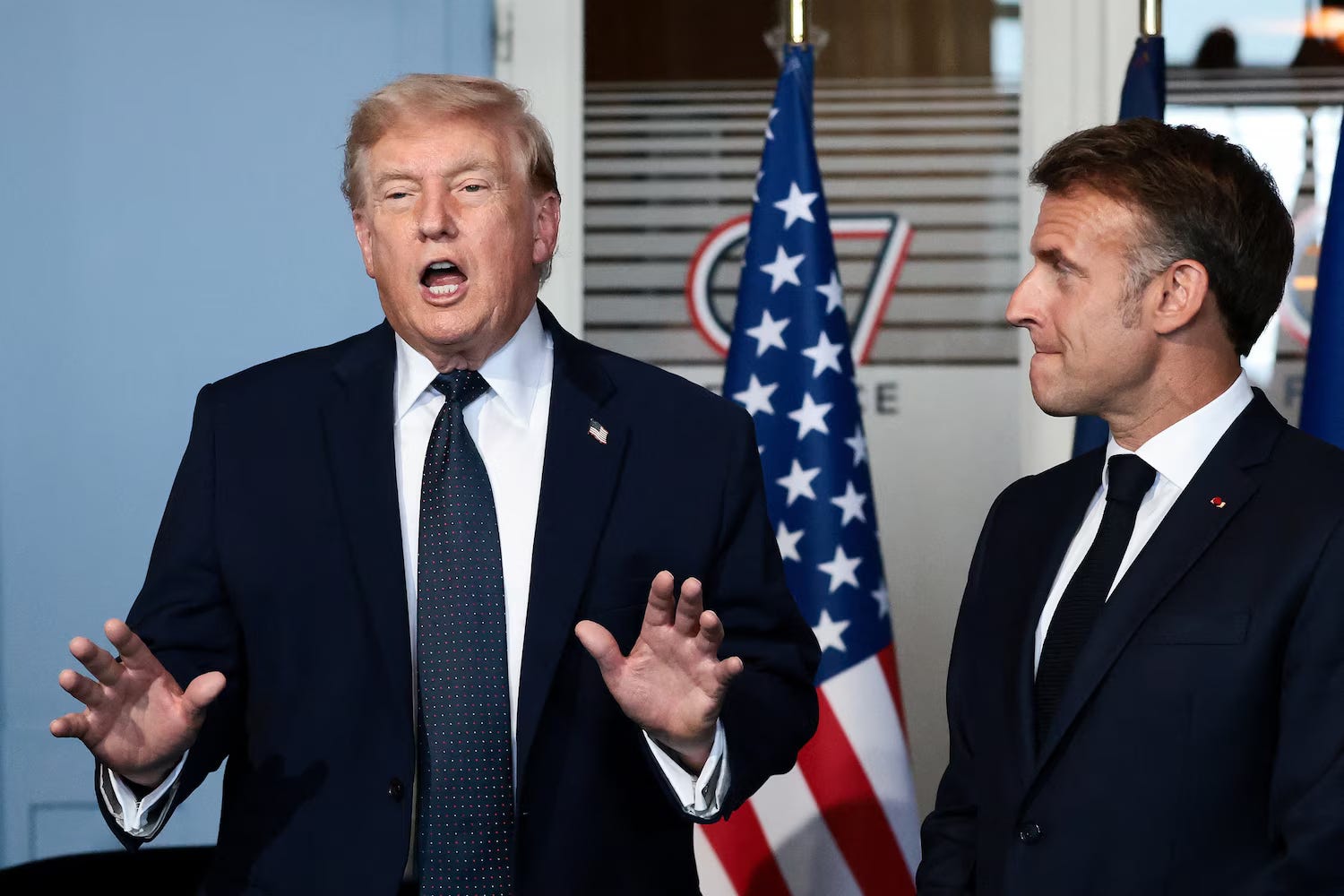
But first things first: President Donald Trump arrived in France on Monday for the opening day of the G7 summit after a whirlwind weekend that culminated last night with the UFC Freedom 250 event on the White House South Lawn. The president landed in Geneva before traveling to Évian-les-Bains, where he opened the summit with a bilateral meeting with French President Emmanuel Macron and joined fellow leaders for an evening dinner overlooking Lake Geneva.
The public portion of Trump’s first day was relatively light, though he signaled optimism about ongoing efforts to end the war between Russia and Ukraine, telling reporters he believes both Russian President Vladimir Putin and Ukrainian President Volodymyr Zelenskyy are open to reaching an agreement. But we’ve heard that tune before, so who knows? ̄\_(ツ)_/ ̄
The summit shifts into a more substantive phase over the next two days.
Trump is scheduled to meet with Zelenskyy alongside G7 leaders on Tuesday before holding bilateral talks with the leaders of Qatar and the United Arab Emirates. Wednesday’s agenda includes meetings with Egyptian President Abdel Fattah el-Sisi and Indian Prime Minister Narendra Modi, as well as a discussion with world leaders and technology executives focused on innovation and artificial intelligence.
The schedule offers a snapshot of the administration’s current priorities: Securing support for a diplomatic off-ramp in the Middle East, pursuing a potential breakthrough in Ukraine and positioning the United States at the center of the global race to build and regulate AI.
🔓 This edition is in front of the paywall. But if you want the Tuesday and Thursday editions, plus the Sunday lookahead, upgrade your subscription for full access to every edition and the complete archive. Whether you’re taking the votes, writing the bills, running the campaigns, shaping the message or trying to influence any of the above, Congress Nerd Daily helps you see around corners before everyone else catches up.
The Capitol Bulletin
Thune eyes Clayton vote as Senate searches for FISA path: Senate Majority Leader John Thune (R-South Dakota) offered the clearest indication yet that Republicans view U.S. Attorney for the Southern District of New York Jay Clayton’s confirmation as director of national intelligence as the key to reviving negotiations over Section 702 surveillance authorities.
Thune said Senate Republicans will move “as soon as we feel like we have the votes to do it,” when asked about the path forward to reauthorizing, adding that the timeline is “probably all contingent upon Clayton getting confirmed into the position.”
The comments amount to a notable acknowledgment of the political reality surrounding the debate. House Minority Leader Hakeem Jeffries (D-New York) and other Democrats have spent weeks arguing they will not support extending the surveillance authority while Federal Housing Finance Agency Director Bill Pulte serves as acting DNI, a position Republicans initially dismissed as unrelated to the underlying national-security debate.
Thune also appeared to leave himself room to maneuver after President Trump demanded over the weekend that Congress pair FISA reauthorization with the SAVE Act, telling reporters he discussed surveillance authorities with the president before Trump made his latest clamor for the elections bill.
“I certainly would hope that if we can get FISA off the floor that he would sign it,” Thune said.
Separately, Thune said Republicans would move quickly to confirm Clayton and Attorney General nominee Todd Blanche if both emerge from committee with strong votes, though he acknowledged Blanche still has senators to convince before reaching the floor.
Warren links AI boom to rising utility bills: Sen. Elizabeth Warren (D-Massachusetts) opened a new front in Democrats’ scrutiny of artificial intelligence, arguing that the private-equity-fueled race to build data centers could leave Americans paying more for electricity.
In letters to KKR, BlackRock, Brookfield Infrastructure Partners and Blackstone, the top Democrat on the Senate Banking Committee warned that surging investment in the infrastructure powering AI is coinciding with concerns about rising utility bills, growing energy demand and environmental strain. Warren noted that private-equity investment in data centers reached a record $45.7 billion in 2025 and is projected to account for $350 billion in financing by 2028.
She pointed to research showing electricity consumption tied to data centers more than doubled between 2018 and 2023 and could push average power costs higher by the end of the decade, with Virginia among the states facing the steepest increases.
The inquiry reflects a broader Democratic effort to connect the AI boom to affordability concerns. While tech companies and investors describe data centers as critical to maintaining U.S. competitiveness, Warren is asking whether ordinary consumers are being forced to subsidize the infrastructure behind that growth.
📬 The best stories often start with a conversation. If you’ve got insight, context or something others are missing, my inbox is open. Send me tips, scoops or just say hi: michael@onceuponahill.com.
The Top Story
Congressional leaders in both parties spent today demanding details about President Donald Trump’s preliminary agreement with Iran, cautioning that the memorandum of understanding announced over the weekend is not a final nuclear deal and leaves many of the most consequential questions unresolved.
The reaction came as Trump used the opening day of the G7 summit in France to tout the agreement as a diplomatic breakthrough. Sitting alongside French President Emmanuel Macron, the president declared that “the deal is all signed,” predicted that the Strait of Hormuz would be fully reopened by Friday and argued that the framework would succeed where the Obama-era nuclear agreement failed.
But lawmakers from both parties said they have yet to receive a full briefing on the agreement, which establishes a 60-day negotiation process rather than a completed accord governing Iran’s nuclear program.
“I want it to be released because it is a really powerful document,” Trump said when asked when the text would become public. “It is not like the Obama documents.”
The agreement’s supporters and skeptics alike appeared to agree that Congress needs more information.
Senate Majority Leader John Thune said he had not reviewed the agreement and expected lawmakers would require a briefing from the administration.
“I don’t know enough about it to say,” the South Dakota Republican told reporters when asked whether the deal would prevent Iran from obtaining a nuclear weapon. “The issues are going to be compliance and how you’re going to enforce that, and what are the financial incentives that the Iranians have from our country and what are they conditioned upon?”
Thune said lawmakers are already discussing what congressional review could look like if negotiations ultimately produce a formal nuclear agreement.
Senate Minority Leader Chuck Schumer (D-New York) similarly demanded details, saying Americans deserve to know “what exactly is in this understanding” and whether U.S. servicemembers remain in harm’s way.
“We’ve been told dozens of times that the war is over,” Schumer said. “Dozens of times, we have been left disappointed.”
The memorandum establishes a 60-day process for addressing issues that have bedeviled U.S.-Iran diplomacy for years, including nuclear restrictions, verification requirements, enforcement mechanisms and the future disposition of Iran’s enriched uranium.
House Minority Leader Hakeem Jeffries (D-New York) said the administration has yet to brief Congress and questioned whether the war has ultimately strengthened America’s negotiating position.
“My concern has been from the beginning that this is a war that we never should have entered into,” Jeffries said during a local TV interview this morning. “It was a reckless war of choice.”
Jeffries also highlighted what he described as contradictions in the administration’s public messaging.
“The president has indicated that even with this tentative agreement, there’s still unresolved issues related to Iran’s nuclear aspirations,” he said. “That’s ironic to us because the president said last year that Iran’s nuclear program had been completely and totally obliterated.”
The top House Democrat argued that it remains unclear whether the agreement ultimately produces a stronger outcome than the 2015 Joint Comprehensive Plan of Action, which Trump withdrew from during his first term.
“We don’t have any confidence that the end result is that you’re going to get an agreement that’s actually longer or stronger,” Jeffries said.
Rep. Gregory Meeks, the top Democrat on the House Foreign Affairs Committee, welcomed the administration’s return to diplomacy while warning that the success of the effort will depend on the final product rather than the announcement itself.
“The terms, not the press release, will determine whether this serves American interests,” Meeks said, adding that any agreement should be “durable, enforceable, transparent, and subject to rigorous oversight by Congress.”
Even some of Trump’s allies appeared reluctant to declare victory before seeing the details.
Sen. Lindsey Graham (R-South Carolina) praised the administration for reaching the memorandum and called the broader vision “transformative for the region.” But he also noted concerns that Iranian officials appear to be describing the agreement differently from American negotiators.
“It is my understanding the terms of the MOU will be released by the administration in the coming days,” Graham wrote on social media. “I look forward to reviewing the actual document.”
Notably, Graham repeatedly identified Vice President JD Vance as the architect of the agreement and said Vance should help present any eventual deal to Congress. Trump reinforced that dynamic at the G7, telling reporters that Vance would participate in the signing ceremony for the memorandum.
“JD is coming for it. He was originally going to do it,” Trump said. “I will probably be gone by then. We are having dinner in a day and a half, I think staying quite late. So I may be involved. I may not.”