


IN THIS EDITION
Blanche rejects Democrats’ claims of politicized DOJ
Clark splits with Jeffries on Israel aid
House GOP releases Reconciliation 3.0 blueprint
Trump pushes ICE to resume traffic stops
CBC backs independent investigation in Nolan Xavier Wells death
FIRST THINGS FIRST
Blanche rejects Democrats’ claims of politicized DOJ
👋🏾 Hi, hey, hello! Welcome back to Congress Nerd Daily. I hope today was everything for you.
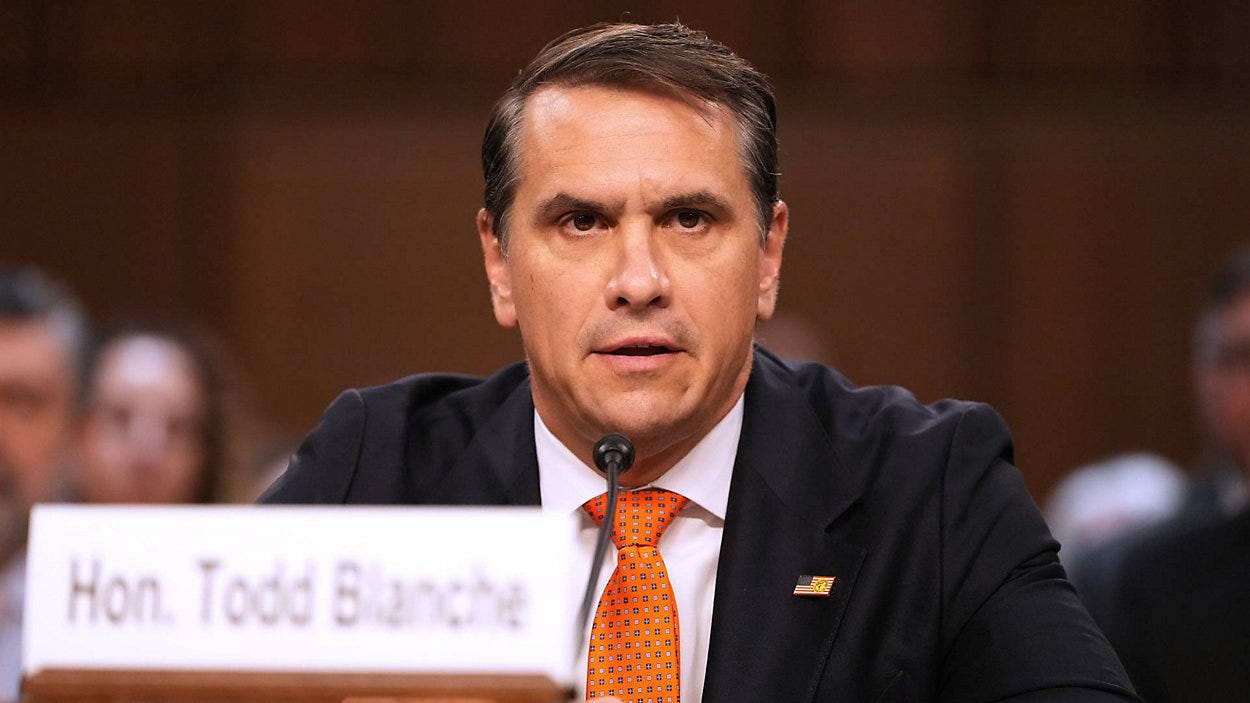
Todd Blanche spent nearly five hours before the Senate Judiciary Committee today defending his record as President Donald Trump’s deputy attorney general and arguing he would lead the Justice Department independently if confirmed as attorney general.
Democrats weren’t buying it.
Instead, they repeatedly cast Blanche as an extension of Trump’s personal legal operation, pressing him on everything from the now-abandoned $1.776 billion anti-weaponization fund and the blanket Jan. 6 pardons to the Epstein files, politically sensitive prosecutions and the Justice Department’s relationship with the White House.
Republicans, meanwhile, largely used their time to reinforce Blanche’s case while focusing on issues including the Jack Smith investigation, medication abortion, election integrity and immigration enforcement.
The hearing also unfolded against a newly uncertain political backdrop following the sudden death of Sen. Lindsey Graham (R-S.C.), who was expected to support Blanche’s nomination in committee. If Democrats remain united in opposition, Republicans will have even less room for defections than anticipated, putting additional attention on senators including John Cornyn (R-Texas), who told reporters afterward he remains undecided, and Thom Tillis (R-N.C.), who appeared more satisfied with Blanche’s assurances.
The fund that wouldn’t go away: The anti-weaponization fund dominated much of the hearing, drawing questions from both Republicans and Democrats.
Blanche repeatedly insisted the proposal is finished.
“It is a moot issue, meaning there is no weaponization fund,” Blanche said. “The weaponization fund is dead. It’s not moving forward.”
He told Cornyn the Justice Department decided independently not to pursue the fund before informing President Trump and argued there was nothing left to debate.
Still, Cornyn remained skeptical.
Later, he told reporters he remains undecided on Blanche’s nomination because he still wants assurances the proposal cannot be revived—a notable sign the issue continues to complicate Blanche’s confirmation even after the department abandoned it.
Tillis, another closely watched Republican vote, struck a different tone, urging Blanche to “stick a fork in this turkey” by helping draft legislative language to permanently end the debate.
Democrats question Blanche’s independence: Democrats repeatedly returned to the same central question of whether Blanche would serve the Justice Department or President Trump.
Sen. Chris Coons (D-Del.) challenged Blanche on whether the DOJ operates independently from the White House.
Blanche responded that the Justice Department “like every single department in the executive is part of the executive,” while insisting elsewhere that he would faithfully follow the law.
Sen. Mazie Hirono (D-Hawaii) pressed him on whether a president has the authority to direct investigations of perceived political enemies, while Sen. Cory Booker (D-N.J.) questioned Blanche about prosecutions involving former FBI Director James Comey, New York Attorney General Letitia James and Newark Mayor Ras Baraka.
Booker argued senators shouldn’t judge Blanche by the promises he made during the hearing but by the decisions he has already made as deputy attorney general.
“This isn’t a confirmation hearing,” Booker said. “This is more of a performance review.”
He accused Blanche of repeatedly favoring Trump’s interests over those of the Justice Department.
“You seem to be favoring the interests of a president over the powerful. You’ve chosen Trump over truth. You’ve chosen corporations over the Constitution,” Booker said. “The attorney general’s client is not the president; it’s the American people.”
The stakes of that debate were visible inside the hearing room.
Rep. LaMonica McIver (D-N.J.), who is facing federal charges stemming from last year’s confrontation outside Newark’s Delaney Hall immigration detention center, stood quietly in the back of the hearing room as senators questioned Blanche. Her office circulated a fact sheet accusing Blanche of personally overseeing key decisions in the case, an allegation that underscores Democrats’ broader argument that the department has become increasingly willing to pursue politically sensitive cases against Trump’s critics.
The familiar flashpoints: The hearing repeatedly circled back to issues that have defined Blanche’s tenure as deputy and acting attorney general.
Democrats criticized Trump’s blanket Jan. 6 pardons, questioned Blanche’s authorization of subpoenas targeting New York Times reporters in what he described as a classified leak investigation, pressed him over the handling of the Epstein files and challenged his role in politically sensitive prosecutions.
Blanche pledged to devote Justice Department resources to limiting the unlawful distribution of mifepristone by mail, defended Trump’s constitutional pardon authority, reaffirmed support for pursuing sanctuary jurisdictions and argued that the SAVE America Act would strengthen the DOJ’s ability to protect federal elections.
He also reiterated that his meeting with Ghislaine Maxwell resulted in no additional criminal charges and said he never discussed a pardon or a prison transfer with her.
More than Trump’s lawyer? One of the day’s more personal moments came when Blanche responded to criticism that his career has become synonymous with representing Trump.
“I am a prosecutor. I’m a career prosecutor,” Blanche said, pointing to his years at the Justice Department and in the Southern District of New York before joining Trump’s legal team.
Representing Trump for less than two years, he argued, “does not define my career.”
That defense echoed earlier testimony when Blanche rejected the suggestion that he and Trump are personal friends.
“I’m his lawyer,” he said. “I’m not sure there’s very many people who have ever had a criminal defense attorney who calls that person their friend.”
What’s next: The committee is expected to move toward a vote on Blanche’s nomination in the coming days, although the timeline could shift following Graham’s death.
Immediately after Tuesday’s hearing, Judiciary Democrats spoke out against the nomination, while Senate Minority Leader Chuck Schumer (D-N.Y.) and Senate Judiciary Committee Ranking Member Dick Durbin (D-Ill.) appeared alongside Epstein survivors and family members to continue their opposition campaign.
The hearing will continue tomorrow morning with testimony from an outside witness panel that reflects many of the issues senators debated during the nominee’s appearance.
Scheduled witnesses include former Attorney General John Ashcroft, former Justice Department Pardon Attorney Elizabeth Oyer, Epstein survivor and advocate Dani Bensky, Federal Law Enforcement Officers Association Foundation President Jon Adler and Jennifer Bos, the mother of murder victim Megan Bos.
Clark splits with Jeffries on Israel aid: Across the Capitol, the House rejected an amendment by Rep. Thomas Massie (R-Ky.) to the 2027 State Department funding bill that would have stripped $3.3 billion in foreign aid to Israel.
The amendment failed, 314–104. But the vote laid bare Democrats’ continuing divide over Israel: 103 Democrats voted for the proposal while 98 opposed it. Another 10 Democrats voted present.
The vote also exposed a rare public divide at the top of the House Democratic leadership team. While House Minority Leader Hakeem Jeffries (D-N.Y.) and House Democratic Caucus Chair Pete Aguilar (D-Calif.) opposed the amendment, House Minority Whip Katherine Clark (D-Mass.) supported it. The number-two House Democrat argued that the proposal is overly broad and politically motivated but that Congress can no longer continue providing Israel with unconditional military assistance because the Prime Minister Benjamin Netanyahu-led Israeli government has failed to comply with U.S. laws, interests and values.
The disagreement is notable because Jeffries, Clark and Aguilar have spent the past three years projecting an unusually disciplined and unified leadership team despite repeated episodes of Republican dysfunction. On one of the most politically sensitive issues facing the caucus, however, they are publicly taking different positions.
The House passed the underlying funding bill, which, as I explained in last night’s edition, will head to the Senate with the SAVE America Act attached after Speaker Mike Johnson (R-La.) agreed to pair the voter ID and proof-of-citizenship legislation with a must-pass appropriations bill to reopen the House floor following a multiweek rebellion by conservative hardliners demanding Senate action on the election measure. The SAVE America Act does not have the votes to pass the Senate, meaning it will almost certainly have to be stripped from the package before the spending bill can reach President Trump’s desk.
🔓 This edition is in front of the paywall. But if you want the Tuesday and Thursday editions, plus the Sunday lookahead, upgrade your subscription for full access to every edition and the complete archive. Whether you’re taking the votes, writing the bills, running the campaigns, shaping the message or trying to influence any of the above, Congress Nerd Daily helps you see around corners before everyone else catches up.
IN THE KNOW
Confirmation carousel: Blanche’s session dominated today’s hearing schedule, but two other Trump nominees also faced senators. Jay Clayton defended his handling of subpoenas targeting New York Times reporters and sidestepped repeated questions about the 2020 election during his Intelligence Committee hearing for director of national intelligence, while CDC director nominee Erica Schwartz sought to reassure lawmakers—especially Senate HELP Committee Chair Bill Cassidy (R-La.)—that she would protect scientific integrity and vaccine policy from political interference.
House GOP releases 3.0 blueprint: House Republicans took the first formal step toward a third party-line bill this morning by releasing a budget resolution directing four committees to draft legislation that would increase the deficit by up to $95 billion over the next decade. Most of that spending—$73 billion—would fund President Trump’s war in Iran and other defense priorities, while the remainder would provide $12 billion in farm aid and $10 billion for election-security provisions tied to the SAVE America Act.
The four committees have until Sept. 11 to report legislation to the Budget Committee, which plans to mark up the resolution tomorrow ahead of a possible House vote next week. But the proposal also highlights how preliminary the effort remains: It includes no spending offsets, tax provisions or Senate reconciliation instructions, leaving major policy and procedural hurdles before Republicans can send a third reconciliation bill to Trump’s desk.
📬 The best stories often start with a conversation. If you’ve got insight, context or something others are missing, my inbox is open. Send me tips, scoops or just say hi: michael@onceuponahill.com.
Trump pushes ICE to resume traffic stops: Trump this morning urged ICE to resume traffic stops less than a day after the Department of Homeland Security paused most non-urgent vehicle stops following the fatal shootings of two undocumented immigrants in Maine and Texas, appearing to undercut his administration’s new guidance.
“We must be strong, tough, and smart, and we CANNOT give up one of I.C.E.’s most important and effective Crime Fighting tools, THE TRAFFIC STOP!” Trump wrote on Truth Social, arguing that suspending the tactic would benefit criminals. He instructed ICE officers to “be judicious, fair and smart” and “go back and do your very important job.”
The pause came after Sen. Susan Collins (R-Maine) said she urged Homeland Security Secretary Markwayne Mullin on Monday night to halt all non-urgent vehicle stops until agents receive additional training and investigators determine what happened in Monday’s fatal ICE shooting in Biddeford.
“The automobile stops should be halted until those investigations are completed, and we have a better sense of what happened,” Collins said. She also defended the agency, saying calls to abolish ICE “would make our country less safe.”
Trump’s comments come as public opinion has turned against the agency’s enforcement tactics. Recent polling has found majorities of Americans disapprove of ICE’s performance and believe its immigration enforcement has gone too far, though views remain sharply divided along partisan lines.
CBC backs independent investigation: The Congressional Black Caucus this morning joined calls for an independent investigation into the death of Nolan Xavier Wells, saying his family, the Mississippi community and the nation deserve a full, transparent and timely accounting of the circumstances surrounding his disappearance and death. The caucus also commended attorney Ben Crump, Rev. Al Sharpton and the National Action Network for pressing for greater transparency and amplified their call for an independent probe. Wells’ death has drawn national attention amid lingering questions about the circumstances surrounding his disappearance and the investigation that followed.
Ossoff posts $20M quarter: Sen. Jon Ossoff’s (D-Ga.) reelection campaign raised $20 million in the second quarter and entered July with more than $42 million in cash on hand, according to figures released by the campaign.
The campaign said nearly 90% of contributions were $100 or less, with an average donation of $42 across more than 474,000 contributions. Ossoff also raised more than $1.5 million through joint fundraising accounts, including with the Democratic Party of Georgia.
The Georgia Democrat is the only Senate Democratic incumbent seeking reelection in a state President Trump carried in 2024 and is already facing significant Republican spending, including a planned $44 million investment from the Senate Leadership Fund.

Sanders doubles down in key primaries: Sen. Bernie Sanders (I-Vt.) will campaign this weekend with Michigan Senate candidate Abdul El-Sayed before heading to Minnesota on Monday for a get-out-the-vote rally with Senate candidate Peggy Flanagan, underscoring his effort to boost progressive candidates in two of Democrats’ highest-profile Senate primaries.
In Michigan, Sanders will be joined by Rep. Alexandria Ocasio-Cortez (D-N.Y.) for rallies in Detroit, Lansing and Grand Rapids ahead of the Aug. 4 primary. He’ll then headline a Minneapolis rally for Flanagan alongside Sen. Tina Smith (D-Minn.), Attorney General Keith Ellison and Rep. Ilhan Omar (D-Minn.) as Minnesota Democrats enter the campaign’s final stretch.
Bipartisan hepatitis bill introduced: Reps. Hank Johnson (D-Ga.), Diana DeGette (D-Colo.) and Mariannette Miller-Meeks (R-Iowa) introduced bipartisan legislation to create a federally coordinated program to eliminate hepatitis C—a curable viral liver disease—by expanding testing and treatment, particularly for underserved populations. The Congressional Budget Office estimates the proposal would reduce federal spending by $6.6 billion over the next decade by increasing access to curative therapies and preventing costly complications from untreated infections.