


👋🏾 Hi, hey, hello! Welcome back to Congress Nerd Sunrise. I hope you had a wonderful weekend.
In this morning’s edition:
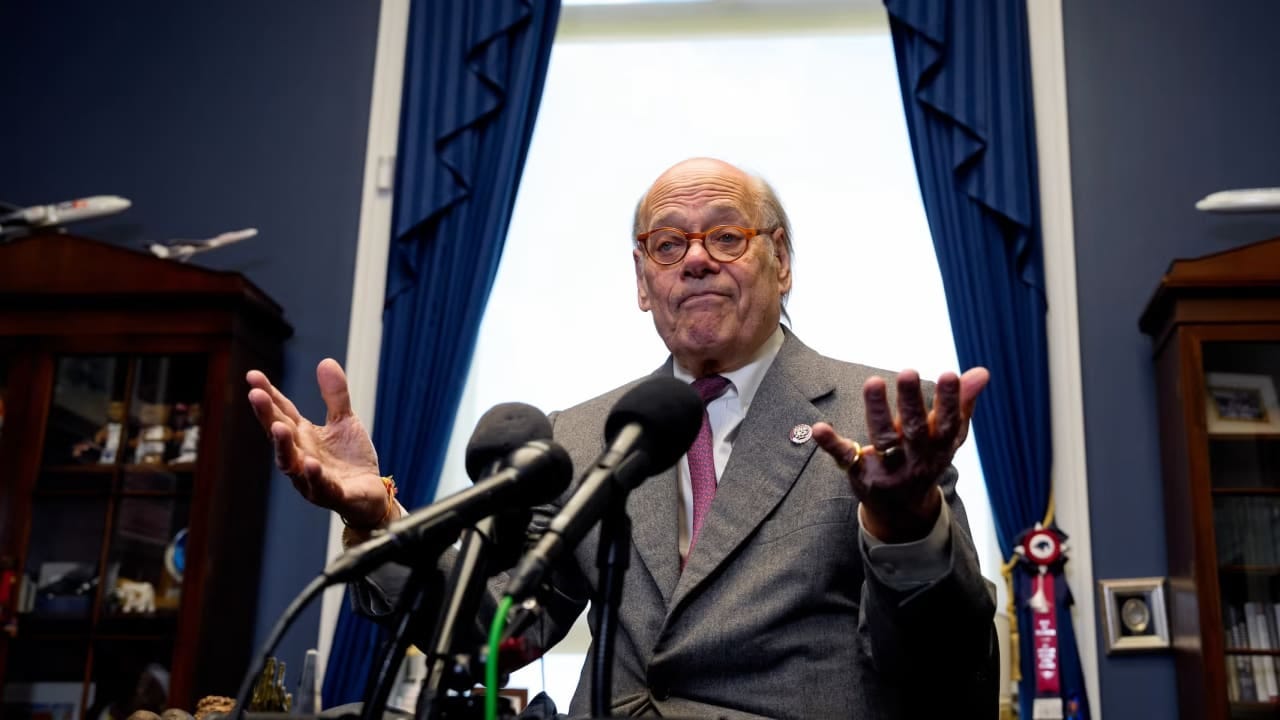
Steve Cohen reflects on Trump, impeachment and retirement from Congress
Why Melanie Stansbury attended the Alabama voting rights protests with her CBC colleagues
Schumer, Senate Dems cheer parliamentarian ruling against GOP $1B ballroom funding
Graves, Larsen unveil sweeping surface transportation bill
📬 Send me tips, scoops or just say hi: michael@onceuponahill.com
What paid subscribers are reading
In last night’s Sunset, I took readers inside the massive voting-rights demonstrations in Selma and Montgomery, where congressional Democrats and civil-rights leaders signaled they want the “All Roads Lead to the South” mobilization to become the foundation for a broader organizing push across the South ahead of the midterms. I spoke with Reps. Terri Sewell (D-Ala.), Shomari Figures (D-Ala.), Joyce Beatty (D-Ohio) and House Minority Leader Hakeem Jeffries (D-N.Y.) about the effort to build a modern-day “Freedom Summer” amid escalating redistricting battles and renewed fights over Black political representation. Still on the free plan? Upgrade your subscription for full access to this report and all future editions of Congress Nerd Sunset.
On the Floor
The House is out.
The Senate will meet at 3 p.m. and vote at 5:30 p.m. on a package of 49 Trump nominees, including U.S. attorneys and marshals, ambassadors, and assistant and undersecretaries.
The Moment
Stansbury: Expanding voting rights “is our generation’s battle”
One of the more notable dynamics from this weekend’s voting-rights demonstrations in Alabama was the number of non-Black Democrats from safe blue states who traveled to Selma and Montgomery in solidarity with Congressional Black Caucus members facing renewed Republican-led redistricting fights.
Rep. Melanie Stansbury (D-N.M.), whose state recently expanded voting protections, told me the demonstrations were about more than partisan politics or individual House seats.
“This fight is not about red or blue, it’s about the future of democracy and representation in America. The Supreme Court’s decision two weeks ago, I believe will ultimately be remembered as one of this country’s greatest mistakes and efforts to take this country backwards,” she said. “Which is why, myself and thousands from all over the country went to Montgomery and Selma yesterday to say: We are not going back!”
Stansbury described the prayer service at Selma’s historic Tabernacle Baptist Church as one of the most memorable moments of the day.
“One of the pastors said we can ‘feel the weariness of our battles’ and we may be ‘knocked down, but we are not knocked out,’” she recalled. “He noted that some would ‘rather destroy democracy itself than share it’ but that voter suppression and their efforts ‘will not have the final word.’”
By the afternoon, more than 80 organizations had gathered outside the Alabama State Capitol in Montgomery, in what organizers hope will become the beginning of a modern-day “Freedom Summer” organizing campaign centered on voting rights.
“The use of voting rights suppression as a tactic in their efforts to hold power shows just how far they’re willing to go,” Stansbury said. “I went to Selma and Montgomery, because the work never stopped, but I believe this is our generation’s battle.”
The Leadership Table
Schumer, Senate Dems cheer parliamentarian ruling against GOP $1B ballroom funding
Senate Majority Leader Chuck Schumer (D-N.Y.) and top Senate Democrats took a victory lap on Saturday evening after the Senate parliamentarian struck down Republicans’ first attempt to steer $1 billion toward security and infrastructure tied to President Donald Trump’s planned East Wing ballroom project.
The provision, included in the Judiciary Committee’s section of the GOP megabill, was ruled subject to the Byrd Rule because the project extended beyond the committee’s jurisdiction and would involve multiple federal agencies.
Schumer quickly seized on the ruling as evidence that Democrats can still inflict procedural pain on Republicans despite being in the minority, with ranking members and leadership aides aggressively scrutinizing the reconciliation package line by line during the ongoing Byrd Bath process.
The ballroom funding has become an especially potent messaging target for Democrats because of its optics, allowing them to contrast Republican efforts to fund Trump’s long-discussed White House expansion plans against broader economic anxieties facing voters.
Republicans are expected to rewrite the provision and try again. Democrats say they’re preparing for another fight if and when it returns.
Committee Watch
Graves, Larsen unveil sweeping surface transportation bill
House Transportation and Infrastructure Committee Chair Sam Graves (R-Mo.) and Ranking Member Rick Larsen (D-Wash.) released on Sunday the text of a bipartisan $580 billion, five-year surface transportation reauthorization bill that would steer federal funding toward highways, bridges, transit, rail and freight programs through 2031 while reshaping several Biden-era infrastructure initiatives.
The BUILD America 250 Act includes what the committee leaders describe as the largest-ever federal investment in bridges, creates the first federal framework for autonomous commercial motor vehicles and imposes new annual registration fees on electric and plug-in hybrid vehicles to shore up the Highway Trust Fund. The legislation would also repeal the Carbon Reduction Program and eliminate the formula component of the PROTECT resilience program, as part of a GOP push to refocus federal transportation policy on “core” infrastructure projects.
The Transportation Committee is expected to mark up the bill on Thursday as lawmakers race to enact a long-term reauthorization package before the current authorization expires on Sept. 30.

The Morning Bulletin
Steve Cohen on retirement, Trump and the breakup of Memphis
Rep. Steve Cohen (D-Tenn.) became the first House Democrat effectively pushed aside by the new wave of Southern redistricting when he announced on Friday morning he would retire after Republicans carved up his district in Tennessee’s aggressive post-Callais gerrymander.
Cohen’s current district was split among three Republican-held or Republican-favored seats represented or sought by Reps. Andy Ogles, David Kustoff and state Sen. Brent Taylor.
Asked what message he would give the trio of Republicans who could inherit many of his constituents, Cohen responded through the lens of what he sees as the erosion of Black political representation in Memphis.
“David knows the Republicans and the business interests in Memphis, but he has no knowledge of the African-American community and the inner city,” Cohen told me. “I don’t think I can tell him anything.”
Cohen reserved his warmest comments for Columbia Mayor Chaz Molder, the Democrat challenging Ogles in TN-05, whose own district was fractured under the new map.
“He’s a good candidate, he’s bright, he’s hard-working, and he may win the district,” Cohen said. “He’s told me he’ll make Memphis a priority.”
The congressman was far more caustic toward Ogles, dismissing the Tennessee Republican as someone “living his life till he gets convicted, and then he’ll get pardoned from Trump.”
Cohen said he only finalized his retirement decision in recent days, even after privately considering stepping aside earlier in the cycle.
“I had more people in Memphis come to me and urge me to run because they know how I’ve delivered community projects and the bridge,” he said, referring in part to his work securing federal infrastructure funding and constituent projects for the city.
Cohen initially planned to continue fighting in court after the legislature approved the new map.
“I responded because it was important for my city when all this came up,” he said. “I support the lawsuit, and I will run [if it succeeds], but I think my decision not to run was just in the last few days.”
The retirement closes the congressional career of one of the House Democratic Caucus’s earliest and loudest Trump antagonists, a role Cohen said he views as his defining contribution to public life.
“In the Congress, I think my constant vigilance over Donald Trump is what’s been most important,” Cohen said.
Cohen noted he introduced some of the first comprehensive articles of impeachment against Trump after the president’s response to the 2017 white supremacist rally in Charlottesville, Va.
“When I was watching Charlottesville, and I saw Trump say there were fine people on both sides, that was it,” Cohen said.
One of the moments Cohen still recalls most vividly involved the late civil rights icon and former Rep. John Lewis (D-Ga.) signing on to the impeachment effort during the final year of Lewis’ life.
“It was the only bill John Lewis got on his last year,” Cohen said. “The last time I went to him on it, he said, ‘You just tell [chief of staff] Michael [Collins], put me on.’”
Even on his way out, Cohen said he remains deeply alarmed by what he sees as Trump’s expanding use of presidential power, pointing to pardons, crypto ventures and tariff actions he argued Congress has failed to meaningfully confront.
“He considers the office to be his personal business,” Cohen said. “So he’s bringing about authoritarian government when the legislature acquiesces.”