

● ○ ○ ○ ○
👋🏾 Hi, hey, hello! It’s Thursday morning—Day 30 of the government shutdown and five away from the longest in American history. Depending on whom you talk to, the two parties are as close to or far away from reaching a deal to reopen the government as ever. I’m less skeptical that a breakthrough is as imminent as some lawmakers and aides would like us to believe. But I can’t remember the last time I’ve hoped I was more wrong about something than this.
The House has not voted in 41 days. It’s been 37 days since Rep.-elect Adelita Grijalva (D-Ariz.) won a special election to succeed her father. She still has not been sworn in and Speaker Mike Johnson (R-La.) says he will refuse to do so until the House is back in session—even though he’s the one who has canceled votes five weeks straight. No House member has ever gone as long as Grijalva without being administered the oath of office. The delay is but one of many signs of the times.
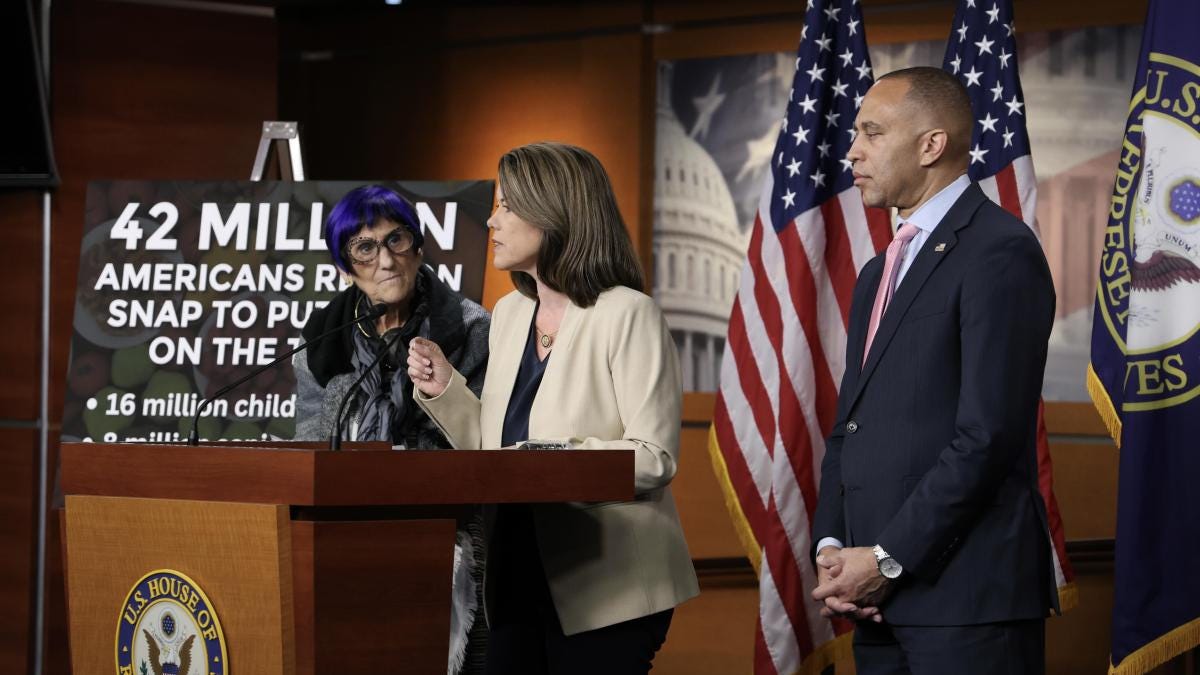
SNAP benefits will lapse on Saturday for the 42 million Americans who rely on the program to feed themselves and their families, unless the Trump administration taps a contingency fund of about $5 billion, which would cover more than half the cost of providing benefits for November. Open enrollment for the Affordable Care Act also begins on Saturday, when millions of Americans could learn their premiums for the upcoming year will skyrocket due to the expiration of the enhanced Affordable Care Act premium tax credits at the end of the year.
Remember the ACA premium subsidies are at the crux of this shutdown showdown. Democrats have demanded an extension of the tax credits as part of a bipartisan spending agreement to reopen the government. They’re also pushing for meaningful guardrails to prevent the Trump administration from clawing back funds for programs that are misaligned with its policy priorities. Republicans say they’re willing to discuss their proposals to address the high cost of health care once the lights are back on.
This is worth noting because it feels like the ACA has taken a backseat to SNAP this week—you could argue rightfully so!—after Democrats spent weeks hyper-focused on amplifying one of the few issues on which the American people trust them more than Republicans to solve. But I spilled a lot of ink on that dynamic in yesterday’s newsletter, so how about we focus on how President Donald Trump’s signature legislative achievement could worsen the SNAP cliff instead? More on that below. But not before a heaping helping of shutdown news and notes to bring you up to speed.
○ ● ○ ○ ○
House staffers received notice they won’t be getting paid on Friday, according to a memo from Chief Administration Officer Catherine Szpindor sent to employees on Wednesday that I obtained.
Szpindor explained that the Office of Payroll and Benefits lacks the authority to pay salaries until Congress passes a continuing resolution or full-year spending bill, delaying the October 31 paycheck until after funding is fully restored.
Health insurance, retirement and other benefits won’t be affected, but staff with automatic payments tied to their paychecks—such as rent, car payments or student loans—were advised to contact lenders directly. The memo said any missed pay will be issued as soon as possible once funding is enacted.
During previous shutdowns, some members of Congress have historically deferred their paychecks in solidarity with federal employees, congressional staff and Capitol Police officers who are furloughed or working without pay.
House Minority Leader Hakeem Jeffries (D-N.Y.) told reporters he would have more to say soon on whether he would follow suit and that he expects the issue will be discussed at the whip meeting later this morning.
I’m told Shalanda Young, who served as White House Office of Management and Budget Director during the Biden administration, will be among the guests at the meeting. Before her stint at OMB, she previously worked as the Democratic staff director of the House Appropriations Committee.
Senate Majority Leader John Thune (R-S.D.) told reporters on Wednesday that bipartisan conversations among rank-and-file members have increased significantly.
“Hopefully that’ll be a precursor of things to come,” he said. “But yeah, there’s a higher level of conversation.”
Thune floated the possibility that there could be enough moderate Democrats interested in these discussions to potentially break the logjam.
“I’m hopeful that something here very soon will be fruitful.”
Thune added that the intensity of the lower-level talks stems from Senate Democratic leadership operating from the outside, looking in.
“They just don’t have any room to maneuver, but there are a lot of rank-and-file members that continue to want to pursue solutions and be able to adreee the issues they care about, which is including health care, which, as I said [on the Senate floor], we’re willing to do,” Thune said. “But it obviously is contingent upon them opening up the government.”
He suggested on Wednesday morning that the Senate would vote on the House-passed continuing resolution for the 15th time today before adjourning for the weekend, unless he saw enough movement to justify keeping members in town.
“If the vote stays the same, I’m not sure that we get anywhere,” he said.
But the bill isn’t on the Senate schedule at press time.
What has also remained the same is Thune’s resistance to so-called rifle-shot bills that aim to fill targeted funding gaps for programs like SNAP or WIC or groups like air-traffic controllers.
“It begs the larger question: How long is this going to drag on? I think that the quickest way to end it is to just open everything up, and then everybody gets paid, and you’re not picking winners and losers or having to explain to this group why you open it up for this group,” he said. “I mean, that just doesn’t make any sense to me.”
Jeffries told me he and Johnson spoke briefly this week about the shutdown.
“I reiterated our position as it relates to a willingness to sit down to find a bipartisan path forward, that we were going to continue to support our hard working federal employees, who they’ve been victimizing since January 20, that we need to reopen the government, and we need to do it now, but we also need to address the Republican health care crisis.”
FWIW, the two leaders did not discuss the death threat against Jeffries that became public last week.
Meanwhile, the nonpartisan Congressional Budget Office released a fresh estimate on the cost of the current funding lapse in Washington.
According to a letter it released on Wednesday, if the standoff ends this week, the U.S. economy will incur roughly a $7 billion hit, rising to $11 billion if the government remains shuttered for six weeks and up to $14 billion for an eight-week shutdown.
The bulk of the damage comes from delayed federal pay, contracts and benefits, and a drop in private-sector demand. And while much of the quarterly loss may be recouped once services resume, a material portion is likely permanent. The CBO also flags that real GDP could dip by one to two percentage points in the fourth quarter of 2025 as a result.
On the polling front, Navigator’s latest survey finds most Americans unhappy with the state of the country and the ongoing shutdown, with 62 percent saying the nation is off on the wrong track and 57 percent disapproving of President Trump’s job performance.
Nearly eight in ten voters have heard about the shutdown, and a majority (47 percent) blame Trump and congressional Republicans, compared with 33 percent who fault Democrats. Concern is especially high about the fallout if the impasse continues—three in four worry about SNAP funding lapsing or health care costs rising—and most voters (64 percent) want Trump and Republicans to compromise to reopen the government.
Democrats continue to hold trust advantages on health care, affordability, and looking out for “people like me,” underscoring how the shutdown fight is reinforcing their strongest issue terrain.

○ ○ ★ ○ ○
At the same time, Democrats are sounding the alarm about the SNAP funding cliff, while states and recipients are preparing for expanded work-requirement verification under the One Big Beautiful Bill Act, which President Trump signed into law in July, with administrative enforcement beginning November 1.
This means recipients and state agencies could face dual administrative crises—one driven by lack of federal funding, the other by new federal red tape.
“This is a president and a Republican Party that is taking a battle as to the bedrock programs that millions of working Americans families rely on,” Sen. Cory Booker (D-N.J.), the number-four Senate Democrat and a member of the Senate Agriculture Committee, which has jurisdiction over SNAP, said in a brief interview. “They’ve already cut billions out of SNAP already. Now they’re putting onerous work requirements they even Republican states like West Virginia have said don’t work and actually cause people who are eligible to lose their the coverage that was intended by Congress.”
House Assistant Minority Leader Joe Neguse (D-Colo.) told me that the policies embedded in the OBBBA, including the SNAP cuts, have exacerbated the cost-of-living crisis that working families across the country are experiencing.
“In my view, it provides you with the answer to the question of why the Trump administration is deciding to violate the law by refusing to release these funds. We know why because they don’t support SNAP,” he said. “How do we know that? Because they cut SNAP earlier this year over the summer in the Republican reconciliation bill that the President signed into law to do what? Pay for billions of tax cuts for the richest Americans in our country and some of the biggest corporations.”
House Agriculture Committee Ranking Member Angie Craig (D-Minn.) said that the SNAP cuts and the Trump administration’s refusal to release the contingency funds are to drive people off the program.
“Millions of Americans are coming off of the SNAP program because they will not be able to overcome the barriers that this administration is putting in place,” she told me. “And it’s cruel.”
Republicans cut $186 billion in SNAP funding under the One Big Beautiful Bill Act by narrowing eligibility and tightening compliance, not by lowering benefit levels. (The average monthly SNAP benefit is $6 per day.) The law expands work and reporting requirements to nearly all able-bodied adults up to age 64, limits parental exemptions to households with children under 14 and eliminates prior carveouts for veterans, unhoused people and former foster youth.
It also makes it harder for states to waive those rules in high-unemployment areas. The Congressional Budget Office estimated that these changes would shrink SNAP enrollment over the next decade—producing the “savings” Republicans claim largely by forcing recipients off the rolls through new paperwork hurdles and stricter enforcement.
The new SNAP work requirements require states to begin enforcing expanded rules for able-bodied adults without dependents up to age 64. While the law technically took effect upon enactment, the USDA gave states until November 1 to update their systems and start tracking compliance with the 80-hour-per-month work, training or volunteer standard.
The first benefit losses for noncompliance could occur as soon as March 2026, but the November start date means new paperwork and verification requirements will arrive just as millions of households face the prospect of delayed or lapsed benefits due to the ongoing shutdown.
For several Democrats I spoke to for this story, the SNAP cuts and the administration’s unwillingness to use the contingency fund shouldn’t come as a surprise. Project 2025, the conservative policy document and recruitment database to reshape the federal government and consolidate executive power to advance right-wing priorities, advocated for stricter eligibility rules and reduced benefits to narrow the social safety net.
It calls for tightening work requirements for able-bodied adults without dependents, making it harder for states to waive them, and ending policies that broaden eligibility or modestly boost benefits, like “broad-based categorical eligibility” and the “heat-and-eat” provision. Project 2025 also proposes rolling back the 2021 update to the Thrifty Food Plan—which determines benefit levels—and moving SNAP’s oversight from USDA to HHS to consolidate welfare programs. The authors of the proposals argue they would promote self-sufficiency and reduce the size of the so-called welfare state, but critics warn they would sharply reduce participation, cut average benefits and deepen food insecurity.

○ ○ ○ ● ○
Democrats held several SNAP-focused events on Wednesday afternoon to publicly shame the Trump administration into tapping the contingency fund, including one press conference led by Sen. Bernie Sanders (I-Vt.) and colleagues and another hosted by Schumer to promote a standalone bill Sen. Ben Ray Luján (D-N.M.) sponsored to fund SNAP and WIC during the shutdown that more than half of the Senate Democratic Caucus signed on to.
Luján would later ask for unanimous consent to pass his legislation. But in a dramatic scene on the Senate floor, Thune objected to the request before lighting into Democrats for proposing piecemeal measures while repeatedly voting against the House-passed bill that would reopen the government through mid-November.
Rep. Melanie Stansbury (D-N.M.) introduced a bill in the House that would fund SNAP for the 2026 fiscal year and reimburse states and tribes for using their funds to cover the program in a shutdown.
The House Democratic Litigation and Response Task Force also met on Wednesday afternoon with attorneys general who earlier this week filed suit against the Trump administration, claiming in part that the suspension of SNAP benefits will inflict irreparable harm on millions of residents who rely on monthly benefits.
“So much of our work to push back against the unconstitutional and lawless actions of this administration has been in a court of law,” Neguse, who co-chairs the task force with House Judiciary Committee Jamie Raskin (D-Md.), told me ahead of the meeting. “And, as a result, the partnership and the ability to work with the attorneys general in different parts of the country, who have, of course, been pursuing various lawsuits to vindicate our Constitution, has been really important—as has the legal work that we’ve done in terms of articulating a position on behalf of House Democrats and the American people in a court of law.”
○ ○ ○ ○ ●
Finally, Speaker Johnson will be joined at his daily shutdown press conference this morning by the New York Republican congressional delegation.
The top three House Republicans previewed the attack lines the GOP New Yorkers will likely lob against Chuck Schumer and Hakeem Jeffries, both of whom Republicans blame for the shutdown and call New York City home. Republican leaders have seized on Jeffries’s statement last Friday expressing support for the Democratic ticket on New York City’s ballot, including Zohran Mamdani, the Democratic socialist who is the favorite to win in Tuesday’s general election, as proof that Mamdani is the new face of the Democratic Party.
“I think Chuck Schumer and Jeffries are irredeemable at this point,” Johnson told reporters on Wednesday. “I don’t think they’ll be able to tell Mamdani in New York and his disciples that they voted to open the government. I’ve given up on the leadership.”
House Majority Leader Steve Scalise (R-La.) invoked the 33-year-old Bernie Sanders- and Alexandria Ocasio-Cortez-endorsed New Yorker’s name as well.
“Maybe Chuck Schumer is waiting for Mamdani to let him know that he can open the government back up again,” he said.
And House Majority Whip Tom Emmer (R-Minn.) called Minneapolis mayoral candidate Omar Fateh the “Mamdani of the Midwest.”
Just as Democrats highlight MAGA hardliners like Marjorie Taylor Greene to define Republicans by their most extreme voices, Republicans are trying to cast Mamdani as emblematic of the entire Democratic Party to paint it as out of touch with mainstream voters. But Mamdani’s politics and profile reflect one progressive faction in New York City—not the national Democratic Party, which is largely led and defined, for better or worse, by figures like Schumer and Jeffries.
“They certainly are ‘irredeemable,’ these Republican extremists when it comes to actually standing up for the American up for the American people. Donald Trump and Republicans promised their core promise last year was to lower the high cost of living on Day One,” he said. “And we know that Republicans lied—stone-cold liars—to the American people when they promise to focus on addressing the high cost of living.”
Leader Thune told me he agreed with his House GOP colleagues that Mamdani was the new face of the Democratic Party.
“I think the question you guys all have to ask Chuck Schumer is if he’s gonna endorse him?“ he added.
Schumer did not respond when asked by CNN's Manu Raju whether he would vote for Mamdani in the general election.
“Look, the bottom line is very simple,” Schumer said. “I have a good relationship with him and we’re continuing to talk.”
As for whether Schumer’s decision not to formally support Mamdani’s candidacy ahead of Tuesday’s election reflects a rift between the two top congressional Democrats—proud Brooklynites in their own right?
“No,” Jeffries said.