


THE LINEUP
Senate Republicans left themselves a September squeeze
Netanyahu rejects Trump-backed Gaza plan
Cortez Masto targets construction worker suicide
Dems face two more Midwest tests
South Carolina GOP to pick Graham successor
THE LEAD
👋🏾 HI, HEY, HELLO! Welcome back to Congress Nerd Sunday. I hope your weekend was everything for you.
A Capitol Hill vacuum legend dies: RIP to Beth, the beloved nearly 50-year-old Hoover vacuum cleaner owned by 92-year-old Sen. Chuck Grassley (R-Iowa), who became an unlikely social media star thanks to Grassley’s annual holiday posts. In a eulogy on X, Grassley announced that Beth had finally broken down after dangerous electrical sparks signaled the end. Need proof Beth had a fan base? She even earned a New York Times obituary.
Case easily turns back progressive challenge: Rep. Ed Case (D-Hawaii) defeated state Sen. Jarrett Keohokalole by more than 20 points in Saturday’s Democratic primary, a decisive win for the 73-year-old Blue Dog co-chair over a younger progressive challenger who argued the safely Democratic district needed generational change. Case leaned on his seniority and perch on the House Appropriations Committee to make the case that his experience translates into influence and federal resources for Hawaii. The result offers a counterpoint to recent progressive victories elsewhere: Democratic voters may be hungry for change, but Case showed that incumbency and an argument centered on delivering for the district can still be potent defenses against an ideological challenge.
Senate GOP’s September legislative squeeze: Senate Republicans left Washington on Saturday morning having checked several major items off their pre-recess list.
They passed a Russia sanctions package, confirmed 74 of President Donald Trump’s nominees and Todd Blanche as attorney general, and approved a stopgap spending bill to keep the government funded through Dec. 11.
But some of the hardest work remains unfinished.
Republicans postponed votes on a budget resolution needed to unlock a third reconciliation package, the CLARITY Act to regulate cryptocurrency markets and the bipartisan Protect College Sports Act. All three are expected back on the agenda when senators return Sept. 14, leaving GOP leaders to navigate unresolved policy and political disputes during an abbreviated pre-midterm stretch when floor time will be increasingly scarce.
The budget resolution may be the most consequential punt.
Senate Republicans spent roughly two hours Friday discussing the measure before deciding they could not be certain it would pass.
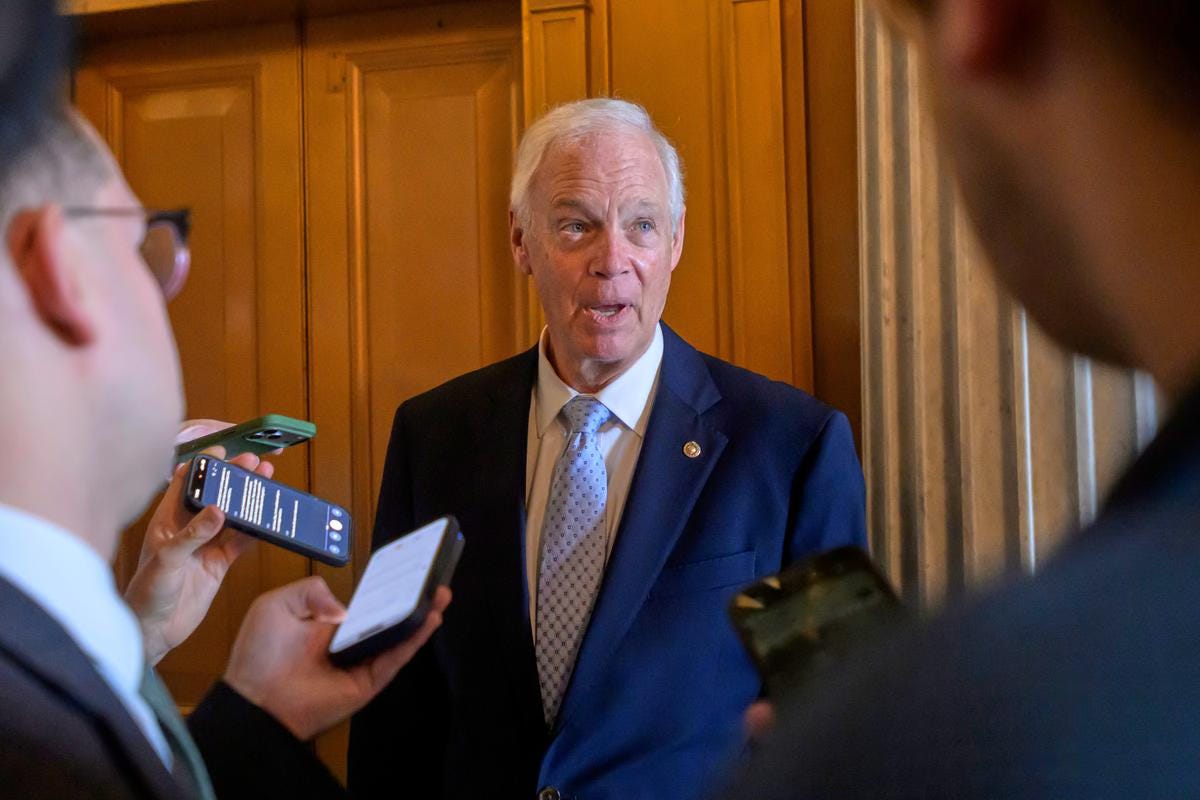
“There was concern whether or not I could actually pass the budget resolution tonight,” Senate Budget Committee Chair Ron Johnson (R-Wis.) told reporters after the meeting.
Johnson said senators also questioned whether the $60 billion proposal in the House-passed blueprint provided enough money for the military. Republican senators then spoke with Trump, who agreed they should forgo a Friday vote and spend the coming weeks developing what Johnson called “a better budget reconciliation bill.”
That decision buys Republicans time to resolve their differences, but it also concentrates the risk.
The resolution would set the parameters for a third reconciliation bill Republicans want to use to increase defense spending, assist farmers hurt by Trump’s tariffs and trade war and fund voter-ID provisions associated with the SAVE America Act. Any Senate changes to the House-passed resolution would require another House vote before committees could finish writing the underlying legislation.
Republicans also left the CLARITY Act unfinished amid disputes over illicit-finance protections and ethics restrictions governing public officials’ crypto holdings. The Senate is expected to hold a test vote Sept. 15 on beginning debate.
The Protect College Sports Act faces its own coalition-management problem. The bipartisan legislation would establish a national framework for college athletics and name, image and likeness rules. Still, supporters have yet to assemble the votes needed to move it through the Senate due to opposition from the Congressional Black Caucus and organized labor and conservatives who feel like the legislation preempts state laws in more than half of the country that ban trans athletes from participating in women’s sports. Leaders nevertheless expect to revisit the measure next month.
The September pileup matters because Republicans have traded one deadline for several overlapping ones.
Senators return with only weeks before lawmakers turn increasingly toward the November midterms (Congress is scheduled to be out of session all of October). The crypto and college-sports bills require bipartisan cooperation. Reconciliation requires Republicans to keep their own conference together. And the Senate still has nominations and other legislative business competing for limited floor time.
Republicans insist the unfinished business is delayed, not dead. Johnson said the conference and Trump were aligned on continuing the reconciliation effort and would work through August and September to assemble a stronger package.
But Sen. Mike Lee (R-Utah) was unusually candid about another piece of the GOP agenda that remains unresolved: the SAVE America Act.
“Would it have been better if we had passed the SAVE America [Act] already? Absolutely,” Lee said. “Would it be better if we had the votes right now to pass it? Yes.”
Republicans, he added, “for a variety of reasons, don’t have the wherewithal [or] capacity right now.”
The extra negotiating time could help Republicans find the votes they were missing on Friday. But September leaves little margin for another delay.
🔓 The Sunday edition is free. But if you want Once Upon a Hill in your inbox each evening, upgrade your subscription for full access to every edition and the complete archive. Whether you’re taking the votes, writing the bills, running the campaigns, shaping the message or trying to influence any of the above, Congress Nerd Daily helps you see around corners before everyone else catches up.
THE POWERS THAT BE
Netanyahu rejects Trump-backed Gaza plan: Israeli Prime Minister Benjamin Netanyahu said Sunday that Israel does not accept the 15-point ceasefire plan proposed by President Trump’s Board of Peace and would make no further withdrawal from Gaza until Hamas is fully disarmed. The rejection exposes a key disagreement over sequencing: The Trump-backed framework links Israeli withdrawals to progress on disarmament, while Netanyahu is insisting Hamas surrender all its weapons first. Netanyahu said Israel is discussing the issue with the U.S. and that some American proposals are unacceptable, adding that his government is prepared to “stand our ground, even against our best friends when necessary.” The dispute tests whether Trump can persuade one of his closest allies to accept the terms of his Gaza peace initiative without jeopardizing the broader ceasefire.
📬 The best stories often start with a conversation. If you’ve got insight, context or something others are missing, my inbox is open. Send me tips, scoops or just say hi: michael@onceuponahill.com.
THE POLICY DESK
Cortez Masto targets construction worker suicide: Sen. Catherine Cortez Masto (D-Nev.) introduced legislation directing the CDC to study suicide risk factors among construction workers—including financial stability, substance and alcohol use and access to health coverage and workplace benefits—to inform future prevention programs. The bill, cosponsored by five Senate Democrats, would also require HHS to recommend policies to Congress. Cortez Masto’s office says construction accounted for nearly one-fifth of suicides with a reported industry in 2023 despite employing about 7% of the U.S. workforce.

THE TRAIL
Dems to face two more Midwest tests: Democratic voters in Minnesota and Wisconsin will head to the polls on Tuesday for a pair of primaries that could offer the clearest indication yet of whether Abdul El-Sayed’s upset victory in Michigan last week was an isolated result or part of a broader shift toward the party’s progressive wing.
In Minnesota, Lt. Gov. Peggy Flanagan and Rep. Angie Craig are the leading candidates to succeed retiring Sen. Tina Smith. Flanagan, the DFL-endorsed candidate, has consolidated support from progressives and much of organized labor, while Craig has pitched her record of repeatedly winning a competitive House district as evidence she is better positioned for a general election. The closing stretch has featured Flanagan attacking Craig over her vote for the Laken Riley Act and Craig tying Flanagan to fraud scandals under Gov. Tim Walz’s administration. Recent polling has shown Flanagan ahead, though surveys have varied considerably.
The stakes are similarly ideological in Wisconsin, where state Rep. Francesca Hong, a democratic socialist, enters Tuesday as the polling leader in the four-way Democratic primary to succeed retiring Gov. Tony Evers. Milwaukee County Executive David Crowley has emerged as Hong’s principal rival after briefly dropping out of the race last month and later reentering with Evers’s endorsement. Former Evers administration official Joel Brennan and state Sen. Kelda Roys round out the field.
Hong has argued Democrats can win the battleground state by expanding the electorate with an unabashedly progressive economic message. Crowley is making a more traditional electability case and has benefited from a late fundraising surge as Democratic establishment support consolidated around him. The winner is expected to face Republican Rep. Tom Tiffany in November.
Flanagan and Hong victories, coming less than a week after El-Sayed defeated Rep. Haley Stevens, would give progressives three major Upper Midwest primary wins in six days—and much stronger evidence that Democratic voters are rethinking what electability looks like heading into November.
SC GOP to pick Graham successor: Republicans in South Carolina will vote this Tuesday in a special Senate primary to choose their nominee to succeed the late Sen. Lindsey Graham, with appointed Sen. Darline Graham, Reps. Ralph Norman and Russell Fry, and former Gov. Mark Sanford among the nine candidates competing for the nomination.
President Trump and the NRSC are backing Graham, whom Gov. Henry McMaster appointed to temporarily fill her brother’s seat after his death last month. Graham has never previously run for elected office, making the primary an early test of whether Trump’s endorsement and the Graham name can consolidate a fractured Republican field around her.
A candidate must win more than 50 percent Tuesday to avoid an Aug. 25 runoff. If no one does, the top two finishers will advance, putting particular attention on Graham’s share of the vote and the contest among Norman, Fry and Sanford to emerge as her potential challenger. The Republican nominee will face Democrat Annie Andrews in November.