

👋🏾 Hi, hey, hello! Welcome back to Congress Nerd Sunday. I hope your weekend was everything for you.
Before we get into this week’s news, I want to express my solidarity with my colleagues at CNN, MS NOW and Politico, whose journalists were barred from the White House this weekend after President Donald Trump announced they would be banned over coverage he dislikes. Reporters from all three outlets were turned away Saturday, and officials confiscated their credentials.
Access to the White House—or any institution of government—cannot depend on whether the people in power approve of the journalism produced there. The reporters affected are colleagues doing the same work so many of us come to Washington to do: asking questions, gathering facts and helping the public understand what its government is doing. I stand with them and with every journalist’s right to do that work without fear of government retaliation.
FIRST THINGS FIRST
Senate negotiators will return to Washington this week with a bipartisan permitting reform deal tantalizingly close—but an increasingly unforgiving floor calendar could determine whether they can turn it into law before the midterms.
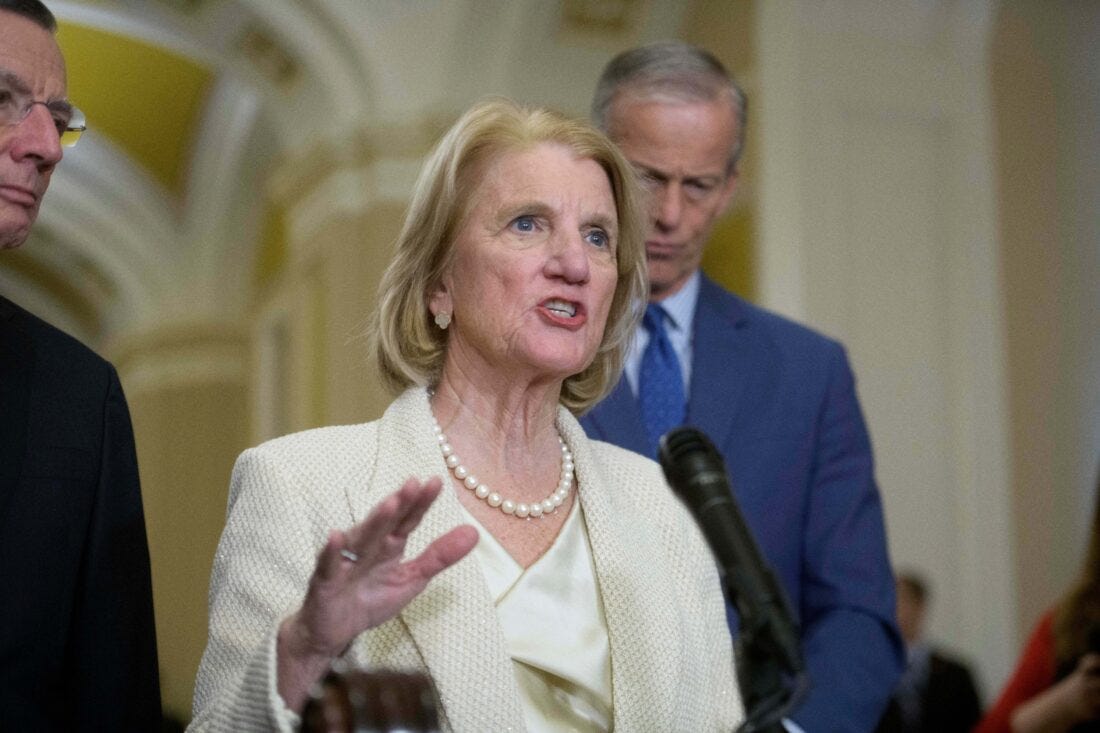
Senate Environment and Public Works Chair Shelley Moore Capito (R-W.Va.) and Ranking Member Sheldon Whitehouse (D-R.I.), along with Energy and Natural Resources Chair Mike Lee (R-Utah) and Ranking Member Martin Heinrich (D-N.M.), have spent months trying to reach an agreement to speed federal approval of energy and infrastructure projects.
Capito said last Thursday that negotiators were “still pushing to try to get permit squeezed in here at the end.” A day later, she told Semafor she was optimistic but that a deal had to “pop out” within 48 hours. Whitehouse wouldn’t rule out that timeline.
That window passed this weekend without the negotiators publicly announcing a deal or releasing legislative text.
The challenge now extends beyond whether the four senators can close their remaining differences. The Protect College Sports Act is the Senate’s pending legislative business, with Majority Leader John Thune (R-S.D.) filing cloture last Thursday on both a Cruz-Cantwell substitute and the underlying bill. The Senate does not return until Tuesday afternoon.
College sports could consume much of the week unless senators strike an agreement to move faster. Sen. Chris Murphy (D-Conn.), an opponent of the bill, has said Democrats could potentially agree to move faster in exchange for amendment votes.
That competition for floor time was already apparent when Capito spoke with reporters before the Senate adjourned last week. Immediately after she said she was trying to squeeze permitting in, a reporter noted that the college-sports debate would take up much of the following week.
And the closer senators get to the midterms, the greater the pressure to get out of Washington and back home to campaign.
What’s in the deal: Permitting reform is Washington shorthand for an effort to make it faster and more predictable to build major energy and infrastructure projects that can require years of federal environmental review, agency approvals and litigation.
The emerging Senate negotiations span more than the National Environmental Policy Act and are expected to touch other federal environmental laws, transmission infrastructure and judicial review. Republicans have long sought faster approval for pipelines, mines and other energy projects, while Democrats increasingly see permitting and transmission reform as necessary to build clean-energy generation and move electricity around the country.
The surge in power demand from AI and data centers has heightened the urgency of the issue.
Asked Thursday whether the negotiations could address data centers, Capito said permitting “definitely will have impacts on data centers” when she was asked last week whether the negotiations could address data centers has added urgency to the issue and referenced ongoing conversations around the Ratepayer Protection Act—the House-passed bill intended to prevent households and small businesses from absorbing infrastructure costs created by large data centers.
Heinrich blocked an attempt by Sen. Jon Husted (R-Ohio) to pass that bill by unanimous consent Thursday. Instead, he sought passage of his own GRID Savings Act, which would give the Federal Energy Regulatory Commission greater authority over large-load interconnections. Sen. Bernie Moreno (R-Ohio) objected.
Thune has left open the possibility of a roll-call vote on the Husted bill but said its prospects depend in part on how quickly the Senate gets through college sports and whether the permitting agreement comes together.
A deal still needs a destination: Even a Senate agreement would leave another problem: The House has already left Washington until after the midterms.
Whitehouse wants Thune, Speaker Mike Johnson (R-La.) and the White House to establish a bicameral path for any agreement, arguing there is little value in making difficult compromises in the Senate without knowing when the House would take them up.
That leaves negotiators confronting three clocks at once: reaching a substantive agreement, finding Senate floor time behind the college-sports bill and securing a path through a House that has already gone home.
Capito’s optimism has not disappeared. But after her weekend target came and went, the question heading into Tuesday is no longer simply whether the four negotiators can strike a deal.
It’s whether they can strike one while there is still time to do something with it.
🔓 The Sunday edition is free. But if you want Once Upon a Hill in your inbox each evening, upgrade your subscription for full access to every edition and the complete archive. Whether you’re taking the votes, writing the bills, running the campaigns, shaping the message or trying to influence any of the above, Congress Nerd Daily helps you see around corners before everyone else catches up.
IN THE KNOW
Sen. Chuck Grassley (R-Iowa) is pressing President Trump to halt U.S. diesel exports as prices squeeze farmers, escalating this morning by accusing “Big Oil” of prioritizing profits from foreign sales.
Democratic Senate nominee Josh Turek, who proposed an export embargo as part of his fuel-price plan last week, seized on Grassley’s call to pressure GOP nominee Rep. Ashley Hinson (R-Iowa) to take a position.
Xi comes to Washington: Chinese President Xi Jinping arrives in Washington this week for the first Chinese presidential state visit to the U.S. since 2015 and his second summit with President Trump this year. The visit will test whether the two leaders can turn their recent push for a more stable relationship into durable agreements, with trade and tariffs, China’s rare-earth exports, AI, Taiwan and the Iran war all expected to figure into Thursday’s White House talks. The summit comes as lawmakers continue to press a more confrontational approach to Beijing on technology, supply chains, human rights and national security—a tension that could sharpen if Trump offers concessions to secure economic commitments from Xi.
Unga takes over NYC: World leaders will descend on New York this week for the United Nations General Assembly’s annual high-level gathering, with President Trump set to address the General Assembly on Tuesday as wars involving Iran and Ukraine, the future of Gaza and growing questions over artificial intelligence crowd the diplomatic agenda. Much of the action will happen away from the podium: Trump is expected to meet with Gulf leaders as the administration navigates the war with Iran, while foreign leaders use the gathering for a dense slate of bilateral meetings and negotiations.
Related: New York City Mayor Zohran Mamdani’s office announced that he will host Trump at Gracie Mansion on Monday while the president is in New York for UNGA. The mayor’s office says the discussion will focus broadly on issues affecting New York City. Neither side has released a detailed agenda or meeting time.
Overton in the HELP hot seat: The Senate HELP Committee will hold a confirmation hearing on Thursday morning for Dr. Heidi Overton, President Trump’s nominee to lead the FDA. Overton, a physician and deputy director of the White House Domestic Policy Council, has helped shape the administration’s health agenda and stood alongside Trump and HHS Secretary Robert F. Kennedy Jr. when the president signed an August order to overhaul the childhood vaccine schedule. If confirmed, she would take over an agency that has faced significant staff losses and contentious fights over vaccines, drug approvals and abortion-pill access since former Commissioner Marty Makary resigned in May. The hearing starts at 10:30 a.m. in Dirksen 430.
Ghost students: Before the Overton hearing, HELP will take up a bipartisan bill from Sens. Ashley Moody (R-Fla.) and Maggie Hassan (D-N.H.) to crack down on scammers who use fake or stolen identities to apply for federal student aid. The bill would require ED to screen FAFSA applications for suspected identity fraud and colleges to verify flagged applicants before disbursing aid. The House passed its version, led by Rep. Burgess Owens (R-Utah), in June.
Flock under the microscope: The Senate Judiciary Crime and Counterterrorism Subcommittee will turn its attention on Wednesday to Flock Safety’s sprawling network of AI-powered license-plate readers, amid growing scrutiny of how the technology lets law enforcement track Americans’ movements across jurisdictions. Chair Josh Hawley (R-Mo.) has invited the CEOs of Flock, Axon, Motorola Solutions and Verkada as lawmakers wrestle with the tradeoff between a tool police credit with helping solve crimes and concerns about warrantless searches, data sharing and potential misuse. Flock says its customers control access to their data and searches are auditable, while Hawley says the company operates more than 120,000 cameras across 49 states. The hearing starts at 2:30 p.m.
Manchin to talk debt in Dallas: Former Sen. Joe Manchin will be back in the congressional spotlight tomorrow on one of his signature issues: the national debt. The West Virginia centrist will headline a House Budget Committee field hearing at Old Parkland in Dallas to examine the case for a bipartisan fiscal commission, an idea Manchin championed in the Senate. Two former OMB directors’ll join him with deep congressional résumés: Leon Panetta, a former House Budget chair, and former Sen. Rob Portman (R-Ohio).
Also on the agenda: Senate Judiciary will hold a Wednesday morning hearing on women’s sports, while the Aging Committee examines efforts to boost domestic generic-drug manufacturing. Behind closed doors, Senate Foreign Relations will receive an update on U.S. efforts to combat wrongful detentions, and the Armed Services Cybersecurity Subcommittee will hear from Pentagon and Cyber Command officials on cyber readiness and election security. SASC members return to the secure room Thursday for an update on the Pentagon budget.
» President Trump told Fox News he is in “deciding mode” over the nearly seven-month Iran war and said “very big things” could happen soon.
He described his choices as further military escalation, continuing economic pressure or negotiating a deal. The comments follow his early return from Camp David and heightened U.S. security alerts across the Middle East.
Trump also said he would “probably be open” to meeting Iranian President Masoud Pezeshkian during U.N. General Assembly week, making this both an escalation signal and a possible diplomatic opening. (There is no confirmed Trump-Pezeshkian meeting at this point.)
» The administration has abandoned its appeal of a federal ruling that blocked it from withholding money for the Gateway/Hudson Tunnel and other New York-New Jersey infrastructure projects, leaving the lower-court loss intact.
The dispute grew out of the administration’s attempt to halt federal funding already committed to the projects. Dropping the appeal does not create new funding, but it removes one avenue the administration used to defend its effort to stop previously approved money from flowing.
» United States Southern Command says a U.S. joint task force struck a “go-fast” vessel Saturday along a Caribbean trafficking route, killing four people. SOUTHCOM says intelligence confirmed the vessel was involved in narcotics trafficking, but it has not publicly released that intelligence or evidence that drugs were aboard.
This was the 69th known boat strike since the administration began the campaign roughly a year ago, with at least 231 people killed. The administration maintains the U.S. is in an armed conflict with cartels; the campaign has also begun expanding toward joint operations on land with regional partners.
📬 The best stories often start with a conversation. If you’ve got insight, context or something others are missing, my inbox is open. Send me tips, scoops or just say hi: michael@onceuponahill.com.

READ ALL ABOUT IT
— “Jon Ossoff is doing something different” by Elaine Godfrey: “What does that mean for 2028?”
— “AI PACs have dumped nearly $1 million into an obscure Senate race” by Hugo Lowell: “The reliably Republican South Dakota Senate seat has an incumbent on the ballot. But PACs associated with AI labs and investors have already spent more money on the race than actual residents have.”
— “Private equity’s next target is indie music” by Michaelangelo Matos: “For years, PE firms have snatched up the catalogs of music’s biggest names. Now they’re after independent labels—and concern is growing.”