


FIRST THINGS FIRST
Louisiana Republicans’ effort to redraw the state’s congressional map after the Supreme Court’s Callais decision has raised the possibility that the Congressional Black Caucus’s next potential chair may not be around to lead the group after the November midterms.
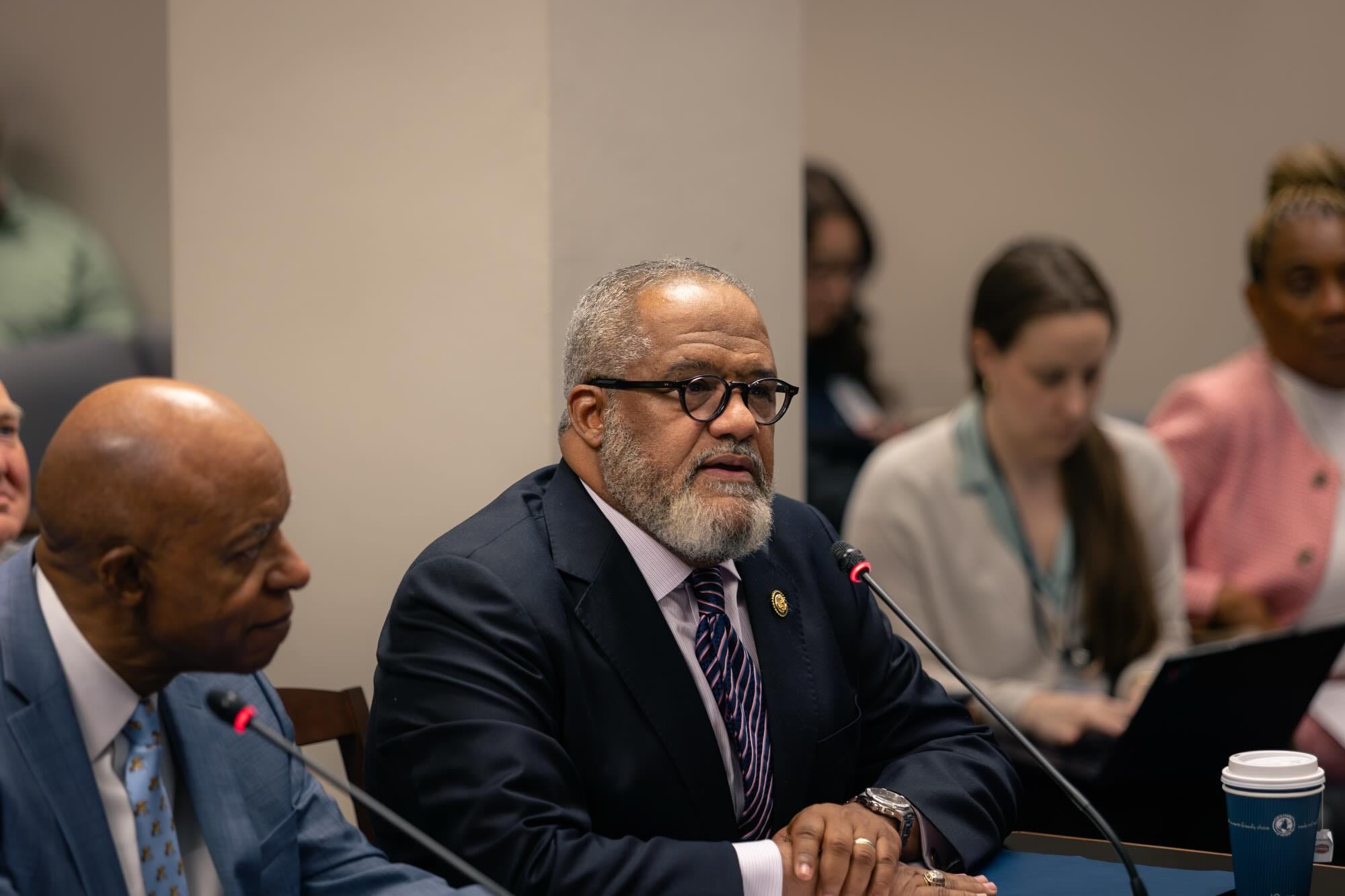
Rep. Troy Carter (D-La.), the current first vice chair who is next in line to succeed Rep. Yvette Clarke (D-N.Y.) next Congress under the caucus’s traditional leadership ladder, is facing growing uncertainty as Louisiana Republicans explore new congressional maps that could dismantle one of the state’s two majority-Black districts in the wake of the Supreme Court’s recent voting-rights ruling. Several CBC members told me they would support Carter for the chairmanship if he remains in Congress.
Carter argued the fight over Louisiana’s congressional map is also a fight over the kind of leadership emerging inside the CBC and the broader House Democratic caucus.
“It’s clear that they’ve identified people who are not going to fall for the okie doke and they’ve recognized that our brand of leadership is a strong one and that we come prepared,” he told me in an interview on Tuesday evening. “So maybe we are too strong for their liking, maybe we are too outspoken for their liking, maybe we are too polished for their liking, maybe we have demonstrated a level of no-quit, you-can’t-bullshit-us kind of quality, and that’s threatening to them.”
Still, Carter said the CBC’s leadership bench extends beyond any one member or election cycle.
“But I will tell you this: Rather it me, [House Minority Leader Hakeem [Jeffries (D-N.Y.)] or anybody else, we’re training up new members to do just the same,” he said. “You can knock any of us down, the next one is going to come just as strong.”
Carter arrived in Congress in 2021 after winning the special election to replace former Rep. Cedric Richmond (D-La.), who left Capitol Hill to join former President Joe Biden’s White House. Before coming to Washington, Carter spent years in the Louisiana legislature and on the New Orleans City Council, building deep ties across the state’s Black political establishment now mobilizing against the GOP’s redistricting push.
After the Supreme Court’s decision in Louisiana v. Callais, Louisiana Republicans moved almost immediately to revisit the state’s congressional map.
Gov. Jeff Landry delayed Louisiana’s congressional primaries to give lawmakers time to redraw the maps after the Supreme Court ruling, a move Democrats and voting-rights groups argue has injected chaos into the election calendar and intensified accusations that the process is being rushed to capitalize on the Court’s decision before legal challenges can catch up.
The current proposals being floated in Baton Rouge could eliminate one or both of Louisiana’s majority-Black congressional districts, including Carter’s New Orleans-based seat and the Baton Rouge-to-Shreveport district held by Rep. Cleo Fields (D-La.).
Under the current map, Carter’s district is majority-Black and heavily Democratic. Republicans now appear to be exploring maps that would either crack up New Orleans and merge parts of Carter’s district into white Republican seats or preserve Carter while dismantling Fields’ district, depending on which configuration produces the safest overall GOP advantage.
There’s also growing speculation that Republicans may decide it’s politically cleaner to target Fields rather than Carter because New Orleans’ Black political infrastructure is harder to split cleanly without generating significant backlash and litigation risk. Fields publicly said this week he would not run against Carter regardless of which new maps emerge to avoid a member-vs-member Democratic primary if Republicans collapse the state back toward a 5R-1D map.
Over the weekend and into this week, Carter convened a large voting-rights town hall at Dillard University in New Orleans alongside local elected officials, clergy and civil-rights advocates.
Before these events, he made an appeal to the better angels of the state lawmakers with whom he had previously served.
“And as I said, they got a tough job to do, tough decisions to make, but not because of right or wrong, but because of the forces of evil that’s pushing [the new maps],” he told me. “So my position was very clear: ‘Listen, man, step out of this and do what’s right. Do what’s right because I’ve seen you do it before.”
👋🏾 Hi, hey, hello! Good Wednesday morning. Thank you for waking up with Congress Nerd Sunrise.
🗓️ The House will vote at 2:45 p.m. and 5:30 p.m. on several measures, including legislation to allow year-round sales for E15 fuel and resolutions expressing support for law enforcement officers, rejecting antisemitism and calling for the release of political prisoners in China.
The Senate will vote at 11:30 a.m. on an Iran War Powers Resolution and legislation to block senators from being paid during a government shutdown. The Senate will vote at 2 p.m. to confirm Kevin Warsh to be Chair of the Federal Reserve. Additional votes expected.
The House Judiciary Subcommittee on Constitution and Limited Government will hold a hearing on why political Islam and Sharia law are incompatible with the US Constitution.
The Senate Judiciary Subcommittee on Privacy, Technology and the Law will hold a hearing on the need for federal action in light of recent social media verdicts.
The Senate Aging Committee will hold a hearing on supporting families in the Sandwich Generation.
House Republicans and Democrats will hold their weekly conference and caucus meetings at 9 a.m. Republican leadership will hold a post-meeting press conference at 10 a.m. at the Republican National Committee. House Democratic Caucus Chair Pete Aguilar (D-Calif.) and Vice Chair Ted Lieu (D-Calif.)
Sens. Jeff Merkley (D-Ore.) and Tim Kaine (D-Va.) will meet with reporters at 9 a.m. on their war powers resolution.
Rep. Steve Cohen (D-Tenn.) will hold a press conference at 10 a.m. on federal marijuana policy.
📬 Send me tips, scoops or just say hi:michael@onceuponahill.com
OVERSIGHT
New Jersey Dems introduce ICE oversight bill one year after Delaney Hall visit
Reps. LaMonica McIver (D-N.J.), Bonnie Watson Coleman (D-N.J.) and Rob Menendez (D-N.J.) introduced legislation Tuesday that would guarantee members of Congress immediate access to immigration detention facilities without advance notice as part of their oversight responsibilities while holding private contractors liable for noncompliance.
The measure would codify Congress’s authority to conduct oversight of ICE and DHS facilities, a power lawmakers argue already exists through Congress’s constitutional oversight role and a 2019 appropriations rider.
As I reported in Tuesday evening’s Sunset, it comes as Republicans are racing to keep President Trump’s immigration-and-border reconciliation package on track for floor consideration before the Memorial Day recess ahead of Trump’s self-imposed June 1 deadline.
Menendez argued Republicans should have to account for how the Department of Homeland Security has spent taxpayer dollars before Congress approves additional immigration enforcement funding through reconciliation, particularly after Democrats spent months demanding policy changes during the record-long DHS shutdown.
He accused Republicans of applying a double standard by citing waste, fraud and abuse to justify roughly $1 trillion in proposed health care cuts in their first reconciliation bill last summer while resisting comparable scrutiny of DHS ICE spending under former Secretary Kristi Noem. He said lawmakers should conduct a full audit of the department’s spending and enforcement activities before approving more funding outside the normal appropriations process.
“That should be the conversations Republicans should want to have, instead of just adding $70 billion to the slush fund that’s literally killing Americans,” he told me. “But you know, Republicans just will not hold this administration accountable or even do what’s right by their own communities and what’s right by the taxpayers.”
Menendez also said Democrats’ demands during the DHS funding fight centered on what he described as basic guardrails that had previously limited immigration enforcement activities at sensitive locations such as schools, hospitals and places of worship before the Trump administration rolled them back. He pointed to recent incidents in his district, including two constituents who he said were detained outside a church in Jersey City, as evidence of why Democrats pushed for the restrictions to be restored.
“So the reforms are things that would bring us to a place that is in a better place than we’ve seen previously,” he said.
The trio’s new bill comes one year after their visit to Delaney Hall, which later prompted the Trump administration to charge McIver with allegedly “forcibly impeding and interfering with federal officers.” She faces up to 17 years in prison if convicted.