

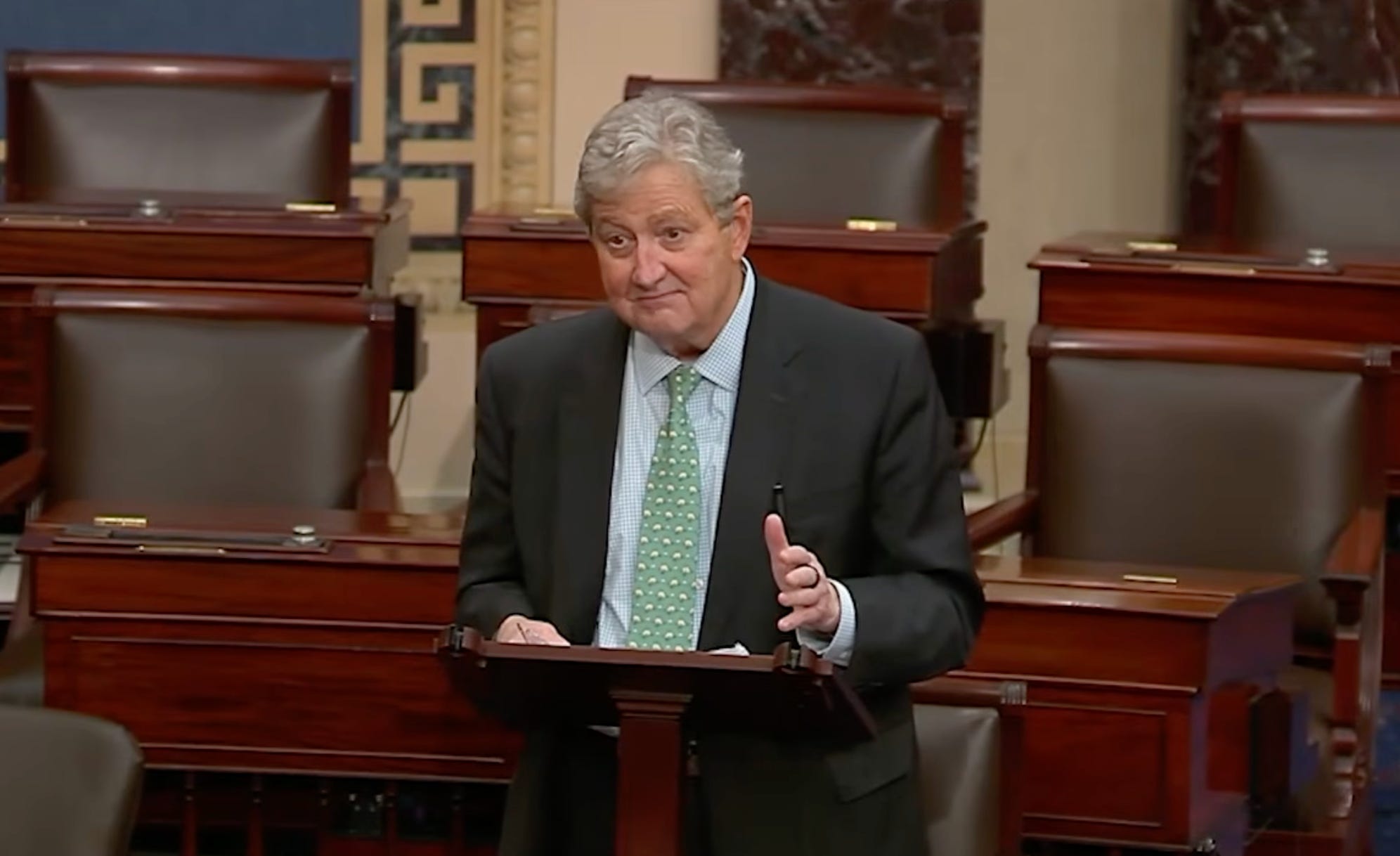

Sen. John Kennedy (R-La.) has been visibly annoyed lately.
He’s expressed frustration with House Republicans for failing to pass the Senate’s version of a sweeping housing bill aimed at increasing supply and lowering rents and mortgage costs.
He’s also complained that the current immigration-and-border-security reconciliation bill wasn’t expanded to address broader affordability and cost-of-living concerns.
But the folksy Louisianan scored a significant win this week when the Senate passed his bill by voice vote to withhold senators’ pay during a government shutdown by placing their salaries in escrow until funding is restored.
“I asked him to do it, and he did it,” Kennedy said of Senate Majority Leader John Thune (R-S.D.), who controls the Senate floor. “And I think he’s a fine American for doing it.”
Thune said Kennedy had been pushing for a vote on the measure for some time and that he committed to bringing it up during negotiations over the budget resolution for the GOP reconciliation bill now under consideration.
“The reason we were in the shutdown is because a lot of Democrat senators put us there, and the reason we’re having to use reconciliation is because they refuse to do certain appropriation bills,” Thune said. “And if this, passing this and applying it to senators, maybe we’ll provide an additional incentive to keep Senate Democrats in the future from shutting the government down again.” (FWIW, Democrats counter that the shutdown fight centered on demands for changes to federal immigration enforcement practices after two U.S. citizens were killed during federal operations in Minneapolis earlier this year.)
Kennedy’s measure seeks to address the politically toxic reality that lawmakers continue collecting paychecks while many federal workers go unpaid during funding lapses.
Still, the practical impact on many senators may be limited. Congress is filled with wealthy lawmakers who can absorb delayed paychecks far more easily than those typically hit hardest during shutdowns.
The bill applies only to the Senate. It remains unclear whether the House will pursue a similar measure for its members.
House Minority Leader Hakeem Jeffries (D-N.Y.) told me earlier this week he was unfamiliar with the bill but would review it and follow up. He later told reporters Thursday that the House should “absolutely” take a close look at withholding member pay during funding lapses.
The bill’s passage marks the second time in recent weeks the Senate has moved to police itself and set an example for the House.
Last month, senators voted unanimously to ban themselves and their staff from trading on prediction markets. Rep. Ashley Hinson (R-Iowa) introduced legislation last week that would extend the Senate’s prediction-market ban to the House, adding momentum to a bipartisan push to prevent lawmakers and government officials from profiting off politically sensitive information.
As I reported at the time, a Jeffries spokesperson told me he broadly supports the bipartisan effort and is reviewing the Senate measure with House Administration Committee Ranking Member Joe Morelle (D-N.Y.). The White House declined to say whether President Donald Trump believes the ban should also apply to the executive branch.
👋🏾 Hi, hey, hello! Thank you for reading Congress Nerd Sunrise. Keep reading for news and notes on the day ahead and what you may have missed over the past 24 hours:
— On and around the Hill • The House is in this morning for a 9:45 a.m. vote on the FY27 Military Construction and Veterans Affairs funding bill.
The Senate is out.
President Trump is on his way back to America from his two-day summit in Beijing with Chinese President Xi Jinping.
— What paid subscribers are reading • In Thursday evening’s Congress Nerd Sunset, I took readers inside House Democrats’ closed-door strategy session on the growing Republican-led redistricting onslaught across the South, where party leaders and rank-and-file members signaled they no longer see the current political moment as business as usual. The piece explains the party’s expanding election protection, litigation and anti-gerrymandering strategy ahead of the midterms, as well as its limitations heading into November. Upgrade your subscription to get access to this and all future evening editions.
— ICYMI • I joined this week’s episode of Punchbowl News’ “Fly Out Day” alongside co-founders Anna Palmer, Jake Sherman and John Bresnahan after Congressional Black Caucus Chair Yvette Clarke (D-N.Y.) sat down with Jake and Anna to discuss the GOP-led redistricting fights reshaping the South ahead of the midterms. We talked through why Black Democrats see the post-Callais map wars as an existential threat to representation, the political implications for House control and what both parties are signaling about the next phase of the battle. Watch the episode on Punchbowl’s YouTube channel.
— Democrats celebrate AAPI political power • I stopped by Ceil Capitol Hill last night, where the AAPI Victory Fund celebrated a decade of Asian Pacific American Heritage Month and uplifted the growing influence of AAPI voters and elected officials across the country.
The event drew a sizable contingent of Democratic lawmakers, including Sen. Tammy Duckworth (D-Ill.), Andy Kim (D-N.J.), Chris Van Hollen (D-Md.) and Reps. Judy Chu (D-Calif.), Mark Takano (D-Calif.), Ted Lieu (D-Calif.), Dave Min (D-Calif.), Shri Thanedar (D-Mich.), Derek Tran (D-Calif.), Raja Krishnamoorthi (D-Calif.), Ro Khanna (D-Calif.), Jimmy Gomez (D-Calif.), Marilyn Strickland (D-Wash.), Ami Bera (D-Calif.) and Suhas Subramanyam (D-Va.), alongside elected officials, labor leaders, advocacy groups, donors, media figures and political operatives.
The gathering highlighted how AAPI political organizing has evolved from a niche investment into a major force in competitive elections. Organizers pointed to fast-growing AAPI electorates in battleground districts and states, including Arizona, Michigan, California, New Jersey, Texas and Alaska, as evidence that campaigns can no longer afford to treat those voters as an afterthought.
AAPI Victory Fund officials also emphasized the group’s continued focus on in-language outreach, voter contact and long-term organizing infrastructure ahead of the midterms.

— GOP immigration package hits Byrd Rule snags • Senate Democrats claimed an early procedural victory on Thursday night after the Senate parliamentarian advised that several provisions in Republicans’ immigration-and-border package would likely be subject to the Senate’s 60-vote threshold under the Byrd Rule.
The disputed provisions are part of the Senate Homeland Security and Governmental Affairs Committee’s title of the reconciliation bill, which would provide nearly $70 billion in additional funding for Immigration and Customs Enforcement and Customs and Border Protection.
The rulings emerged from the Senate’s ongoing “Byrd Bath” process, during which the parliamentarian reviews whether reconciliation provisions comply with the chamber’s strict budget rules. Under federal budget law, provisions deemed primarily policy-related rather than budgetary can be stripped from the bill unless 60 senators vote to keep them.
According to Democrats, the parliamentarian raised concerns that portions of the package extended beyond the committee’s jurisdiction, attempted to use reconciliation funding to replace traditional appropriations and included immigration-processing provisions tied to longstanding protections for migrant children.
The rulings do not kill the broader ICE and border funding package outright, but Republicans will likely need to rewrite or narrow the affected sections to preserve the bill’s simple-majority pathway.
Senate Budget Committee Ranking Member Jeff Merkley (D-Ore.) and Senate Minority Leader Chuck Schumer (D-N.Y.) both cited the rulings as evidence Democrats can still slow or reshape portions of the GOP package despite being in the minority.
The Byrd Bath for the Judiciary Committee’s title of the reconciliation bill is expected to begin today. It includes the controversial $1 billion proposal for security enhancements tied to President Trump’s East Wing ballroom project.
— SCOTUS preserves access to abortion pill • The Supreme Court on Thursday temporarily preserved nationwide access to mifepristone through mail delivery and pharmacy dispensing, blocking a lower-court ruling that would have immediately reinstated in-person dispensing requirements for the abortion pill.
The unsigned order stays a May 1 decision from the 5th Circuit Court of Appeals while litigation continues, handing abortion-rights advocates and drug manufacturers a short-term victory in one of the most closely watched post-DOB legal fights.
Justices Clarence Thomas and Samuel Alito dissented.
In a lengthy dissent, Alito accused the court of enabling efforts to undermine states that restrict abortion and argued Louisiana was justified in challenging Food and Drug Administration rules allowing mifepristone to be dispensed without an in-person visit.
Thomas separately argued that federal law, including the Comstock Act, bars the mailing of abortion drugs and said manufacturers should not receive emergency relief to protect profits tied to what he described as unlawful activity.
The case centers on a Louisiana-led challenge to FDA changes made in 2021 and 2023 that expanded access to medication abortion by mail after the Supreme Court overturned Roe v. Wade in 2022.
📬 Send me tips, scoops or just say hi: michael@onceuponahill.com. I hope you enjoy your weekend.