

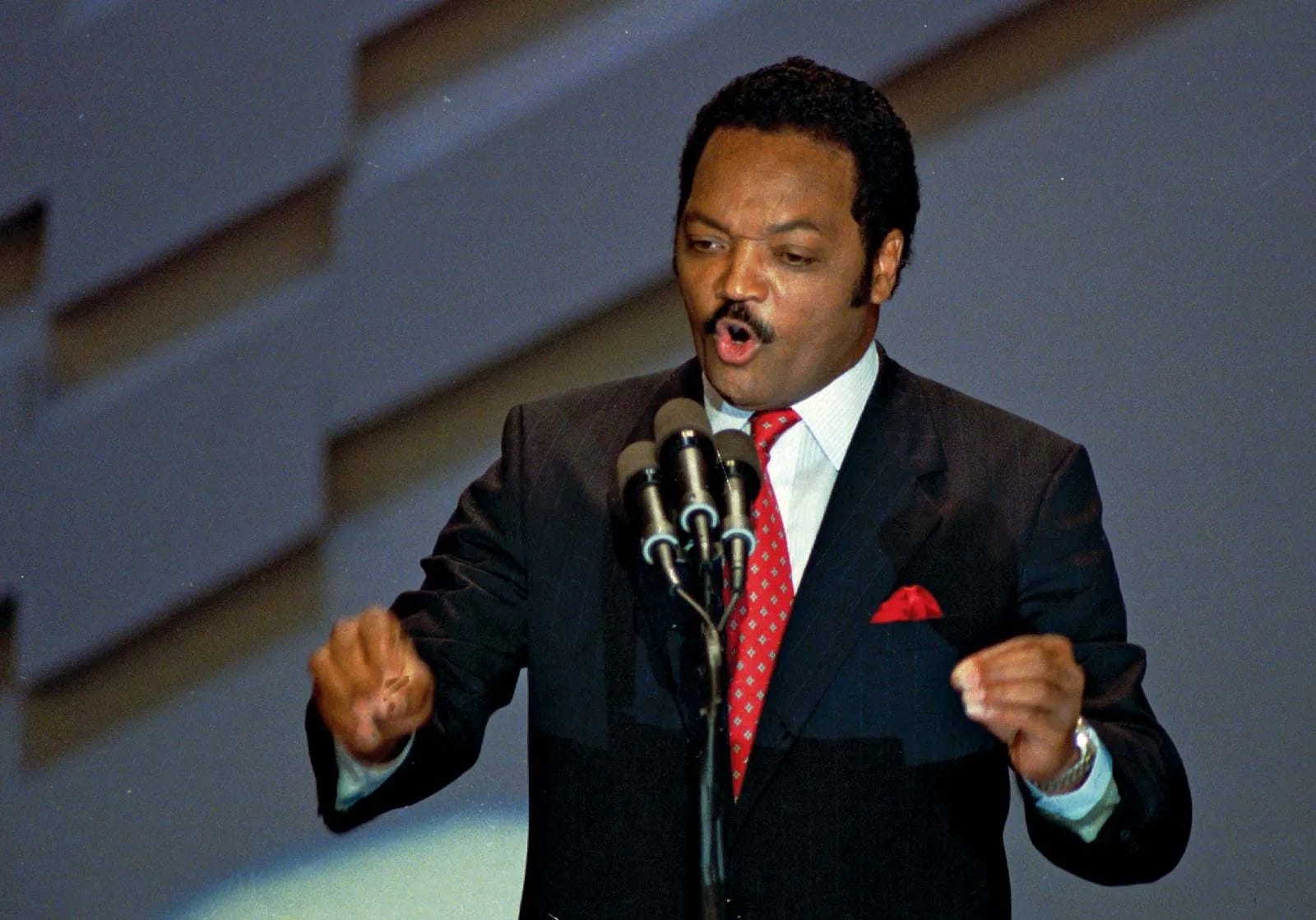

The family of Rev. Jesse Jackson this morning announced his death at 84 years old, triggering a rolling wave of tributes from Democratic leaders, civil rights organizations, labor advocates and ‘80s-era allies who came up in and around Jackson’s movement for economic and social justice.
Jackson leaves behind a legacy as the bridge between the civil rights movement and modern primary politics, which treated coalition-building as both a moral project and an electoral strategy. His organization’s pressure campaigns foreshadowed today’s fights against corporate rollbacks of diversity, equity, and inclusion, for labor and community partnerships, and for the argument that civil rights and economic rights are intertwined.
He embodied a kind of public, explicitly moral politics that feels rarer in a hyper-polarized, algorithmic-driven era. And though Jackson never held elected office, he still shaped elections, agendas and talent pipelines—a reminder that impact doesn’t always require titles.
“Rev. Jackson always centered human dignity, and he reminded us that change is not inevitable,” Sen. Raphael Warnock (D-Ga.) told reporters this afternoon. “It requires persistence. You have to be courageous. You have to be relentless, and you have to build the kind of coalition that’s necessary to move all of us forward.”
Warnock said that while the country is grieving Jackson’s death, his moral voice endures and is urgently needed at a time when democratic norms and voting rights are under threat. The Georgia Democrat pointed to what he described as the Trump administration’s seizure of ballots in Fulton County and the presence of undertrained ICE officers policing communities and said Jackson’s example remains a guide for ensuring every child has a fair shot and that democracy works for everyone.
“His voice is now silenced,” Warnock added. “But his example is eternal—and that work is left to us.”
Jackson’s surviving loved ones include Rep. Jonathan Jackson (D-Ill.), wife Jackie, daughter Santita and former Rep. Jesse Jackson Jr., who is currently running for the seat he held for nearly 17 years before resigning in 2012 for campaign finance violations.
Born in the segregated South, Jackson joined the civil rights movement as a student, marching in Selma and becoming a part of the late Dr. Martin Luther King Jr.’s circle through the Southern Christian Leadership Conference.
Jackson would go on to found Operation PUSH in 1971, a nonprofit organization focused on economic empowerment, corporate pressure, jobs, education, and civil rights advocacy. The National Rainbow Coalition emerged in the 80s, before the organizations merged into the Chicago-based Rainbow PUSH Coalition in 1996.
Jackson burnished his national profile with two presidential runs that expanded the electorate, trained a generation of organizers and strategists, and pushed the party left on poverty, voting rights, and social spending—even though he never actually won the nomination.
The first campaign in 1984 helped prove that a Black candidate could build a national coalition within a major party, not just make a symbolic bid. Four years later, Jackson built a better campaign infrastructure and carried the credibility he earned from his third-place finish the prior cycle, improving to second place in 1988 and cementing himself in Democratic National Convention lore with his famous “Keep Hope Alive” moment. His elite skills as a political orator—bolstered by slogans like “I am Somebody”—provided spiritually rooted politicians like Obama and Warnock with a template for creating change that was equal parts preacher, candidate, and movement translator.
Warnock, who was a student at Morehouse College when Jackson delivered his 1988 DNC speech, described it as the “gold standard” that “changed American politics forever.”
“In that moment, he channeled the moral sensibilities and vocabulary and spiritual power of the Black church onto the national stage and created the kind of multiracial coalition that propelled him forward and made someone like Barack Obama possible and someone like Sen. Raphael Warnock—he made me possible through the work that he did all of those decades ago,” Warnock said.
Jackson announced he was diagnosed with Parkinson’s disease in 2017, which he had been living with since 2015. Last April, Jackson was diagnosed with Progressive Supranuclear Palsy (PSP), a rare degenerative brain disorder that gradually affects a person’s balance, movement, vision and speech, and worsens over time.
In a statement on his Truth Social app, President Donald Trump called Jackson a “good man,” praised his “grit” and “street smarts,” and extended condolences to his family. Trump also leveraged Jackson’s death to defend himself against decades-long accusations of racism based on his proximity to the civil rights icon before he entered presidential politics. The president also made several ill-timed, self-serving claims, including that he provided Jackson and Rainbow Coalition with office space in the Financial District of Manhattan, New York City, the 2018 First Step Act was a response to Jackson’s request for criminal justice reform, and that Jackson credited Trump for the investments in HBCUs and so-called opportunity zones during the president’s first term.
Former President Joe Biden’s statement centered on Jackson’s moral leadership and movement work while invoking themes of equality and unfinished business. He described Jackson as “a man of God and of the people” and emphasized Jackson’s role in helping to redeem the “soul of our Nation,” the classic Bidenism from the former president’s 2020 campaign and subsequent term in office.
“Reverend Jackson believed in his bones the promise of America: that we are all created equal in the image of God and deserve to be treated equally throughout our lives,” Biden added. “While we’ve never fully lived up to that promise, he dedicated his life to ensuring we never fully walked away from it either.”
Former President Obama said former First Lady Michelle Obama was exposed to political organizing at the Jackson’s kitchen table when she was a teenager and credited Jackson’s two historic presidential campaigns as trailblazers for his own.
“Michelle and I will always be grateful for Jesse’s life of service and the friendship our families share,” Obama said in a statement. “We stood on his shoulders.”
In addition to preaching about political power, Warnock said Jackson inspired Black leaders and the Democratic Party alike to reimagine it. By broadening what was politically possible, even when it meant pushing back against allies, Jackson helped awaken a generation to their collective strength. And Warnock argued that the backlash playing out today—particularly on voting rights—reflects that same recognition of Black political influence by those who would roll it back.
“I owe it to Rev. Jackson—and we owe it to the next generation— to pass voting rights and to ensure that we level the playing field so that every voice is heard in our democracy,” Warnock said. “Because that’s how we get to the right public policy.”