

First Things First
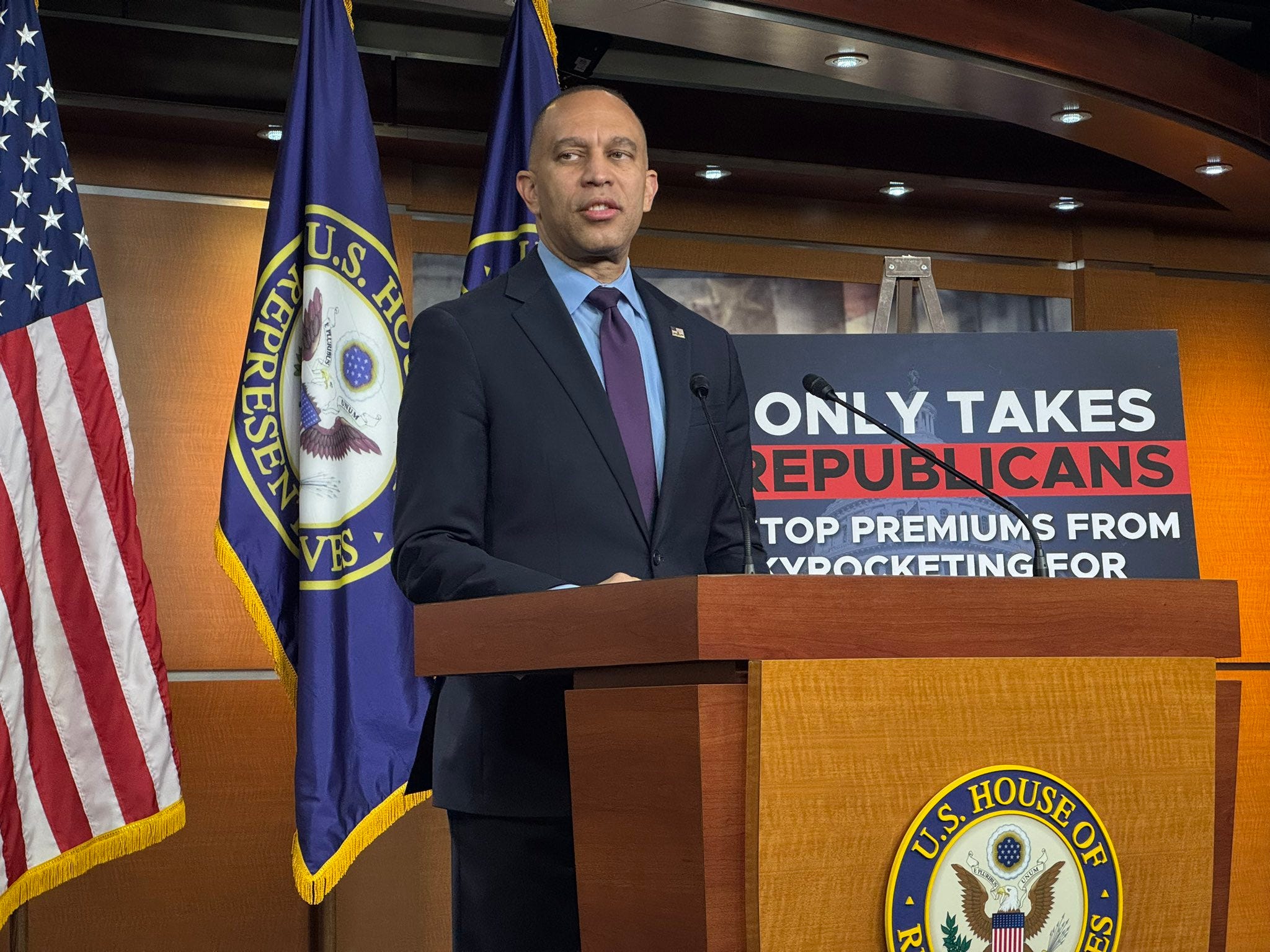
House Minority Leader Hakeem Jeffries (D-N.Y.) announced on Tuesday morning the launch of a new group of Democrats who will meet throughout 2026 and develop policy expertise on artificial intelligence.
The House Democratic Commission on AI and the Innovation Economy will work closely with technologists, industry groups and the committees that actually shape tech policy. Jeffries tapped Caucus Vice Chair Ted Lieu (D-Calif.) to co-chair the effort with Reps. Josh Gottheimer (D-N.J.) and Valerie Foushee (D-N.C.), while Zoe Lofgren (D-Calif.) and Frank Pallone (D-N.J.)—the top Democrats on the Science and Energy and Commerce committees—will serve as ex officio co-chairs.
The group will begin work in a moment when AI is advancing faster than the capacity to govern it, creating a widening gap between technological power and public policy. Congress has created multiple AI task forces and produced several reports over the past two years, but none have resulted in legislation. And when placed under scrutiny, Congress’s approach to AI mirrors its approach to social-media governance more than lawmakers would like to admit.
Jeffries told me the commission was necessary because House Republicans had abdicated their responsibility to act on the recommendations outlined in a bipartisan task force report he and House Speaker Mike Johnson (R-La.) established last Congress.
“The year has ended,” Jeffries told me. “There’s no interest from the other side of the aisle in actually doing something meaningful in this space, engaging meaningfully with experts and academics and stakeholders all across the country so we can do something thoughtful.”
In addition to the bipartisan task force, a bipartisan Senate working group released a roadmap for AI policy following months of discussion, hundreds of stakeholder meetings and nine first-of-their-kind forums with experts, academics and advocates. Sen. Mark Kelly (D-Ariz.) in September introduced AI for America, a plan that establishes an AI Horizon Fund fueled by contributions from leading AI companies to provide the resources needed to reinvest in workers, infrastructure, and responsible deployment.
I’m told by a source familiar with the commission’s formation that it’s an effort to avoid repeating the social-media failure cycle by building substantive expertise early. But unless leadership commits to concrete legislative goals, deadlines, and committee pathways, the commission risks becoming another thoughtful body with no statutory output.
Related: House Foreign Affairs Committee Ranking Member Gregory Meeks (D-N.Y.) blasted the Trump administration’s decision to allow American-based technology company Nvidia to sell advanced semiconductor chips to China.
“This unilateral concession to China will accelerate China’s AI industry, giving away America’s technological edge to the very companies trying to evade U.S. export controls. This decision reeks of corruption,” Meeks said in a statement. “Export control decisions must be made based on national security, not solely on the whims of the president and the offer coming from the highest bidder.”
Advanced semiconductors are the fuel for training powerful AI models. For the past two years, Washington has treated chip export controls as a core national-security tool to slow China’s ability to develop cutting-edge AI systems and preserve U.S. leverage. The administration is effectively changing the balance of that strategy by loosening those controls.
