

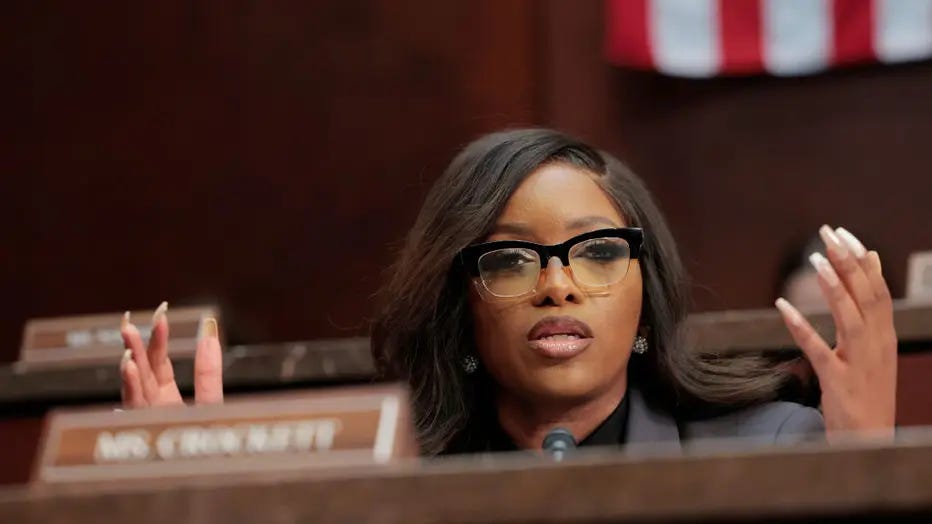
Long before Rep. Jasmine Crockett started polling a possible Senate run, she was standing on an Austin tarmac in 2021 as one of the Texas Democrats who bolted to Washington in a last-ditch attempt to stop their state’s voting restrictions. The showdown catapulted her into national politics and sharpened her conviction that federal voting protections were the only backstop when states rolled them back.
Those bills later collapsed in the Senate and Crockett hasn’t forgotten it. Now, as she edges closer to entering the 2026 race, she says the same issue that launched her career is pulling her toward the chamber where it stalled.
“We wouldn’t be dealing with mid-decade redistricting right now. We wouldn’t be dealing with the fact that Elon [Musk] purchased an election if those two bills had passed,” the second-term Dallas congresswoman said during an extended conversation outside the House floor on Monday evening. “Because in general, if you are going to try to finish work in the House, you need a Senate that can get it done. And frankly, voting rights, to me, is what’s most important.”
Crockett pointed to a combination of factors that inspire her belief that she could do what no Democrat has done since 1988: Win a U.S. Senate seat in Texas.
“My name ID is extremely high. I think that the party right now is looking for a kind of youthful energy, and they imagine me that way, even though I’m older than most people think I am,” the 44-year-old said. “I think it’s people knowing that nobody is telling me what to say because there would never be a consultant that would tell me to say half the things that I say. And I think people appreciate authenticity.”
But she also made no illusion about the extent of the uphill climb she’d be undertaking if she does, in fact, run.
“This comes down to execution. We’re just now kind of trying to re-establish our Democratic Party within the state. It’s not really organized, and it’s tough to win that way. So to me, there has to be another way to kind of win. Like, the numbers are great, but how do you make the numbers a reality? And so for me, it’s just a matter of can we build it out?”
Crockett has spent the past few days poring over internal polling she commissioned to gauge her viability. She spoke with the other two leading Democratic candidates—former Rep. Colin Allred who was the nominee last year in a failed challenge to Sen. Ted Cruz and state Rep. James Talarico, whose star has risen since August when he was one of 51 members of the Texas House who left the state to delay the passage of new congressional maps—to share the results of the data.
She declined to share it with Once Upon a Hill, but said she decisively leads in every category and would release the polling publicly if her team advised her to do so. A Talarico spokesperson declined to comment. The Allred campaign did not respond to a request for comment.
Rather than wait for the Texas Democratic Party to modernize itself, Crockett has been sketching out the kind of parallel campaign infrastructure she thinks a statewide Democrat would need to win. As she envisions it, a winning operation is built outside the traditional apparatus and modeled on the independent machines that powered candidates like Beto O’Rourke and Barack Obama. (Ironically, O’Rourke also lost his challenge to Cruz, but Obama remains deeply popular among Democrats nearly a decade post-presidency.) The core question isn’t whether the political environment is favorable, but whether she can assemble a campaign strong enough to turn promising numbers into actual votes.
To answer that question, she has been on the phone with people who’ve run unconventional statewide efforts. Stacey Abrams was one of her first calls, not just as a former state legislator who engineered a nationalized turnout operation in Georgia, but as a Black woman who understands what it takes to build political power from the outside in. (Abrams lost her two bids to be the Peach State’s governor.) She also intended to seek counsel from the late Bishop Reginald Jackson, a key figure in Georgia’s organizing ecosystem, before his death last week.
Crockett has widened the aperture well beyond Georgia. As she’s traveled the country campaigning for Democratic groups, candidates and causes, she has used those relationships to quietly gauge whether political leaders in other states would help her build an operation that Texas Democrats can’t on their own.
“I’ve been in your states. I’ve helped your states out,” she has told them. “Are you willing to help out?” She says the reception has been “fantastic.”
And she isn’t thinking only about her own race.
Crockett has begun encouraging potential candidates for lieutenant governor and attorney general, aiming to assemble a statewide slate that could expand the electorate and share resources. She declined to name names, but she confirmed she’s looking at contenders with strong fundraising networks or the ability to self-finance. She has also consulted Maryland Sen. Angela Alsobrooks and soon plans to connect with Lisa Blunt Rochester of Delaware, the other Black woman senator.

In just three years on Capitol Hill, Crockett has carved out one of the fastest ascents in modern Democratic politics, transforming from the hand-picked successor of the legendary late Eddie Bernice Johnson into a nationally recognized voice on civil rights, oversight and the party’s moral argument against Trump-era governance. She arrived in Washington with a built-in profile from that voting-rights standoff in the Texas Legislature, but supporters tell me it’s been her relentlessness in committee rooms—from grilling witnesses in Oversight and Judiciary to sparring with Republicans eager to make her a foil to mastering the modern viral moment—that has kept her in the spotlight. She’s become a fixture on cable news, a sought-after surrogate for Democrats across the country and a prolific fundraiser with a devoted small-dollar base.
Still, she’s been in the minority in both of her terms, which means she’s been unable to advance her policy priorities with legislation since Republicans control the floor. And despite the undeniable grassroots and online enthusiasm she garners, it hasn’t always translated into support from her colleagues. She has lost two internal elections since last April—first, to lead the House Democrats’ policy and messaging arm and then to serve as the top Democrat on the House Oversight Committee, following the death of former Ranking Member Gerry Connolly earlier this year.
Crockett has also paid a personal and political price for her profile. She has been the target of death threats and now travels with security both in Washington and in her North Texas district. And while many Democrats admire her fearlessness, some in competitive districts say her high-octane style and viral prominence can make their own reelection fights harder as Republicans try to tether them to a brand of progressive politics that doesn’t always play well in swing seats.
To remain ascendant within the halls of Congress, Crockett would have to topple a statewide heavyweight in Sen. John Cornyn, who is seeking a fifth term to continue a two-decade career that has included running Senate Republicans’ campaign arm, serving as the party’s chief vote counter during former President Trump’s first term and a senior seat on the powerful Senate Judiciary Committee.
Cornyn has issues of his own, though. He has been under fire from the MAGA base ever since he helped enact the Bipartisan Safer Communities Act—the most significant gun reform law in three decades—in 2023, months after the Uvalde school shooting. The RINO label has stuck enough to give Texas Attorney General Ken Paxton an opening to exploit the far right’s skepticism that Cornyn is a relic of a bygone era. And in his pursuit of Trump’s endorsement to survive the primary, Cornyn risks alienating the suburban and moderate voters he would need to win a fifth term in November.
Crockett seemed to empathize with her senator’s political reality while reiterating that she and Cornyn have an amiable relationship.
“I think it is a shame that that kind of takes him down in his primary. I don’t think that there’s any harm that becomes me because I’ve worked across the aisle and worked on things such as fentanyl legislation with Senator Cornyn, worked on food security issues with Senator Cornyn,” she said. “People don’t look at that and think that’s a bad thing on my side of the aisle. But in his primary, these are the kind of attacks that they’re making on him is that ‘Oh, you worked with Crockett,’ which is insane. I am one of his members, and frankly, if I were to run for the Senate and to be successful, I would work with all the members.”
Cornyn projected confidence in his candidacy when I caught up with him earlier today to ask about Crockett’s potential.
“Well, if she’s the Democratic nominee, she said I’ll win the election,” he told me. “I think she’s right on that.” (Crockett said last month that she did not think a Democrat could beat John Cornyn in a general election in what she described to me as an acknowledgment of the structural challenges Texas Democrats face statewide.)
“If I become the nominee, I plan to win, period—no matter who is the nominee on the other side,” she said.
A spokesperson for the Paxton campaign did not respond to a request for comment.

Several Democratic members of Texas’s congressional delegation said Crockett’s entrance would reshape and likely intensify the primary.
Rep. Sylvia Garcia told me that Crockett would bring the energy the race needed.
“I just think there would be a lot more excitement. A lot more energy, especially for some of our younger voters, which we need to come over and vote,” she said. “So I think she changes the dynamics and makes it a more exciting race.”
Rep. Julie Johnson, who is backing Talarico, served with Crockett in the state house and praised her political talent.
“Jasmine would bring an incredible energy to that race,” she said. “Texas needs a robust primary like that. It’s a race that will get Democrats really excited and people excited to come out and vote. We have three very talented, very experienced legislators who would all make great senators. It’s a choice of riches, and it’s a great problem for Texas Democrats.”
Rep. Lizzie Fletcher, an Allred supporter, said Democrats will be competitive regardless of who emerges.
“I think the Texas Senate race is going to have a lot of action next year. No matter what happens, we’re going to have a good candidate going into the general election, and we’re really going to fight for that seat in November,” she told me. We’ve got a lot of exciting Democratic candidates in that race. Democrats in Texas are really motivated.”
And Rep. Lloyd Doggett, the dean of the Texas delegation, said Crockett’s growing profile could make her a factor.
“It’s a very competitive primary already. She obviously, with her strong challenges to the Trump administration, has gained a profile, and that’s apparently reflected in her polls,” he told me. “So she could be a strong contender.”
Ultimately, Crockett framed her decision against the backdrop of Trump’s second term, which she views as a fundamentally more volatile and lawless moment than the one that first brought her to Congress.
“I think the environment is so bad. And when I think about what you hear from the base, things about holding him accountable. You can’t hold him accountable with just the House. The House can continue to expose, but hell, he goes out there and basically tells everybody what he’s doing anyway,” she said. “I mean, they’re randomly killing people. We know that they most likely have committed war crimes. If it walks like a duck, talks like a duck, quacks like a duck, it’s probably a duck, right? But, like, what does that mean for accountability?”