


THE LINEUP
What four years of the IRA taught Democrats
Jeffries keeps his distance from the left’s agenda
House Dems take ICE oversight to Maine
Florida Dems face tests of ideology and representation
THE LEAD
👋🏾 HI, HEY, HELLO! Welcome back to Congress Nerd Sunday. I hope your weekend was everything for you.
Programming note: Congress Nerd Daily is on summer break this week, so there will be no Monday-through-Thursday editions. I’ll be back in your inbox next Sunday with another look at the week ahead before Daily returns the week of Aug. 30, when the House comes back from its August recess. Enjoy the break—and what’s left of summer.
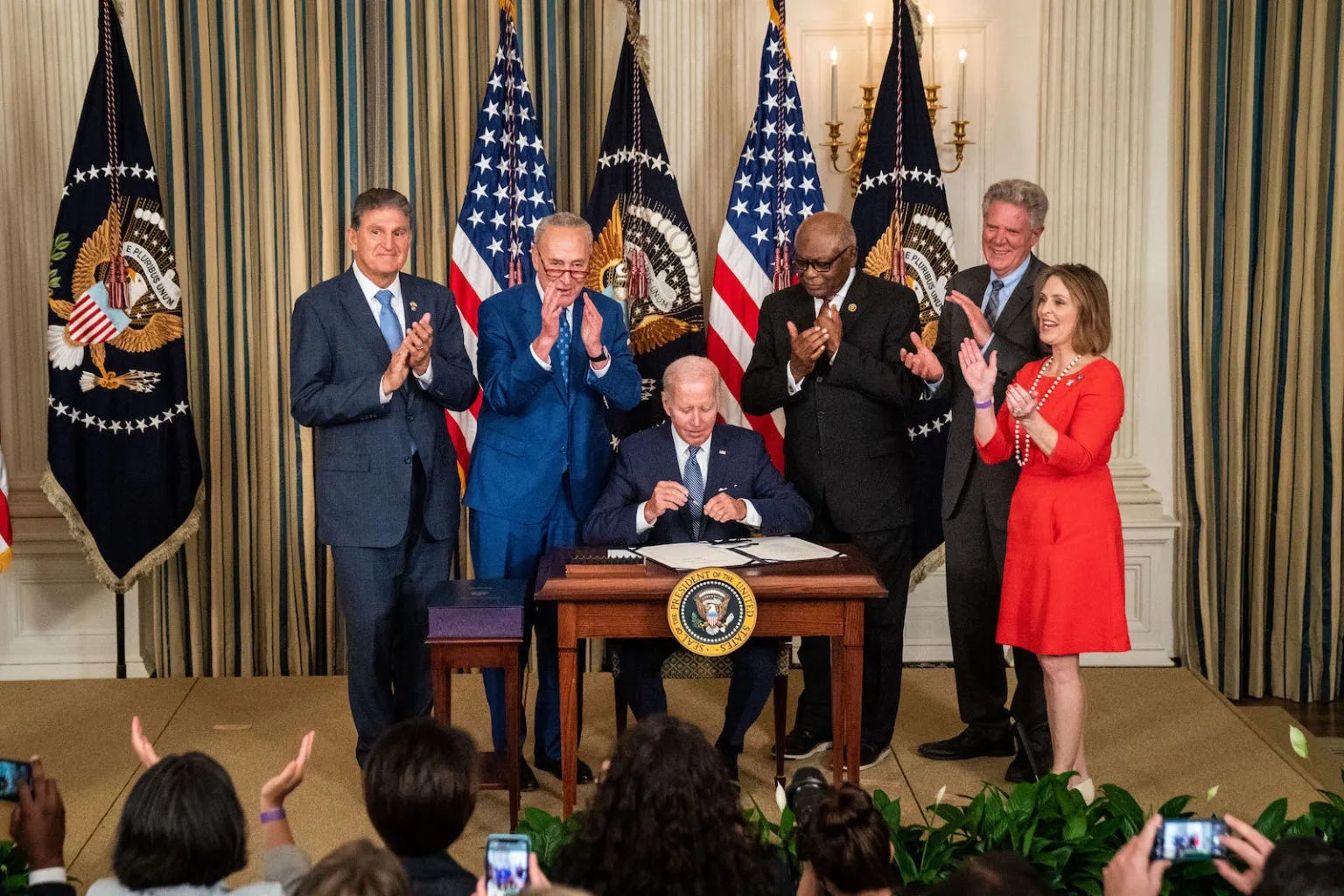
The IRA, four years later: Former President Joe Biden signed the Inflation Reduction Act into law four years ago today, capping a yearlong Democratic effort to turn unified control of Washington into a sweeping rewrite of the social safety net and clean-energy economy.
What reached Biden’s desk was considerably smaller than what House Democrats passed nine months earlier under the Build Back Better banner. But the IRA still represented the largest federal investment to combat climate change in U.S. history, empowered Medicare to negotiate prescription drug prices for the first time and extended enhanced Affordable Care Act subsidies.
1461 days, another presidential administration and a Republican rollback later, the law’s legacy is coming into clearer focus. Here are four lessons from what Democrats enacted, what they left behind and what happened next.
1. The IRA became more about health care and climate than inflation.
Inflation was running near four-decade highs when Democrats passed the bill, and then-Democratic Sen. Joe Manchin of West Virginia—an indispensable vote in a 50-50 Senate—had spent months warning that additional federal spending could make matters worse.
But the law’s most durable consequences have been elsewhere. The IRA made Medicare a prescription-drug price negotiator, capped beneficiaries’ out-of-pocket drug spending and limited insulin costs for Medicare patients. It extended enhanced ACA premium assistance and poured hundreds of billions of dollars into clean energy, manufacturing and emissions reductions.
Four years later, the law is more consequential as a health, climate and industrial-policy measure than as the anti-inflation legislation its name advertised.
2. The IRA’s major policies have had very different staying power.
The law provided nearly $80 billion over a decade to rebuild the IRS after years of budget cuts. Congress began clawing back that funding before Republicans regained unified control, and by fiscal year 2026, nearly $54 billion of the original $79.4 billion had been rescinded. (The rollback began under divided government, with Congress rescinding $21.6 billion in 2023 and 2024 before Republicans regained unified control.)
The GOP went further after returning to power. The One Big Beautiful Bill Act, signed by President Donald Trump last year, accelerated the expiration of tax credits for electric vehicles, residential clean energy and home efficiency improvements while restricting other incentives.
Those rollbacks came after the IRA had already driven billions of dollars in private clean-energy investment. Some investment has continued; other projects have been delayed or canceled as federal policy changed.
The result offers Democrats evidence of how quickly federal policy can influence private investment—and how quickly a subsequent Congress can rewrite the policy behind it.
3. Democrats haven’t abandoned Build Back Better.
House Democrats passed the Build Back Better Act in November 2021 with universal pre-K, child-care subsidies, an expanded Child Tax Credit, housing investments, expanded home care and other policies designed to lower household costs.
Manchin rejected the House package, while then-Democratic Sen. Kyrsten Sinema of Arizona separately resisted pieces of Democrats’ tax agenda. Months of negotiations eventually produced the narrower agreement that became the IRA.
But many of the ideas left behind never disappeared from Democratic politics. Four years later, Democrats confronting an affordability crisis are again proposing ways to lower housing, child-care and health-care costs, expand family tax benefits and use federal policy to relieve household expenses. The details have changed, but parts of Build Back Better’s economic argument survived its legislative defeat.
4. The IRA could shape Democrats’ next governing agenda.
Democrats would not enter their next period of unified government where they stood in 2021. Medicare can already negotiate prices for certain prescription drugs. The party has seen the effects of using the tax code to encourage private investment on a massive scale—and which policies Republicans targeted when they regained power.
Meanwhile, affordability policies Democrats couldn’t get through the Senate remain part of the party’s conversation about what governing should look like the next time it controls Washington.
That doesn’t mean a future Democratic Congress would dust off the House-passed Build Back Better Act. The party, economy and political environment have changed.
But the problems that animated it haven’t gone anywhere. The unfinished question isn’t simply whether the IRA worked. It’s what Democrats learned from the pieces that did—and whether their next majority will return for the ones they left behind.
🔓 The Sunday edition is free. But if you want Once Upon a Hill in your inbox each evening, upgrade your subscription for full access to every edition and the complete archive. Whether you’re taking the votes, writing the bills, running the campaigns, shaping the message or trying to influence any of the above, Congress Nerd Daily helps you see around corners before everyone else catches up.
THE POWERS THAT BE
Jeffries keeps his distance from the left’s agenda: House Minority Leader Hakeem Jeffries (D-N.Y.) used an appearance on NBC’s Meet the Press this morning to resist being drawn into his party’s ideological fights, declining to say Democratic Socialists don’t belong in the party even as he distanced himself from several of the left’s signature policies. Jeffries said he does not support the DSA agenda but acknowledged socialist candidates who win in November will join what he expects to be a “broad” caucus alongside progressives, New Dems and Blue Dogs. Pressed on what that caucus might do in the majority, Jeffries backed dramatically reforming ICE but stopped short of committing to a vote to abolish the agency, said he does not currently support Medicare for All, and left broader Supreme Court reforms beyond an ethics code to Judiciary Democrats. Instead, he repeatedly returned to the ground on which he wants House Democrats fighting the midterms: affordability, health care and holding the Trump administration accountable.
📬 The best stories often start with a conversation. If you’ve got insight, context or something others are missing, my inbox is open. Send me tips, scoops or just say hi: michael@onceuponahill.com.
THE POLICY DESK
House Dems take ICE oversight to Maine: House Homeland Security Committee Ranking Member Bennie Thompson (D-Miss.), House Minority Whip Katherine Clark (D-Mass.) and Reps. Chellie Pingree (D-Maine), Troy Carter (D-La.) and Val Hoyle (D-Ore.) will hold a shadow hearing tomorrow morning in Biddeford, Maine, to examine ICE’s use of force following the July 13 killing of Johan Sebastián Durán Guerrero. The lawmakers will hear from Durán Guerrero’s family attorney, Biddeford Mayor Liam LaFountain and immigrant-rights advocates about the circumstances surrounding his death and the broader impact of ICE operations in Maine.
Warren targets presidential bank conflicts: Senate Banking Ranking Member Elizabeth Warren (D-Mass.) and nine colleagues will introduce legislation barring presidents, vice presidents, their immediate families and other senior federal officials from owning or controlling banks or obtaining key regulatory approvals for financial institutions they control. The bill comes after the Office of the Comptroller of the Currency approved a national bank charter for World Liberty Financial, the Trump family-linked crypto company. It would also require federal banking regulators to review approvals issued since Jan. 20, 2025, and terminate those granted while a covered official owned or controlled the applicant. “This is the most brazen act of self-dealing our financial system has ever seen,” Warren said.
Massachusetts Dems inspect ICE detention facility: Reps. Ayanna Pressley, Jim McGovern and Stephen Lynch conducted an unannounced oversight visit Friday at the Plymouth County Correctional Facility, the only Massachusetts facility holding civil immigration detainees long-term. The lawmakers said they met detainees who described inadequate food, drinking water and medical care and called for greater accountability and changes to ICE detention and enforcement practices. Pressley and McGovern renewed their calls to abolish ICE, while Lynch said lawmakers should continue using their authority to conduct unannounced inspections and oppose agency funding absent reforms, including body cameras, a ban on masks and new use-of-force standards.

THE TRAIL
Florida Dems face tests of ideology and representation: Florida Democrats will vote on Tuesday in several House primaries that could offer another measure of where the party is heading. The sharpest fight may be in the safely blue 20th District, where Rep. Debbie Wasserman Schultz is running to represent a seat Black Democrats have fought to preserve as a center of Black political representation after Republican redistricting made her current district considerably more difficult for Democrats. Local Black Democratic leaders have opposed her move, while Elijah Manley, Dale Holness, Luther Campbell and former Rep. Sheila Cherfilus-McCormick are competing to keep the seat under Black representation. In the 25th, Rep. Jared Moskowitz faces democratic socialist Oliver Larkin in a test of whether the left’s recent primary momentum can extend into a more competitive district, while Democrats will also choose among seven candidates to succeed retiring Frederica Wilson in the safely blue 24th.
DCCC puts a price tag on its affordability message: The Democratic Congressional Campaign Committee launched a new website that lets voters calculate how much prices for everyday groceries have increased and share a personalized “receipt” by text or social media, the latest effort by House Democrats to make affordability central to their closing argument ahead of the midterms. The committee is branding the increases the “House Republican Price Hike” and tying higher prices for staples including ground beef, coffee and bread to GOP control of Washington. The launch comes as Democrats seek to capitalize on persistent voter concerns about the cost of living, with annual inflation reaching 3.4% in July.
Dems lock in their 2028 primary map: The Democratic National Committee voted at its summer meeting in Austin on Saturday to approve six states for its 2028 presidential primary early window, putting South Carolina first on Jan. 22, followed by Nevada on Feb. 1, New Hampshire on Feb. 8, New Mexico on Feb. 15, Michigan on Feb. 22 and Virginia on Feb. 29. The calendar, previously recommended by the party’s Rules and Bylaws Committee, significantly expands the racial and geographic diversity of the early-state electorate while placing the battlegrounds of Nevada and Michigan prominently in the nominating process. DNC Chair Ken Martin said the calendar would “truly represent our party and our values” while helping produce a nominee prepared to retake the White House.