

👋🏾 Hi, hey, hello! Welcome back to Congress Nerd Sunday, coming to you a day late due to the Martin Luther King Jr. holiday. I hope yours was filled with rest and reflection.
The House is scheduled this week to take up two bills backed by the anti-abortion movement that would promote alternatives to abortion care through the social safety net and higher education policy.
The first would explicitly empower states to use TANF funding to support crisis pregnancy centers, nonprofit organizations that present themselves as reproductive health clinics but exist primarily to persuade women from seeking abortion care. The second measure would require colleges and universities that receive federal student aid to share information on rights, accommodations and resources for pregnant students and those who may become pregnant, a mandate critics of the bill view as indirect anti-abortion policy because it focuses on carrying a pregnancy to term.
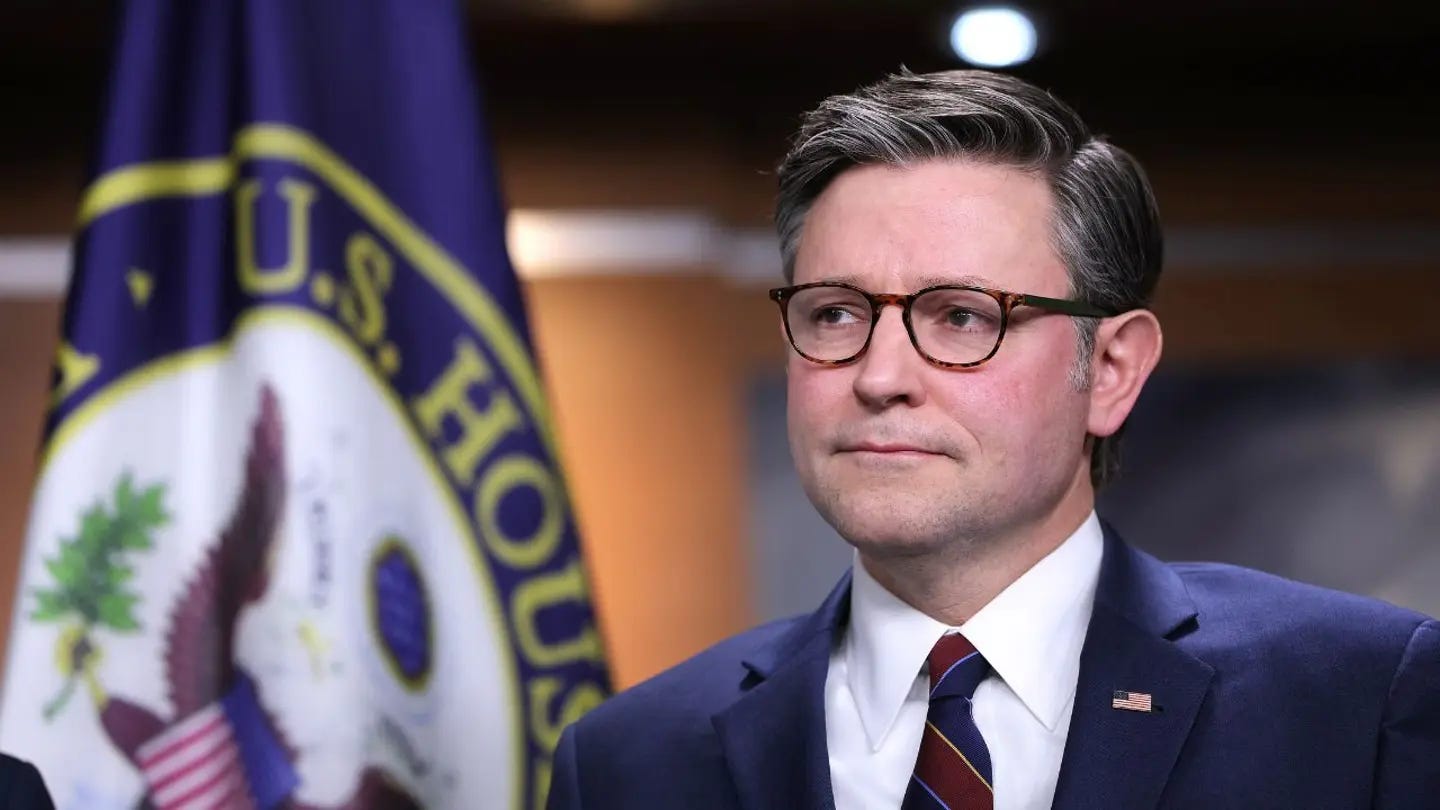
Anti-abortion politics is much more unifying for the Republican Party than the labor issues that led a handful of House GOPers to sink an anti-worker bill and leadership to pull two more from the schedule. Still, while Speaker Mike Johnson (R-La.) holds just a two-seat margin on paper, it’s practically nonexistent due to a recent unexpected death and health emergencies for Republican members and their loved ones.
There’s no telling if Speaker Johnson will be able to bring these messaging bills to the floor, let alone muster the votes to pass them. Johnson’s tricky floor math has also given small blocs of holdout members effective veto power over leadership priorities and allowed them to extract concessions on unrelated policies they otherwise wouldn’t have received. This is a dynamic worth watching.
House Republicans will also move to undo federal land protections in northern Minnesota under the Congressional Review Act—a mid-1990s law that allows Congress to overturn recent agency rules with a simple majority vote in both chambers and presidential sign-off. (Once a rule is overturned, the agency generally can’t reissue a substantially similar rule without new statutory authority.)
The Biden administration pulled certain federal lands off the table for mining and development projects, a rule Republicans oppose because it locked up land without buy-in from local stakeholders and stunted job growth and economic development. Critics of the resolution argue that land protections prevent pollution, safeguard water systems and preserve tribal lands.
The House may also consider a resolution sponsored by Reps. Jim McGovern (D-Mass.), Thomas Massie (R-Ky.) and Joaquin Castro (D-Texas) to prevent President Trump from conducting military operations in Venezuela that Congress hasn’t authorized under the War Powers Resolution. A similar resolution advanced in the Senate earlier this month, only to be blocked last week by the Trump administration and GOP leadership, which convinced two Republicans to block it from receiving a floor debate, amendment process, and final vote.
Congress faces FY26 funding crunch as DHS bill remains in flux
The next government funding deadline is in 11 days and Congress still has its work cut out for it. The House is out next week, leaving senators with only the balance of this week to process the four remaining fiscal year 2026 funding bills.
House Republican leaders hoped to clear the deck with a final package of three measures for health, education, housing, transportation and defense agencies and programs—already a heavy lift on their own. But appropriators dropped the Department of Homeland Security funding bill from what was supposed to be a separate three-piece last week. Bipartisan consensus in support of the bill fell apart amid Democratic demands for reforms to the agency after Renee Nicole Good was fatally shot by an ICE agent in Minnesota earlier this month.
House Judiciary Subcommittee on Immigration Ranking Member Pramila Jayapal (D-Wash.) told me last week that her panel has been drafting a list of what constitutes meaningful reforms, including like preventing ICE agents from wearing masks, requiring a warrant for an arrest, banning DHS from using private detention facilities and mandating the government to share information with state and local law enforcement officials around independent investigations for accountability.
“So there are a number of things that we have identified that are really all critically important because the abuses are so widespread and occur in so many different places,” Jayapal told me. “We have to address all of them. And I think it is important for us to understand that one small fix to some meaningless provision does not constitute serious accountability.”
The Congressional Progressive Caucus, which Jayapal previously chaired for two terms, announced last week that it adopted an official position opposing new funding for DHS immigration enforcement until significant reforms are enacted.
Party leaders and appropriators would prefer to avoid a long-term continuing resolution for DHS or any of the other bills for which House Republicans can’t muster the votes. But they’re each navigating delicate politics on a volatile issue that could be compromised with positions viewed as too extreme by base and independent voters.
Across the Capitol, the Senate is out this week. In addition to the final four funding bills the House sends to the Senate this week, it must also take up two measures on national security and financial regulation that the House advanced last week. Before skipping town, it passed a trio of bills to fund core justice, infrastructure, energy and environmental priorities that now await President Trump’s signature.
One more note: Speaker Johnson and Senate Majority Leader John Thune (R-S.D.) have spent weeks hailing this year’s appropriations process as a success—pointing to the fact that Congress avoided a year-end, Christmastime omnibus and defining their tenures as the top two Hill Republicans as a return to regular order. But the fiscal year ended 111 days ago and we’re weeks from President Trump releasing his FY 2027 budget request, the official kickoff to the annual appropriations season. Against this backdrop, the praise feels a bit premature.
Senate Dems to move against Trump’s tariff threats tied to Greenland gambit
Senate Democrats are expected to introduce legislation this week to block President Trump from carrying out his threat to impose a 10% tariff on all goods from eight NATO-aligned European countries on Feb. 1, until Greenland is sold to the U.S.
The tariff would jump to 25% on Jun. 1 if the purchase of the world’s largest island, situated within Denmark between the Arctic and Atlantic Oceans near North America.
Trump announced his threat in a Truth Social post on Saturday, claiming that the U.S. has subsidized Denmark and the European Union for decades by not imposing tariffs and that America is the only country that can protect Greenland.
The president views Greenland as a massive, strategically located asset that’s rich in resources and military value. But Danish leaders have repeatedly and publicly said Greenland is not for sale. Not to mention, acquiring it isn’t a priority for most Americans.
70% of Americans in a new CBS News poll disapprove of buying Greenland with U.S. funds and the data shows overwhelming opposition to using military force to take the island. Most Americans disapprove of President Trump’s tariff policy (62% according to a new CNN poll and 51%, per fresh polling from The Wall Street Journal). And 59% of Americans, according to a recent CNN poll, said Trump has gone too far in expanding U.S. power abroad. In comparison, 64% say the president hasn’t paid enough attention to the country’s most important domestic problems.
The Supreme Court is expected to decide soon whether President Trump can use an emergency-powers law to impose sweeping tariffs on imports without clear congressional approval.

Johnson takes the global stage for major U.K. address
Speaker Johnson will deliver a speech to the U.K. Parliament on Tuesday morning (4:30 a.m. Eastern Time for the insomniacs and political obsessives out there), at the invitation of Commons Speaker Sir Lindsay Hoyle to mark America’s 250th anniversary. The moment gives Johnson a rare, statesmanlike platform abroad where he’s expected to link the U.S. to its democratic roots and burnish his standing as a national figure—even as his grip on the House back home remains fragile and deeply constrained.
Paris Hilton to join AOC in lobbying for DEFIANCE Act House vote
Paris Hilton will be back on the Hill this Thursday afternoon to join Reps. Alexandria Ocasio-Cortez (D-N.Y.), Laurel Lee (R-Fla.) and advocates and other members to ask Speaker Johnson to put the DEFIANCE Act on the House floor for a vote.
The Senate unanimously passed the legislation last week, which members of both parties say would help confront the spread of nonconsensual, sexually explicit AI-generated deepfake videos. Women and girls are the overwhelming targets of this type of abuse.
Ocasio-Cortez told me last Tuesday that she planned to speak to Johnson and House Judiciary Chair Jim Jordan (R-Ohio) about the path forward. She was spotted chatting with Johnson on the House floor the next day during a vote series.
The bill, which was led in the Senate by Dick Durbin of Illinois, the number-two Democrat and highest-ranking Democrat on the Senate Judiciary Committee, and Sen. Lindsey Graham (R-S.C.), would give victims the right to bring civil lawsuits against people who knowingly create, distribute, or traffic in explicit digital forgeries made without consent.
Hilton is no stranger to child-safety advocacy. She has spent years pushing for stronger protections for young people in residential treatment programs, beginning with her 2021 testimony before Utah lawmakers about being emotionally and physically abused during an 11-month stay at an involuntary treatment center when she was 17. That fall, she joined Rep. Ro Khanna (D-Calif.) and Sen. Jeff Merkley (D-Ore.) to call for a children’s bill of rights, later testified before the House Ways and Means Committee on child-welfare reforms, and in 2023 backed bipartisan legislation signed into law by former President Joe Biden to expand oversight and data transparency for institutional youth treatment facilities.

Oversight, health care and housing dominate a volatile week of House hearings
The House Oversight Committee will vote on Wednesday morning whether to hold former President Bill Clinton and former Secretary of State Hillary Clinton in Contempt of Congress for their refusal to comply with subpoenas as part of the committee’s broader effort to cast the Epstein scandal as a cover-up involving Democratic elites and to pressure the Justice Department to release or explain withheld files. The Clintons argued that the subpoenas were politically motivated, overly broad, and duplicative of existing records—and that neither had been accused of wrongdoing or shown to have relevant firsthand knowledge warranting compelled testimony.
The House Ways and Means Committee will hold a hearing the next day with health insurance CEOs, at a moment when Congress is weighing whether to shore up, rein in, or fundamentally rethink insurers’ role in the U.S. health care system. In the middle of fights over ACA subsidies, coverage costs, and corporate consolidation, hauling CEOs before the committee could force insurers to publicly defend pricing, profits, and patient outcomes as lawmakers decide what kind of health system they want to preserve or change. The House Budget Committee will also hold a hearing this week on skyrocketing health care costs within the context of America’s fiscal future. And the House Energy and Commerce Subcommittee on Health will meet for a hearing on health insurance affordability.
Housing policy will remain a hot topic this week, as the House Financial Services Committee will hear testimony from Secretary of the Department of Housing and Urban Development Scott Turner on his agency and the Federal Housing Administration. The House Oversight Subcommittee on Economic Growth, Energy Policy, and Regulatory Affairs will also hold a hearing on housing affordability and the preservation of the American Dream.
Below are the rest of the week’s committee hearings I’ll have my eye on:
Tuesday:
House Rules will meet to prepare the Supporting Pregnant and Parenting Women and Families Act, Pregnant Students’ Rights Act and Bureau of Land Management CRA for floor debate and a vote (3 p.m.).
Wednesday:
House Homeland Security will hold an oversight hearing of the Cybersecurity and Infrastructure Security Agency, TSA and Science and Technology Directorate (10 a.m.).
The House Small Business Subcommittee on Rural Development, Energy, and Supply Chains will hold a hearing on empowering rural America through investment and innovation (10 a.m.).
The House Small Business Subcommittee on Rural Development, Energy, and Supply Chains will hold a hearing on addressing fraud and the theft of taxpayer dollars (10 a.m.).
The House Ways and Means Subcommittee on Work and Welfare will hold a hearing on strengthening the child support enforcement program (3 p.m.).
Thursday:
House Judiciary will hold an oversight hearing on the Office of Special Counsel Jack Smith (10 a.m.).
House Administration will hold an oversight hearing of the Government Publishing Office in the digital-first era (2 p.m.).
The House Foreign Affairs Subcommittee on Africa will hold a hearing on advancing peace in the Democratic Republic of Congo and Rwanda through President Trump’s Washington Accords (2 p.m.).
House Small Business will hold a hearing on how franchising is a pathway to entrepreneurship (2 p.m.).