

○ ● ● ●
👋🏾 Hi, hey, hello! Welcome to Day 14 of the government shutdown. While not close to record territory yet, the current funding lapse has already eclipsed many past shutdowns that were shorter than two weeks.
If you’re keeping track at home, the longest shutdown lasted 35 days in 2018–2019. The second-longest was 21 days during the 1995-1996 shutdown. The 2013 shutdown lasted 16 days, making it the third longest.
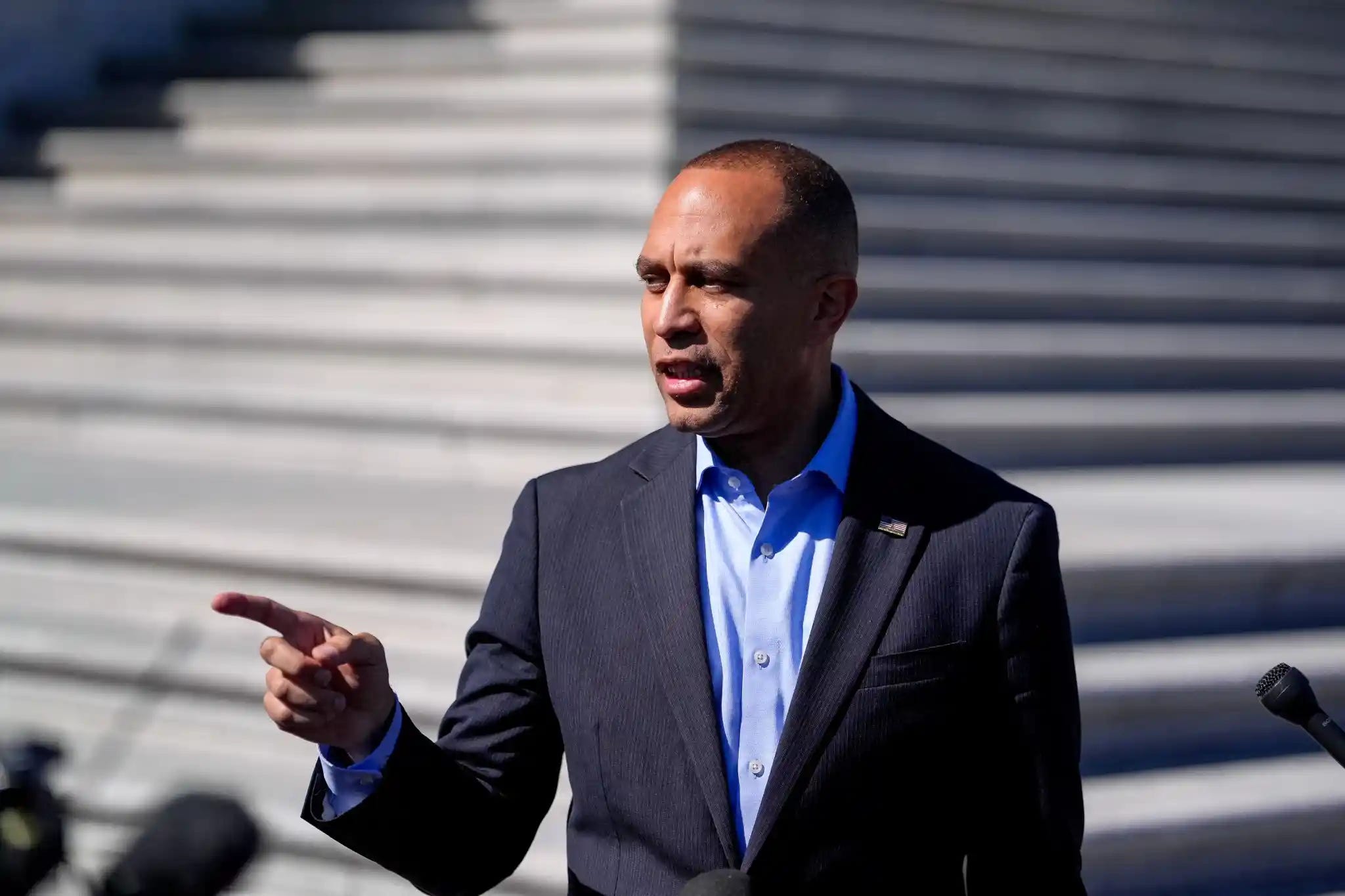
House Minority Leader Hakeem Jeffries (D-N.Y.) has called his members back to Washington this evening, despite House Speaker Mike Johnson (R-La.) canceling votes for the third consecutive week. Kevin Kiley, who represents a swing district in California, is among the GOP members calling on Johnson to bring the House back to reopen the government, address the ACA subsidy cliff and swear in Rep.-elect Adelita Grijalva (D-Ariz.), who won the special election to succeed her late father by 39 points three weeks ago.
“We will return to legislative session as soon as the Democrats come to their senses and open the government,” Johnson told reporters on Monday morning at the Capitol. I doubt the speaker will be able to maintain this position much longer.
House Democrats will meet in person for a caucus meeting at 6 p.m. this evening in advance of a full slate of events on Wednesday. The programming will include another closed-door caucus meeting, a special event on the Capitol steps, a hearing on the rising costs of health care, press engagements and Democrats’ third virtual town hall.
Democrats, even those Republicans hope to flip like the retiring Sen. Jeanne Shaheen (D-N.H.), have maintained that the path to ending the shutdown starts with a negotiation between President Donald Trump and the four legislative leaders (Johnson, Senate Majority Leader John Thune (R-S.D.), Senate Minority Leader Chuck Schumer (D-N.Y.) and Jeffries) over Democrats’ demands to extend the Affordable Care Act enhanced premium tax credits among others.
But with Vice President J.D. Vance in Indiana last Friday—attempting to convince Hoosier State Republicans to gerrymander their congressional maps ahead of next year’s midterms—while Trump was at Walter Reed speaking to troops and receiving a semiannual physical, leader-level talks weren’t in the cards over the weekend.
“It’s very unfortunate that their behavior continues to signal that they are uninterested in the type of bipartisan negotiations necessary to bring the Trump Republican shutdown to a close,” Jeffries told me last week. “I hope that changes. I hope it changes today. I hope it changes tomorrow. We’ll meet with them anytime, anyplace, anywhere, either here at the Capitol or back in the Oval Office. But Republicans need to get serious about reopening the government; they need to get serious about reaching a spending agreement that actually makes life better for the American people, addresses the cost-of-living crisis that exists in America that Donald Trump promised to fix on Day One.”
The Senate is in session this evening for another procedural vote on the House-passed continuing resolution, which is expected to fail for the eighth time. Senate Majority Leader John Thune (R-S.D.) will no longer allow Senate Majority Leader Chuck Schumer (D-N.Y.) to schedule votes on the Democratic counterproposal—a hardball tactic designed to deny Democrats a procedural win and force them to negotiate on Republican terms.
“John Thune’s strategy is to continue to do the same partisan thing over and over and over again and expect different results,” Jeffries told reporters last Friday. “That’s legislative insanity.”
Additional Senate votes are expected during Tuesday’s session.
● ○ ● ●
Dems remain resolute despite Trump RIFs
The fallout continues from the chaotic sweeping reduction-in-force effort the Trump administration launched last Friday, supposedly in response to the shutdown. But since the administration has conducted mass firings since Trump took office in January, Democrats say it would have gone forward regardless of the funding lapse—underscoring why they won’t agree to turn the lights back on without health-care concessions and assurances that federal dollars are spent as Congress directs.
In the meantime, there are several unanswered questions, including whether courts will block or reverse particular RIFs or limit their scope. Some legal experts and Democratic lawmakers have cautioned that such RIF actions—particularly during a shutdown—are unprecedented and may be vulnerable to court challenges. In prior RIF attempts earlier in this year, courts had issued injunctions or restraining orders. However, some of those restrictions were later overturned (including by the Supreme Court), allowing RIFs to proceed in certain agencies.
Federal employee unions challenged the legality of layoffs during a funding lapse, arguing that such terminations may violate the Antideficiency Act or lack a proper statutory basis. In court filings and press statements, the administration estimated that over 4,100 federal employees across multiple agencies would be affected, including Commerce, Education, Energy, Health and Human Services, Housing and Urban Development, Homeland Security and Treasury. (Some smaller actions or threatened RIFs included the Environmental Protection Agency and the Cybersecurity and Infrastructure Security Agency.
The president publicly characterized these layoffs as cuts to “Democrat programs,” indicating the possibility of political targeting, and White House budget chief Russell Vought and administration communications suggest the intent is to use the RIFs as leverage in the budget impasse, to pressure Democrats to agree to a funding deal. But it remains to be seen whether reversals or reinstatements will occur, particularly if a funding agreement is reached. It’s also unclear when the layoffs formally take effect, given the required notice periods, or the operational impact on agency functions, services and mission-critical work.
“We’re ending some programs we never wanted and we’ll probably never allow them to come back,” Trump said en route to the Middle East on Sunday afternoon to mark the ceasefire agreement his administration clinched between Israel and Gaza last week.
A group of senior Senate Democrats has called on Vought to step down, a request that’s likely to go ignored.
“This isn’t simply a policy disagreement between Congress and the White House,” Schumer, Budget Committee Ranking Member Jeff Merkley (D-Ore.), Appropriations Committee Vice Chair Patty Murray (D-Wash.) and Homeland Security Committee Ranking Member Gary Peters (D-Mich.) said in a statement. “Vought’s weaponization of the federal government and disregard for the rule of law threatens the very checks and balances that make our system of government work. He is unfit to serve, and he must resign.”

● ● ○ ●
Trump, Milei meet at fraught moment for U.S., Argentine economies
President Trump will meet with Argentine President Javier Milei this afternoon at a fraught moment for both leaders.
The meeting comes as Trump’s trade war wreaks havoc on American farmers. Family farms are going bankrupt at the fastest pace in five years and farm debt is projected to hit a record high of nearly $600 billion this year. Soybean producers are under significant pressure: China, the largest purchaser of U.S. soybeans, retaliated against Trump’s unpredictable trade war by refusing to buy American soybeans, locking farmers out of their biggest market indefinitely. Because the fund the Trump administration used during his first term to bail out farmers is depleted, Congress may have to appropriate emergency resources to rescue the agriculture industry this time.
Late last month, the Treasury Department announced the U.S. would exchange $20 billion for pesos to help stabilize Argentina’s financial markets ahead of this month’s midterm elections, during which Milei hopes to secure additional seats to advance his reforms. Critics point to the Trump administration’s rescue moves for Argentina and a White House photo-op two weeks before the South American country votes as a signal of confidence in Milei, who embraces Trumpian shock-therapy economic reforms and a combative, populist style often compared to the U.S. president.
Supporters of the agreement argue that the move stabilized a key regional ally, preserved the U.S. leverage in Latin America, and may ultimately reduce market volatility if Argentina’s economy steadies. Opponents counter that it represents a de facto bailout that allowed Argentina to waive export taxes and quickly sell cargoes to China at lower prices, intensifying pressure on U.S. growers. The truth likely lies somewhere between.
“One of the things that’s interesting is that Donald Trump and the administration found $20 billion for Argentina and soybean farmers in Argentina who are competing with soybean farmers in Iowa. Is that America First?” Jeffries told reporters last week. “No, that’s Argentina First, and that’s what the administration has done. They’re rewarding their billionaire donors, both in this country and people who’ve got investments in places like Argentina. Shame on them.”
Ahead of the meeting, the Democratic National Committee will host a call with reporters and Gov. Tim Walz (D-Minn.), Rep. Sharice Davids (D-Kan.) and a soybean farmer.

● ● ● ○
Trump declares start of next phase of historic peace agreement
President Trump on Monday declared the start of the second phase of the peace agreement his administration brokered last week between Israel and Hamas—a deal that, if it holds, could mark the most dramatic shift in the region’s politics in years. The announcement came in Egypt, shortly after a sweeping prisoner exchange freed the last of 20 living hostages from Gaza and nearly 2,000 Palestinians held in Israel.
It’s a potentially historic moment, signaling an effort to move beyond a ceasefire toward lasting structural change. But the hardest work—disarmament, governance and security guarantees—still lies ahead, and even U.S. officials privately caution that optimism may be premature.
Still, the first formal U.S.-brokered framework between Israel and Hamas has stirred rare hope that Gaza’s future might finally be shaped through diplomacy rather than destruction.
“There is an enormous opportunity ahead for a long-term and lasting peace,” Schumer, the highest-ranking Jewish member of Congress in American history, said in a statement. “It is of utmost importance that every party involved pursue the opportunity to finally build a lasting peace—ultimately through a realized two-state solution that ensures security, prosperity, and dignity for Israelis and Palestinians alike.”
Trump signed the peace documents during a ceremony with representatives from Turkey, Egypt and Qatar. Reporters in the room observed the sound of the president’s pen writing his signature on the papers echoing in the quiet room. He also shook hands and took pictures with several world leaders during the event.
Before the signing ceremony, Trump delivered remarks to the Knesset. Several folks in the audience wore red MAGA-style hats that said “TRUMP THE PEACE PRESIDENT.” The Knesset broke into a sustained applause for about two minutes when Trump entered. The president’s daughter, Ivanka, also received a warm welcome moments prior. Knesset Speaker Amir Ohana said he would work with Speaker Johnson to rally world leaders to nominate and advocate for Trump to win the Nobel Peace Prize.
Trump invited Benjamin Netanyahu to join him at the ceremony, but the Israeli prime minister declined because of Simchat Torah, a holiday marking the festival season at the end of Sukkot.
“Donald Trump is the greatest friend that Israel has ever had in the White House. No American president has ever done more for Israel. And it’s not even close,” Israel Prime Minister Benjamin Netanyahu said in his remarks at the Knesset. “There is a time for peace and a time for war. The coming years will hopefully be a time for peace.”
In one of the more remarkable moments of the day, Trump urged Israeli President Michael Herzog to pardon Netanyahu, who faces multiple corruption charges.
“I had some disputes with him and they were quickly settled,” Trump said to reporters on Air Force One en route to Israel. “As far I’m concerned I think he’s done a great job. I think he was the right person at the right time.”
Given the 67,000 Palestinians in Gaza that have been killed since the start of the Israeli offensive two years ago—almost half of them women and children—and more than 170,000 injured, it’s likely history will tell a different story.