

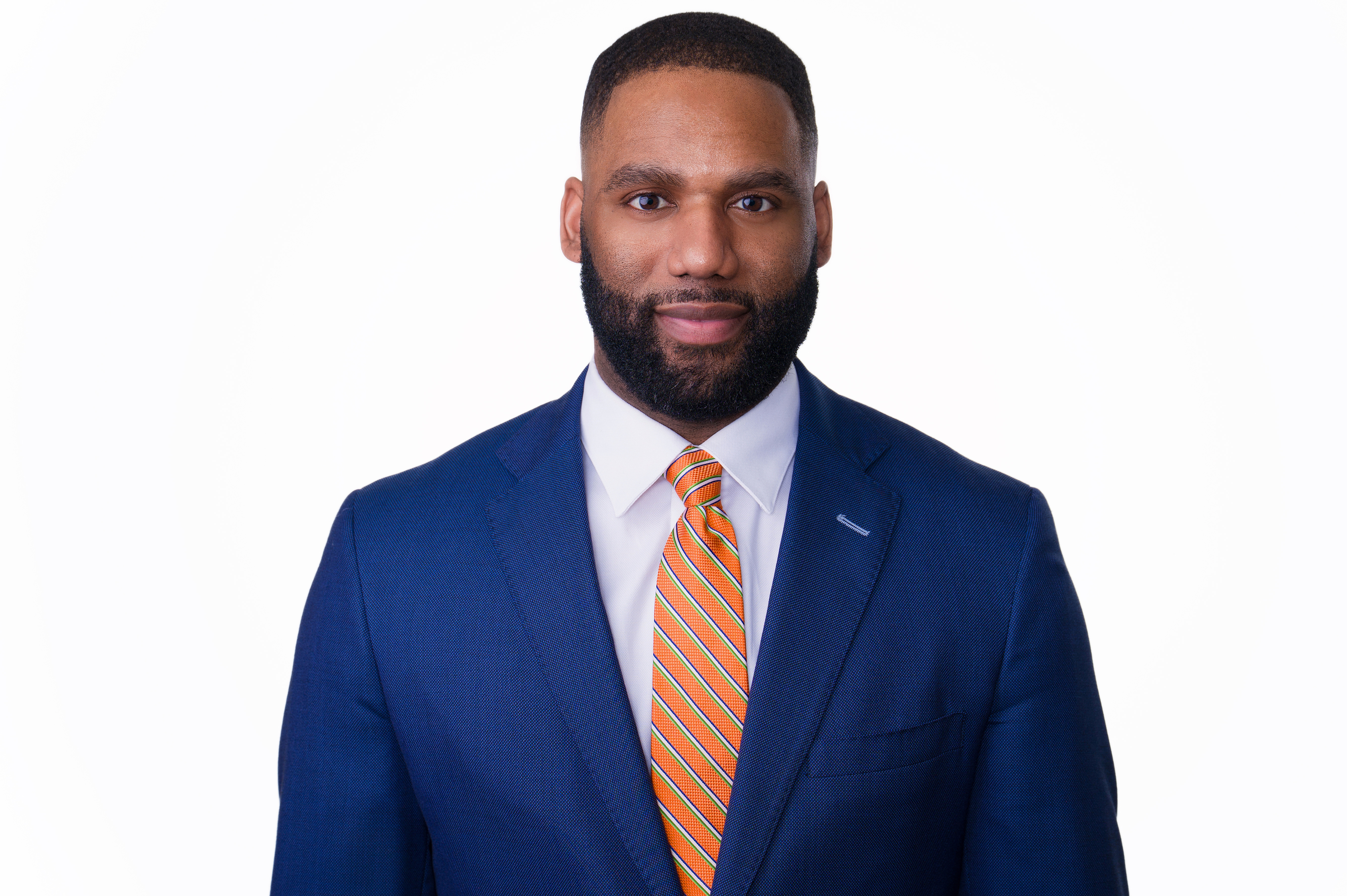
It didn’t take long after returning home to Jackson, Mississippi, for EVAN TURNAGE to realize that the place he grew up in was experiencing tough times.
Since he’s been back, he’s noticed half of his cousins and his high school friends have moved away. More broadly, he’s seen a hollowing out of the middle-age group, which means fewer children are being born in the city. And grandparents lament the reality that they have to watch their grandkids grow up on social media.
These challenges aren’t new to someone like the 33-year-old Turnage, who this morning announced the launch of a primary challenge to Rep. BENNIE THOMPSON in Mississippi’s 2nd congressional district—the only one in the state held by Democrats.
“It’s time. The time is now. The people are hungry for change. There’s a lot of appetite for change,” Turnage told me over the phone last Friday afternoon. “There’s economic hardship that’s been unaddressed. We need real plans to help eradicate poverty and restore real job opportunity here.”
Before launching his campaign, Turnage built his career in law and Democratic policymaking, first as an antitrust lawyer at Kirkland & Ellis and later as senior counsel to Sen. ELIZABETH WARREN (D-Mass.). He went on to serve as chief counsel to Senate Minority Leader CHUCK SCHUMER (D-N.Y.)—the top legal post in the Senate, where he worked on corporate accountability, voting rights and economic policy.
During that time, Turnage helped draft the Price Gouging Prevention Act, legislation Democrats used to respond to corporate price hikes and later adopted as a centerpiece of Vice President KAMALA HARRIS’s presidential campaign platform. He also authored the No Kings Act in the wake of the Supreme Court’s ruling on presidential immunity, legislation Senate Democrats used to underscore that no president is above the law and that later became the roots for the nationwide No Kings demonstrations.
After leaving Washington, Turnage returned to Mississippi and founded the Southern Justice Project, focused on organizing Black, rural and low-income residents around advocacy, economic empowerment and grassroots political engagement.
Beyond his pitch for generational change, Turnage pointed to several policy areas he argues have been insufficiently addressed under Thompson’s watch. He cited persistent gaps in broadband access—both in Jackson and across the Delta—as a barrier to economic mobility in an increasingly remote workforce. He also flagged voting access as a priority, arguing that Mississippi’s lack of early voting has made participation unnecessarily difficult. And he pointed to rising violent crime as a statewide concern, describing it less as a standalone public-safety issue than as a symptom of deeper economic hardship that, in his view, demands more comprehensive solutions.
“I think it’s important to have somebody who’s been at the forefront of policy in this country,” Turnage said. “And we desperately need some new policies to revitalize Mississippi.”
Thompson was elected to Congress in 1992 and has represented MS-02 for more than three decades, making him one of the longest-serving members of the House. A former county supervisor and local government official, Thompson has built his congressional career around issues of civil rights, homeland security and oversight, rising to chair the House Homeland Security Committee during Democratic control.
He gained national prominence as chair of the House select committee that investigated the Jan. 6, 2021, attack on the U.S. Capitol. Thompson represents a sprawling, majority-Black district that includes much of the Mississippi Delta and parts of Jackson—an area long marked by entrenched poverty and economic disinvestment.
As the 16th-most senior member of the House, Thompson theoretically lends the district valuable institutional clout. But Turnage argued that seniority for seniority’s sake is unhelpful.
“We need seniority that delivers results for the district. And so to people in this district, I would ask, you know, what has he been bringing for the last 33 years?”
Thompson is also one of four Congressional Black Caucus members who serve as the top Democrat on a House committee, underscoring the CBC’s institutional influence within the House Democratic Caucus and giving Black lawmakers real leverage over legislative priorities, oversight agendas and messaging.
But Turnage argued that Thompson has not fully leveraged the authority that comes with that institutional power, pointing specifically to his role as chair of the House select committee that investigated the Jan. 6 attack on the Capitol. While Thompson pursued contempt charges against former Trump aides who defied subpoenas, Turnage said, he failed to apply the same standard to then-President Trump himself. Turnage criticized Thompson’s decision to withdraw Trump’s subpoena rather than pursue contempt proceedings as a missed opportunity to hold the central figure in the investigation accountable.
“When Bennie Thompson had the chance to hold Donald Trump accountable, he folded,” Turnage said. “And I think that people right now want real fighters who aren’t afraid to hold criminals accountable for their wrongdoing.
He also noted that Thompson was the only House Democrat to vote against the For the People Act, a sweeping voting rights bill that expanded voting access, curbed partisan gerrymandering, and overhauled campaign finance rules, which died in the Senate after Republicans unanimously opposed it and Democrats failed to overcome the filibuster without changing Senate rules.
At the time, Thompson said he opposed the legislation because key provisions—particularly public campaign financing and independent redistricting commissions—did not have his constituents’ support, leading him to vote based on district concerns rather than party priorities.
Turnage also accused Thompson of being too closely aligned with corporate interests, arguing that the congressman’s campaign fundraising undercuts his ability to challenge powerful companies operating in the district. He pointed to Thompson’s donations from insurers, utilities and large corporations—including Aflac, Kroger, and Entergy—as raising questions, in his view, about whose interests are ultimately being prioritized when corporate accountability is at stake.

Despite the critiques, Turnage expressed deep respect for Thompson as a civil rights leader and called him the only congressman he’s ever voted for.
“But I think there comes a time where after many, many years, you might be moving away from the values you once held,” he said.
And while Turnage acknowledges he may not have the seniority Thompson has, he believes he has a perquisite that the incumbent doesn’t: Relationships in the Senate, due to his time in Schumer and Warren’s offices.
“We hear complaints from members of the House all the time that they pass great bills and then they’re sent over to the Senate and they die,” he said. “I think it will be a huge asset to the district to have a congressman who’s intimately familiar with the Senate, who can walk right into the Senate leader’s office and let him know what he should be prioritizing for Mississippi because I’ve been setting pieces of Chuck Schumer’s agenda for years.”
But Turnage’s argument cuts against some prevailing Beltway wisdom. Schumer has faced skepticism from Hill staffers and activists alike, and insurgent candidates have increasingly made distance from Senate Democratic leadership a feature rather than a liability. There is also no guarantee Schumer will remain Democratic leader beyond the next Congress—or even seek reelection later this decade—raising questions about how durable those relationships would be over time. Nonetheless, it was clear that Turnage is betting that deep familiarity with the Senate’s internal mechanics, rather than formal seniority alone, could give a freshman House member an uncommon foothold in a chamber where legislation so often stalls.
Turnage said the first fight he would take on in Congress would be for democracy reforms, such as rooting out corporate money from politics and supporting a ban on stock trading for members of Congress.
“We’re sick of the partisan bickering. We’re sick of all the Donald Trump stuff. It’s much bigger than that,” he said. “I’m going to fight for a cleaner system. And once we have a cleaner system in place, I really believe we can more reliably deliver economic relief for people nationwide, but specifically here in the district.”
Turnage gave me no indication that he underestimates the challenge of unseating a deeply entrenched incumbent.
When asked directly whether voters could ultimately decide that Thompson should continue representing the district, he did not dismiss the possibility—even as he made clear he is running to win.
He spoke of the campaign as a test of something larger than any single election outcome: whether voters can demand a model of representation centered on accountability, responsiveness and the belief that Congress can work for working families if elected officials are pressed to listen and deliver.
“Nobody’s entitled to this seat, and so I think just by virtue of running this race, we’re going to put together a coalition of voters who have not participated for years in the process,” he said. “They’re apathetic. They’re indifferent. And I hope that for thousands of people here, we can actually inspire some new hope, some new optimism, that maybe there is a political candidate who speaks to their needs.”