


👋🏾 Hi, hey, hello! Thank you for starting your workday with Congress Nerd Sunrise.
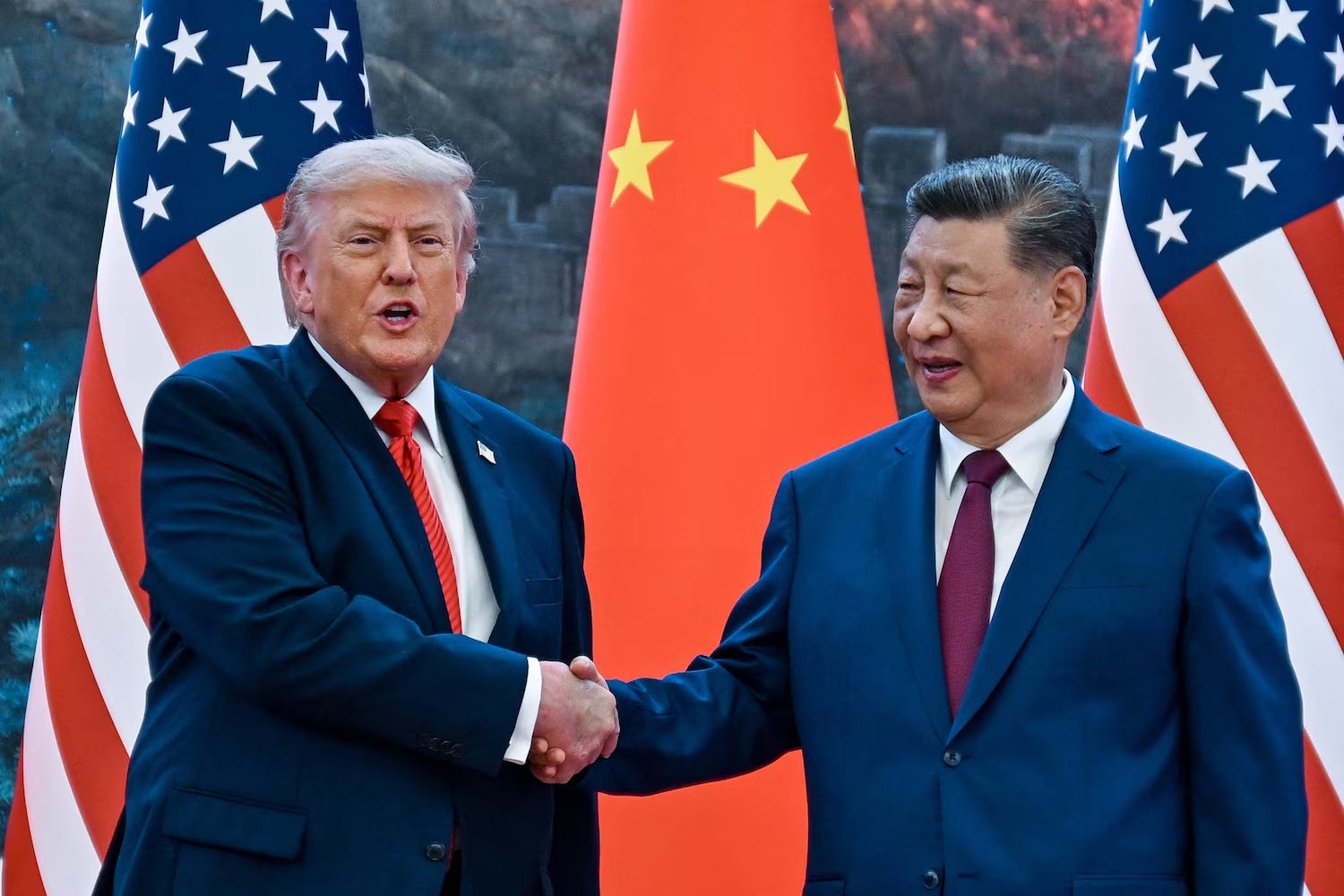
🌅 In this morning’s edition: The current state of play in China, where President Donald Trump is currently attending a state banquet with Chinese President Xi Jinping.
💡First in Congress Nerd Sunset: Paid Once Upon a Hill subscribers got my deep dive last night into how the Senate’s four Black Democrats—Cory Booker (N.J.), Raphael Warnock (Ga.), Lisa Blunt Rochester (Del.), and Angela Alsobrooks (Md.) are rallying behind their Congressional Black Caucus colleagues as Republican-led redistricting fights across the South intensify after the Supreme Court’s Callais ruling.
The piece explores the striking split-screen unfolding on Capitol Hill: Black representation in the Senate is reaching historic highs even as many Black lawmakers fear Black representation in the House is entering one of its most precarious periods in decades. Upgrade your subscription to read it now.
📺 Tune in! I’ll be on this week’s episode of “Fly Out Day,” Punchbowl News’ weekly YouTube show. Congressional Black Caucus Chair Yvette Clarke (D-N.Y.) will join hosts Jake Sherman and Anna Palmer to discuss Republican-led redistricting efforts, why Black Democrats say representation is under threat across the South and what’s at stake heading into the midterms. Then the legendary John Bresnahan and I will break it all down during a panel conversation. Subscribe to Punchbowl’s channel so you don’t miss it.
Here’s what’s happening on the Hill today:
— The House is in at 10 a.m. with votes slated for 4 p.m. on three Republican-led public safety measures in observance of police week. Members will also consider an Iran War Powers Resolution by Rep. Josh Gottheimer (D-N.J.).
— The Senate is in at 10 a.m. and will vote on a measure sponsored by Sen. John Kennedy (R-La.) to prevent senators from being paid during a government shutdown. The Senate will also vote at 12 p.m. to advance a package of 49 presidential nominations, spanning federal legal and administrative roles.
— House Democrats will hold a caucus-wide briefing at 11 a.m. with House Administration Committee Ranking Member Joe Morelle (D-N.Y.) to discuss what House Minority Leader Hakeem Jeffries described earlier this week as a sweeping voter-protection and anti-gerrymandering strategy aimed at countering Republican efforts to redraw the political map ahead of the midterms.
— The House Judiciary Subcommittee on Immigration will hold a hearing on sanctuary policies.
— The House Oversight Subcommittee on Federal Law Enforcement will hold a hearing on the Bureau of Alcohol, Tobacco, Firearms and Explosives’ relationship with the Tiahrt Amendment, a two-decade-plus-old provision in Department of Justice appropriations bills that restricts the ATF from publicly releasing data on gun traces.
— The House Education and Workforce Committee will hold a hearing on the policies and priorities of the Education Department.
— Congressional Bipartisan HBCU Caucus Co-Chairs Alma Adams (D-N.C.) and French Hill (R-Ark.) will hold a press conference at 11:15 a.m. on the IGNITE HBCU Excellence Act, a bill that establishes a grant program to support long-term improvements of historically Black colleges and universities and graduate programs at HBCUs.
— Rep. George Whitesides (D-Calif.) will hold a press conference at 3 p.m. on National Scam Survivor Day and scam prevention.
Now, on to this morning’s report:
As President Donald Trump met with Chinese President Xi Jinping in Beijing alongside a delegation packed with tech executives, Cabinet officials and family members, congressional Democrats have expressed deep skepticism that the trip would produce meaningful economic relief for ordinary Americans.
Instead, Democrats argued the optics of the trip reinforced longstanding concerns about Trump’s governing style, pointing to the presence of billionaire CEOs and Trump allies on Air Force One while inflation, oil prices and broader economic uncertainty remain top concerns for voters back home.
“The president went to China on bended knee, and he’s not going to be able to accomplish anything that makes a difference in the lives of everyday Americans, which is why he just brought his friends and family members over there who are probably just going to continue to try to cut deals to benefit them financially,” House Minority Leader Hakeem Jeffries (D-N.Y.).
Rep. Shontel Brown (D-Ohio), a member of the House China Competition Committee, was no more optimistic.
“Let me just tell you, I don’t have a whole lot of high hopes for this trip just by virtue of the fact that who he’s taking with him tells you where his priorities are—all these CEOs. He’s a bad negotiator to start,” she said. “We see that with what’s happened with the Middle East. We see that and what’s happened in past deals. Even in his personal business dealings, he just does not demonstrate the ability to negotiate a deal that is beneficial for anyone other than himself.”
Senate Majority Leader John Thune (R-S.D.) said he hopes the trip results in progress on trade, particularly by reopening agricultural markets strained by tensions between Washington and Beijing.
“I think the president obviously has a lot of leverage. We’re the two biggest economies in the world, and hopefully they can arrive at some understanding that allows for a more open bilateral economic trade relationship,” he said. “But we’ll see. Time will tell.”
Thune added that any talks between the two countries would likely extend well beyond trade, citing ongoing tensions over artificial intelligence, intellectual property theft and Taiwan, among other geopolitical and national security issues.
“So I assume it’ll be a full blown and far ranging discussion and conversation, but I hope a productive one, because I think it’s important for the world’s two largest economies to figure out a way to get along.”
Trump’s visit is his administration’s attempt to cool tensions with Beijing after years of tariff fights, export-control battles, AI competition and mounting security concerns around Taiwan, while also seeking Chinese cooperation on Iran, energy markets and broader economic stability.
The president brought a small galaxy of CEOs and tech leaders because the administration wants tangible economic wins and because many of America’s biggest companies remain deeply tied to the Chinese market despite the political rhetoric of decoupling. Executives traveling with Trump reportedly include Elon Musk, Jensen Huang, Tim Cook, BlackRock CEO Larry Fink, Boeing CEO Kelly Ortberg and leaders from companies like Meta, Cisco, Citi and Mastercard.
Trump arrived in Beijing on Wednesday and was greeted with a formal welcome ceremony at the Great Hall of the People before holding bilateral talks with President Xi. The early meetings focused on trade tensions, AI, Taiwan and the wars in Iran and Ukraine. The most striking moment of the opening talks came when Xi warned Trump that mishandling relations with Taiwan could push the two countries toward conflict.
The summit also included a major state banquet and a carefully choreographed display of diplomatic hospitality from Beijing. China appears eager to project itself as stable, disciplined and globally indispensable while the U.S. grapples with wars abroad and economic uncertainty at home.
So far today, the talks have continued with a sharper focus on concrete issues, such as trade and tariff stabilization, AI and semiconductor restrictions, China’s posture toward Taiwan, the war in Iran and energy markets, and broader military and geopolitical tensions in the Pacific.
Chinese officials also signaled they may widen access for foreign businesses and reportedly renewed licenses for hundreds of U.S. beef exporters during the summit.

And here’s what you might have missed yesterday:
— The Deep South redistricting fight is now moving on two tracks: immediate 2026 battlefield redraws in some states and longer-term positioning for 2028 in others. Here’s the latest state-by-state:
Louisiana: Republican lawmakers advanced a proposed 5R-1D congressional map that would effectively eliminate the second majority-Black district created after the 2020 census. The proposal keeps Rep. Troy Carter’s New Orleans-based district intact while dismantling the Baton Rouge-to-Shreveport district currently represented by Rep. Cleo Fields. Gov. Jeff Landry delayed the state’s House primaries to give lawmakers time to redraw the map, and the Senate could move quickly on final passage.
Alabama: Republicans are moving aggressively after the Supreme Court vacated lower-court rulings that forced the state to maintain two Black-opportunity districts. Gov. Kay Ivey already called a special session, and GOP officials are openly discussing restoring a map that would likely return Alabama to a 6R-1D delegation. Freshman Democratic Rep. Shomari Figures is viewed as the most vulnerable target, though Democrats warn that the broader effect could weaken Black representation statewide by eliminating Rep. Terri Sewell’s district as well.
Georgia: The situation escalated dramatically this week. Gov. Brian Kemp officially called a June 17 special session to redraw congressional, legislative and state Senate maps. Importantly, Kemp said any new maps would take effect in the 2028 cycle rather than 2026 because the current election calendar is already underway. Republicans are widely expected to target Democratic Rep. Sanford Bishop’s southwest Georgia district, which is one of the few remaining Democratic-held seats outside metro Atlanta.
South Carolina: The legislature failed earlier this week to extend the regular session to allow immediate redistricting after some Republican state senators balked. But Gov. Henry McMaster is now expected to call lawmakers back for a special session after adjournment, reviving the possibility of changes targeting Rep. Jim Clyburn’s district. Unlike Alabama and Louisiana, though, South Carolina Republicans still appear less internally unified about how aggressive to be.
Mississippi: Gov. Tate Reeves backed away from an immediate redraw and indicated the state is now looking more toward redistricting tied to the 2028 cycle rather than the 2026 midterms, reducing the immediate threat to Rep. Bennie Thompson’s district, though not eliminating it. Republicans still appear interested in revisiting the map once the electoral calendar gives them more room to maneuver. Mississippi is now more of a strategic delay than retreat.
— The Senate confirmed former Federal Reserve governor Kevin Warsh to serve as Fed chair in a 54-45 vote, giving President Trump’s pick the narrowest confirmation margin for the position in modern history. Sen. John Fetterman (D-Pa.) was the lone Democrat to cross party lines in support of Warsh, while no Republicans opposed the nomination.
— Related: Wholesale inflation surged in April, with the Producer Price Index jumping 1.4% from the previous month and 6.0% year over year, both well above expectations and marking the hottest annual reading since late 2022. The report, driven largely by soaring energy costs tied to the war with Iran and the closure of the Strait of Hormuz, added to concerns that the Federal Reserve could keep interest rates higher for longer.
— The Senate narrowly rejected Sen. Jeff Merkley’s (D-Ore.) Iran War Powers Resolution in a 50-49 vote, marking the seventh failed attempt by Democrats to force congressional approval of U.S. military involvement in the conflict with Iran. Republican Sens. Lisa Murkowski (Alaska), Susan Collins (Maine) and Rand Paul (Ky.) crossed party lines to support the measure, while Fetterman was the lone Democrat to oppose it.
— The House passed legislation to allow the nationwide year-round sale of E15 gasoline in a 218-203 vote, handing a long-sought victory to ethanol producers and farm groups amid rising fuel prices tied to the war and the closed Strait. The measure drew bipartisan support, alongside opposition from lawmakers concerned about higher compliance costs and the bill’s projected $2.3 billion deficit impact over the next decade.
— A bipartisan discharge petition to force a House vote on new Ukraine aid and sanctions on Russia reached the required 218 signatures, the sixth of this Congress. The petition was backed by 215 Democrats, Republican Reps. Don Bacon (Neb.) and Brian Fitzpatrick (Pa.), and independent Rep. Kevin Kiley, whose signature pushed the effort over the threshold.