

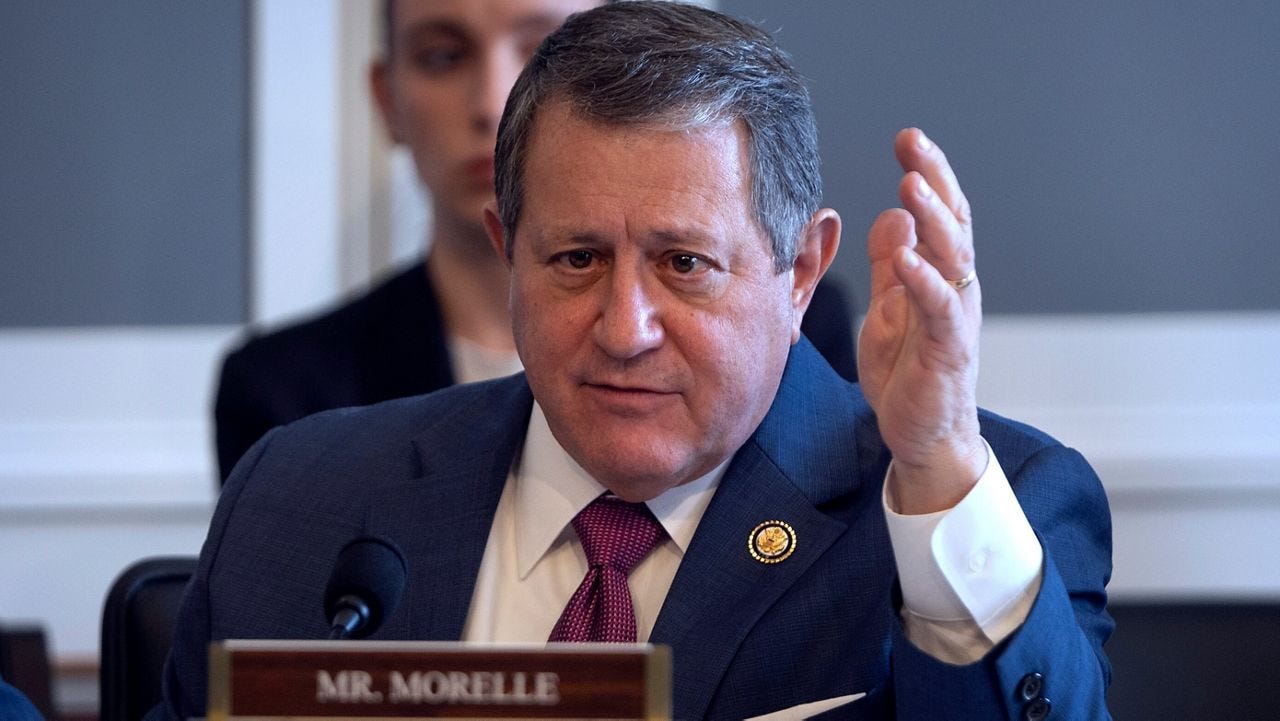
A group of House Democrats this afternoon stressed that any updates to a Clinton-era voting rights law must balance protecting voters with responsible voter list maintenance and highlighted how removing barriers to the ballot box for all eligible voters makes America stronger.
They made the case during a House Administration Subcommittee on Elections hearing to discuss potential updates to the National Voter Registration Act. The convening comes against a backdrop of the Trump Justice Department earlier this year asking multiple states to hand over their statewide voter registration rolls, and as Democrats navigate the growing tension between efforts to modernize and expand registration and a parallel push to impose stricter registration requirements that risk disenfranchising voters.
House Administration Committee Ranking Member JOE MORELLE (D-N.Y.) told me before the hearing that Democrats see national voter registration through different prisms.
“They see their future tied so directly to excluding people who don’t agree with them. Our view is every American should be able to register easily and have their ballots not only cast but recorded,” he said. “Everything they do is about restraining people from having the opportunity to vote. They want to pick and choose and they they want to try to somehow socially engineer who they think is going to vote for them.”
Inside the room: Subcommittee Republicans focused their questions on the accuracy of mail-in voting and steps Congress could take to improve the process around the 90-day window before a federal election, when states are barred from conducting large-scale voter-roll purges that could remove eligible voters. Democrats probed witnesses on how online registration could increase voter participation and on the case for Congress prioritizing funding for election officials to administer their elections.
Trump’s state-level meddling: Starting in 2025, the DOJ sent letters to at least nine states requesting their full voter-registration databases—including both “active” and inactive” records and, in some cases, sensitive data such as dates of birth, driver-license numbers and partial Social Security numbers.
When several states declined or raised concerns about privacy and legality, the DOJ filed several lawsuits against at least six states (California, Michigan, Minnesota, New York, New Hampshire and Pennsylvania) seeking to compel compliance.
The DOJ argues federal laws like the NRVA, the Help America Vote Act (HAVA) and the Civil Rights Act of 1960 justify their demands to inspect voter rolls as a safeguard against ineligible voting. But many state election officials—Democrats and some Republicans—plus voting rights and privacy advocates say the scope and nature of the requests are unprecedented, raise serious concerns about federal overreach and voter privacy and risk creating a de facto national database of voter data.
Speaking of federal overreach: President DONALD TRUMP signed an executive order in March that mandated that federal voter-registration forms require documentary proof of U.S. citizenship, set Election-Day–only ballot-receipt deadlines for mail-in votes, and empowered federal agencies to audit voter rolls and voting systems to block non-citizens and enforce stricter security standards.
Civil rights and voting rights groups, including the League of Women Voters Education Fund and the ACLU, filed suit, arguing that the order was unconstitutional and a power grab. A second challenge came from a coalition of 19 Democratic-led states plus party organizations.
A federal court issued a preliminary injunction in April blocking the citizenship-proof requirement. And in late October, a court permanently enjoined enforcement of the provision requiring documentary proof of citizenship for the federal registration form, ruling that the president lacked constitutional authority to impose it.
FWIW: Each witness told Morelle that they believed the Constitution empowered the states and Congress, not the executive branch, to set the rules for federal elections.
What to watch: Look out for renewed fights over voter-roll maintenance, citizenship-verification requirements and federal data demands that could reshape access to voter registration before the midterms.
