

🔒 FREE PREVIEW: You’re reading a preview of today’s Congress Nerd Daily. Upgrade to get my original reporting from Capitol Hill, smart analysis of the day’s biggest developments and the insider context that explains what happens next. Upgrade now.

👋🏾 HI, HEY, HELLO! Welcome back to Congress Nerd Daily. I hope today was everything for you. The midterms are in 48 days.
Speaker Mike Johnson (R-La.) canceled tomorrow’s votes, sending members home a day early for the campaign trail—and keeping them there until after the election. Johnson touted his Republican majority as the second-most productive in House history by bills passed and blamed the Senate for failing to turn more of them into law.
Independent legislative trackers paint a less rosy picture: The House has churned through plenty of partisan and priority bills, but the number making it through both chambers and into law trails several previous sessions.
The early exit also spares Republicans, for now, from a potentially uncomfortable vote on the articles of impeachment Rep. Thomas Massie (R-Ky.) filed Tuesday against Defense Secretary Pete Hegseth. The House isn’t scheduled to vote again until Nov. 9.
The Senate took no votes today after Democrats and Republicans failed to agree on speeding up consideration of the Protect College Sports Act, which cleared its first procedural hurdle on Tuesday. Under Senate rules, the next vote can occur tomorrow without an agreement.
Heads up: I’ll be a panelist on Punchbowl News’ Fly Out Day tomorrow. Maryland Gov. Wes Moore will join Anna Palmer and Jake Sherman to talk redistricting, the possibility of a Democratic congressional majority, AI and data centers in Maryland and more. Then CNN’s Alayna Treene and I will yap about it all.
FIRST THINGS FIRST
Speaker Johnson said the House has yet to build consensus around bipartisan legislation giving victims of sexually explicit deepfakes the right to sue their abusers, leaving the measure stalled as lawmakers prepare to leave Washington until after the midterm elections.
The Senate unanimously passed the DEFIANCE Act in January, the second consecutive Congress the chamber has approved the legislation without objection. The bill, led by Senate Judiciary Ranking Member Dick Durbin (D-Ill.) and the late Sen. Lindsey Graham (R-S.C.) and Reps. Alexandria Ocasio-Cortez (D-N.Y.) and Laurel Lee (R-Fla.), would create a federal civil cause of action for victims of nonconsensual sexually explicit digital forgeries.
“There’s a lot of input on that,” Johnson told reporters Tuesday evening when asked about the bill. “I don’t know. We haven’t built consensus around it yet, but I mean, it’s good policy.”
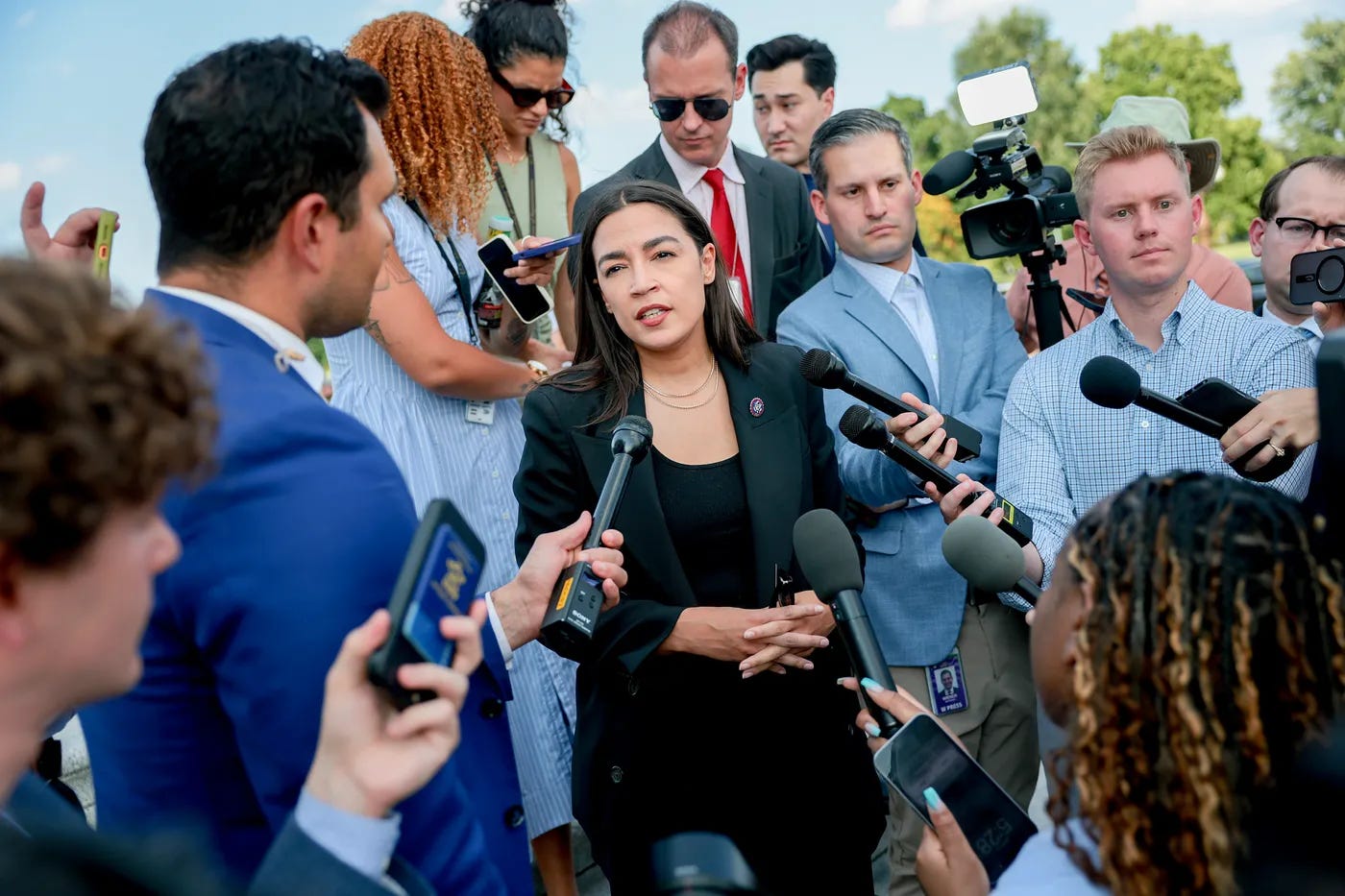
Ocasio-Cortez told Once Upon a Hill in an exclusive interview this evening that the lack of action is particularly puzzling because opposition to the bill has not broken along party lines.
“In the membership, it’s not a partisan issue,” she said, adding that even some major technology companies support what she described as “common sense guardrails” and a civil right of action for victims.
Ocasio-Cortez said she has heard suggestions that resistance to the legislation could be personal, though she emphasized that she does not know whether that is the case.
With no remaining pre-election opportunity for the House to pass DEFIANCE, Ocasio-Cortez was already looking beyond the current Republican majority…
📬 The best stories often start with a conversation. If you’ve got insight, context or something others are missing, my inbox is open. Send me tips, scoops or just say hi: michael@onceuponahill.com.
IN THE KNOW
House wraps its pre-midterm work—with some Dem drama: The House passed a sweeping Russia sanctions package this evening as Democrats confronted another round of internal tension over two members crossing party lines to help Republicans advance the legislation.
The Russia bill, which passed 262-159, would impose a broad new sanctions regime targeting senior Russian officials and oligarchs, major banks, the defense and energy sectors and vessels in the so-called shadow fleet used to evade existing restrictions. It would also restrict U.S. investment in Russia, transactions involving Russian financial institutions and purchases of Russian sovereign debt. The Senate passed the legislation 86–11 last month, so House approval sends it to President Trump, whose administration supports the measure.
But the bill divided House Democrats in part because it would give Trump sweeping tariff authority.
The president would be required to raise tariffs on Russian imports to as much as 500 percent and could impose tariffs of up to 100 percent on goods from countries that rank among the five largest buyers of Russian oil or natural gas or among the top facilitators of Russian oil-sanctions evasion.
House Minority Leader Hakeem Jeffries (D-N.Y.) and Foreign Affairs Ranking Member Gregory Meeks (D-N.Y.) were among the Democrats who opposed the legislation, arguing Congress should not give a president additional tariff discretion who Democrats say has already unlawfully exercised his existing authority.
The legislation nevertheless became the latest flashpoint in a separate Democratic dispute over party discipline after Reps. Marie Gluesenkamp Perez of Washington and Jared Golden of Maine joined Republicans Tuesday to approve the rule governing consideration of the sanctions bill and several other measures.
Perez and Golden said they supported the rule because they did not want the Russia sanctions package to become stuck in procedural gridlock. But their votes came mere weeks after the two Democrats helped Republicans rescue another rule, prompting some members to push leadership to change caucus rules to deter similar freelancing in the future.
Jeffries declined several opportunities Wednesday to weigh in on the latest episode.
“I’ll have more to say about the situation when I have more to say about the situation,” he told reporters, repeating the same response when pressed several times.
House Minority Whip Katherine Clark (D-Mass.) was less circumspect Wednesday morning when asked whether members who cross party lines on rules should be allowed to sit on exclusive committees.
“We got 49 days to win this House and make sure that we return a majority,” Clark said. “And when we return a majority, it matters that we govern and how we govern.”
Clark added that Democrats need “team players” focused on making the caucus successful on behalf of Americans—and said those members “should be sitting on exclusive committees.”
That puts a spotlight on Perez, who sits on the exclusive Appropriations Committee.
Clark did not respond when reporters followed up to ask whether she considers Perez a team player.
Also on the floor: The House passed, by a 214-208 vote, a Congressional Review Act resolution to overturn an EPA decision partially authorizing California to enforce stricter emissions standards for commercial harbor craft, including ferries, tugboats and other vessels operating in and around ports.
Members also approved, by a 352-72 margin, legislation creating a National Fraud Enforcement Division within the Justice Department and, in a 217-207 vote, a bill requiring states to provide the DOJ with information it requests for investigations or prosecutions of fraud involving federally funded programs.

READ ALL ABOUT IT
“Women built MAHA. MAGA bros have taken it over.” by Jill Filipovic: “Forget regulating food—manly MAHA cares about meat, testosterone and erectile dysfunction.”
“How far would you go for sisterhood?” by Angelina Chapin: “College girls are desperate to join the best sororities. Some are turning to weight-loss drugs to get there.”
“How the restaurant burger went from cheap indulgence to luxury meal” by Tim Carman and Federica Cocco: “The $30 burger can be found on menus from New York to California, despite efforts to rein in soaring beef prices.”