


Programming note: Congress Nerd Sunday took the Labor Day holiday off yesterday. I neglected to give you a heads-up in Thursday’s edition—my apologies for the oversight.
To make sure everyone still gets a free edition of Congress Nerd this week, I’m opening tonight’s Daily to all readers. Paid subscribers will be back behind the paywall with me tomorrow evening.
Also, Congress Nerd looks a little different today. I’ve brought back a three-section format from the newsletter’s early days: First Things First, In the Know and Read All About It. The goal is simple: make each edition faster and more enjoyable to read without sacrificing the original reporting, insider context and policy intelligence you come here for. Think of it as an old format built for the Congress Nerd of today.
FIRST THINGS FIRST
Birthright citizenship is usually discussed today as an immigration issue. Its constitutional roots are in the fight over whether Black Americans belonged to the country at all.
The 14th Amendment’s Citizenship Clause was ratified after the Civil War to settle that question after Dred Scott, the Supreme Court decision that denied U.S. citizenship to Black Americans.
More than 150 years later, President Donald Trump has sought to narrow that guarantee primarily through restrictions aimed at children of immigrants—even after the Supreme Court reaffirmed this summer that children born in the United States to parents who are unlawfully or temporarily present are citizens under the amendment. The opinions themselves trace the Citizenship Clause to Reconstruction-era efforts to secure citizenship for Black Americans.
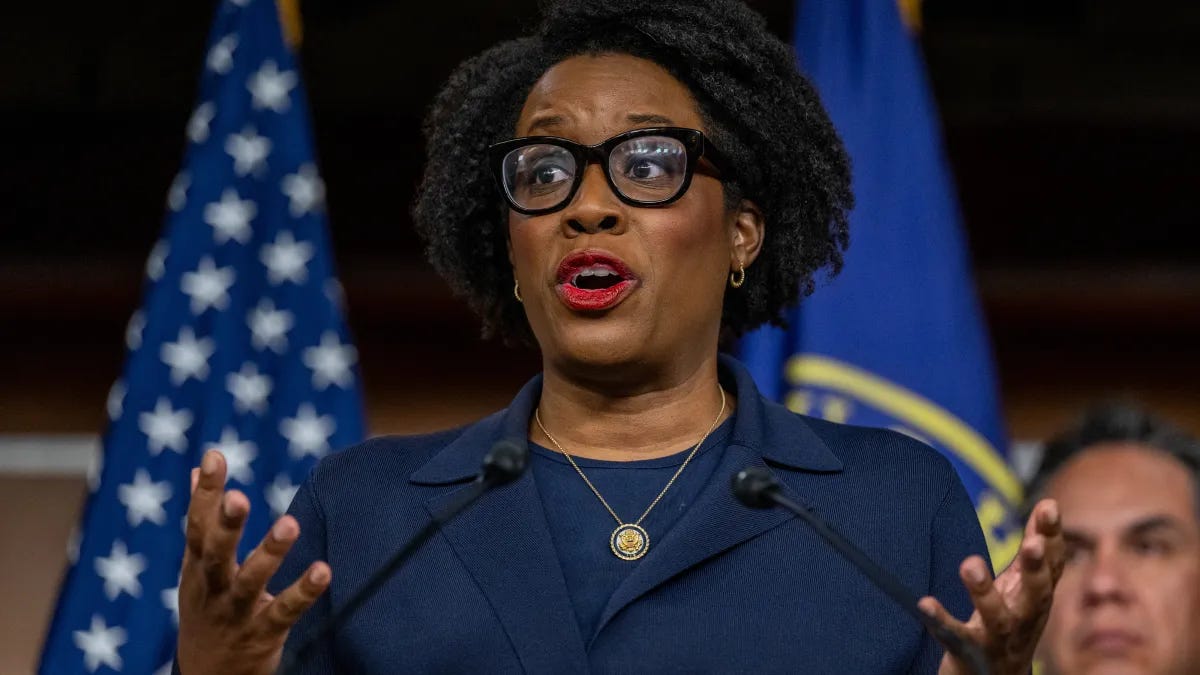
Rep. Lauren Underwood (D-Ill.) points to this history to explain why Black Americans should see themselves in a political and legal fight that has largely been framed around immigration.
“The threat remains as urgent as ever that Donald Trump and the administration and the Supreme Court have left open the possibility that birthright citizenship can be overturned, which is a direct attack on Black people and communities here in this country,” Underwood told Once Upon a Hill last week.
Underwood has been sounding the alarm for months—and specifically warning that the immigration debate obscures who else has a stake in the outcome.
“Birthright citizenship was originally written about us,” she told OUAH in February at the House Democratic retreat. “The Trump administration is framing it in terms of Hispanic immigrants, but we know that there is an anti-Black sentiment that courses through every policy coming out of the Trump administration.”
Then came Trump v. Barbara.
The Supreme Court rejected Trump’s original approach in June. But Republicans did not treat the decision as the final word. Trump issued a narrower executive order in August identifying several categories the administration says fall outside birthright citizenship. And last week, the House Judiciary Constitution subcommittee convened a hearing explicitly devoted to the Supreme Court decision and “potential legislative responses.”
In other words: The constitutional ruling settled a case, but did not end the argument in Washington over the boundaries of citizenship.
Underwood points to another Republican priority in that argument: requiring Americans to produce documentary proof of citizenship to register to vote.
House Republicans last week passed a nonbinding resolution calling for enactment of the SAVE America Act. The legislation would require documentary proof of citizenship for federal voter registration, with several forms of documentation available to satisfy the requirement. Republicans argue the additional safeguard is necessary to ensure only citizens are registered to vote in federal elections.
Underwood sees the same policy from the other end: What happens when being an American is no longer enough and the government increasingly asks you to prove it?
A 2023 YouGov survey found just 34% of Black Americans had a current U.S. passport, compared with 42% of white Americans and 55% of Hispanic Americans. The SAVE America Act accepts several forms of documentary proof beyond passports. Still, Underwood argues Black Americans could face particular burdens as the government demands more evidence of a status the Constitution grants at birth.
“We never were a country where you had to show your papers,” she said last week. “But for us, there’s an urgency around that because our right to vote and our right to enjoy the benefits, so to speak, or privileges of U.S. citizenship, there is an urgent threat coming our way.”
There is a separate question for Democrats: If the Supreme Court just reaffirmed birthright citizenship, should a future Democratic Congress spend political capital protecting it again?
At least one House Democrat says no.
“I don’t think so. I don’t want us to have to reaffirm everything in the Constitution,” the member told OUAH. “We need to start with the rebuild.”
The member explained that means more than any one policy: restoring government and voters’ sense that it works for them.
“I really think people want to see the government working for them again,” the member said. “The fighting, BS and noise is exhausting, overstimulating and empty.”
Underwood isn’t necessarily prescribing a congressional response either. Her warning is about what could happen outside the text of the 14th Amendment as the political fight continues over who gets presumed to be an American—and who gets asked to prove it.
“The overwhelming majority of Black people do not have passports,” Underwood said in February. “I’m not saying it’s right. I’m saying we got to be ready for the threat that’s coming.”
🔓 This edition is free. But if you want Once Upon a Hill in your inbox each evening, upgrade your subscription for full access to every edition and the complete archive. Whether you’re taking the votes, writing the bills, running the campaigns, shaping the message or trying to influence any of the above, Congress Nerd Daily helps you see around corners before everyone else catches up.
IN THE KNOW
FIRST IN CONGRESS NERD: SKD eyes DPCC opening: Rep. Sydney Kamlager-Dove (D-Calif.) is laying the groundwork for a potential bid for Democratic Policy and Communications Committee co-chair, according to a person familiar with her thinking. The California Democrat, who serves as CBC whip and on the Foreign Affairs and Judiciary Committees, has begun talking with colleagues about the position, has received encouragement to run and Democratic leadership is aware of her interest. Kamlager-Dove views her work as a party messenger and collaborator with colleagues on issues important to their constituents as central to her potential pitch for the job, the person said.
Missouri map fight reaches SCOTUS: Opponents of Missouri’s new congressional map formally asked the Supreme Court to reject Secretary of State Denny Hoskins’ emergency bid to revive it for November, arguing the state Supreme Court properly applied Missouri referendum law. Without intervention before the Sept. 19 military-ballot deadline, the state will use its 2022 map while voters decide the new map’s fate by referendum.
House Dems challenge Trump’s boat strikes: The top Democrats on House Foreign Affairs, Armed Services, Intelligence and Homeland Security introduced a War Powers Resolution last week to end U.S. military strikes on suspected drug-trafficking boats in the Caribbean and eastern Pacific. Gregory Meeks (N.Y.), Adam Smith (Wash.), Jim Himes (Conn.) and Bennie Thompson (Miss.) said the yearlong campaign, which they say has killed at least 227 people, was never authorized by Congress and should instead be handled through law enforcement.
GAO pokes hole in DHS savings claim: The Department of Homeland Security said its DOGE-era contract terminations could avoid $10.5 billion in costs, but a new GAO report found the actual amount will be lower. Nearly $10 billion of the claimed savings came from canceled IT contracting vehicles whose work could shift elsewhere and DHS already spent $1.7 billion through other government-wide contracts for those needs. GAO found just $92 million in net deobligations from 438 terminated contracts.
Senate Dems press DOJ on gun law: Sen. Mark Kelly (D-Ariz.) and 12 other Senate Democrats pressed Attorney General Todd Blanche to explain why the Justice Department declined to seek an immediate stay after a federal judge struck down key National Firearms Act requirements covering short-barreled rifles and shotguns and silencers. The senators urged the DOJ to appeal and questioned whether the reversal conflicts with Blanche’s confirmation commitment to defend federal laws when reasonable constitutional arguments exist.
Trump threatens Bombardier over U.S. production: President Trump said Canadian aircraft maker Bombardier should be barred from selling planes in the U.S. unless it builds them here, escalating the trade dispute with Canada. The White House has not explained how it would carry out the threat. Bombardier already has a defense facility in Kansas and Trump made similar aircraft-related threats in January that were never implemented.
Russia leaves door open to new peace talks: Kremlin spokesman Dmitry Peskov said Moscow does not rule out renewed trilateral negotiations with the U.S. and Ukraine after Steve Witkoff and Jared Kushner’s weekend diplomacy. However, no date or venue has been set. Any momentum remains tenuous: Russia resumed attacks across Ukraine after a temporary pause, killing at least three people and injuring dozens, according to Ukrainian authorities.
Iran tightens pressure on Hormuz shipping: Iran said it will establish a new restricted maritime zone in the Persian Gulf and new shipping corridors through the Strait of Hormuz, while warning U.S.-linked oil and gas facilities could be targeted if American attacks continue. The threat followed U.S. strikes on three Iranian tankers as Hormuz traffic remained sharply reduced and Brent crude traded near $97.50 a barrel.
Trump moves on beef prices: President Trump signed two executive orders last week to support ranchers and lower meat costs as the U.S. cattle herd sits at a 75-year low. One directs tougher enforcement against anticompetitive meatpacking practices and seeks to expand interstate sales by smaller processors. The other orders reviews of country-of-origin labeling, grazing and wolf protections and directs agencies to prioritize lower consumer prices.
More labor muscle for El-Sayed: Three Michigan SEIU locals representing tens of thousands of health care workers, janitors, security officers and public employees endorsed Abdul El-Sayed for Senate. SEIU Healthcare Michigan, Local 1 and Local 517M join the Michigan AFL-CIO, UAW, AFT, AFSCME, National Nurses United and Michigan Education Association in backing El-Sayed, further consolidating organized labor behind his campaign.
DCCC steps up its ground game: House Democrats’ campaign arm said more than 2,200 volunteers knocked 91,000-plus doors across 52 battleground districts during its August weekend of action. That was twice as many doors as its July push and more than four times its June total. The DCCC reported particularly strong participation in NY-17, TX-34, CA-22, VA-01, WA-03 and NJ-07.
📬 The best stories often start with a conversation. If you’ve got insight, context or something others are missing, my inbox is open. Send me tips, scoops or just say hi: michael@onceuponahill.com.

READ ALL ABOUT IT
“Donald Trump’s Capital makeover” by Antonia Hitchens: “A coterie of advisers, planners, and architects is enabling the president’s passion project—renovating D.C. in his own image.”
“Meta’s reckoning” by John Hermann: “Like its users, the company is stuck in an endless, unhappy doomscroll.”
“The last thing teenagers will let you teach them” by Liz Krieger: “An interesting shift happens when a kid is learning to drive, and you’re both inside a box with your fear, moving 40 miles an hour.”