


👋🏾 Hi, hey, hello! Welcome to Congress Nerd Daily, Once Upon a Hill’s reported evening briefing chronicling the strategic decisions, procedural fights and campaign dynamics that determine how power is exercised, challenged and won on Capitol Hill.
New York Democrats spent part of the day grousing over President Donald Trump’s planned appearance at Game 3 of the NBA Finals tonight, with House Minority Leader Hakeem Jeffries (D-N.Y.) accusing him of bringing the “MAGA circus” to Madison Square Garden and Senate Minority Leader Chuck Schumer (D-N.Y.) arguing the visit is disrupting what should be a celebration of the Knicks’ first Finals home game in nearly three decades.
Trump’s attendance triggered an extensive security perimeter around MSG, canceled the planned outdoor watch party, imposed airport-style screening and forced fans to arrive much earlier than usual.
In this evening’s issue: Hakeem Jeffries says House Democrats won’t support a FISA extension while Bill Pulte remains acting DNI, a sign the surveillance fight may be headed toward a cliff with just days left before expiration.
Plus: Elizabeth Warren presses the Trump administration to defend its AI oversight strategy before Congress and a new poll offers Democrats fresh evidence the Iowa Senate race may actually be in play.
🔓 This edition is in front of the paywall. But if you want the Tuesday and Thursday editions, plus the Sunday lookahead, upgrade your subscription for full access to every edition and the complete archive. Whether you’re taking the votes, writing the bills, running the campaigns, shaping the message or trying to influence any of the above, Congress Nerd Daily helps you see around corners before everyone else catches up.
The Capitol Bulletin
Jeffries: ‘Silence is complicity’: Hakeem Jeffries escalated pressure on major corporations that have remained silent amid a wave of Southern redistricting fights that Black lawmakers argue threaten Black political representation ahead of the midterms.
He signaled that Democrats are keeping score when I asked him this afternoon how he would respond if companies that previously backed voting-rights protections after George Floyd’s murder and Georgia’s 2021 election law failed to answer a recent Congressional Black Caucus appeal.
“Everybody has a responsibility in this moment,” Jeffries told me. “People have to choose: Are we going to move the country forward or are we going to turn back the clock?”
The comments come roughly two weeks after the CBC urged dozens of major corporations to publicly condemn what members describe as a coordinated effort by Republican-led states across the South to dilute Black voting strength following the Supreme Court’s decision in Louisiana v. Callais. The caucus also asked companies to disclose political spending tied to officials advancing disputed maps and participate in a voting-rights convening with civil-rights leaders.
Jeffries said he would defer to CBC Chair Yvette Clarke (D-N.Y.) on the campaign itself but made clear that Democrats view corporate silence as a choice.
“Do we want to further build and sustain a multiracial democracy in America as we celebrate our 250th birthday, or are we trying to go back to the Jim Crow era?” Jeffries said. “We believe that in this moment silence is complicity.”
He added a warning for companies that have opted not to engage: “Those who are choosing to bury their heads in the sand, we are taking notice of what is occurring, and those folks will have a lot of questions that will need to be answered.”
The remarks suggest Democrats and civil-rights groups are continuing to expand a pressure campaign that increasingly targets institutions with economic influence and reputational exposure, reflecting a growing belief that litigation alone will not be enough to counter the post-Callais redistricting landscape.
Warren seeks AI scrutiny: Senate Banking Committee Ranking Member Elizabeth Warren (D-Mass.) is pushing Chair Tim Scott (R-S.C.) to broaden Congress’s oversight of artificial intelligence by bringing top Trump administration officials before the committee. She argued in a letter on Monday that lawmakers should hear directly from Treasury Secretary Scott Bessent and Commerce Secretary Howard Lutnick about the administration’s approach to regulating AI, particularly after last week’s executive order establishing a voluntary review process for advanced AI models. Warren contends the administration is relying too heavily on industry self-policing and raised separate concerns about AI-related financial risks and export-control enforcement, setting up what could become a broader Democratic effort to scrutinize the administration’s AI agenda beyond Capitol Hill’s ongoing legislative debates.
Democrats question DOJ election guidance: Senate Democrats raised new concerns about the Justice Department’s role in the 2026 midterms after the agency quietly removed a longstanding election-crimes manual from its website. In a letter to Acting Attorney General Todd Blanche, Senate Rules Committee Ranking Member Alex Padilla (D-Calif.), Senate Judiciary Committee Ranking Member Dick Durbin (D-Ill.) and Senate Judiciary Subcommittee on Federal Rights Ranking Member Sheldon Whitehouse (D-R.I.) argued the move, combined with recent voter-roll lawsuits, changes inside DOJ’s voting-rights operation and the appointment of officials aligned with President Trump’s election-fraud claims, raises questions about whether the department intends to maintain longstanding policies designed to prevent federal investigations from influencing elections. The senators are seeking answers by June 22, including whether the DOJ plans to restore or revise the guidance and what role political appointees may play in any rewrite.
Congress takes aim at reading crisis: A bipartisan group of senators led by Mark Kelly (D-Ariz.) and Bill Cassidy (R-La.) renewed a long-running effort to improve childhood literacy with legislation aimed at expanding evidence-based reading instruction, early literacy screening and support for schools and families. The READ Act comes as lawmakers in both parties continue searching for areas of agreement in education policy despite broader fights over school funding, curriculum and the federal role in education.
📬 The best stories often start with a conversation. If you’ve got insight, context or something others are missing, my inbox is open. Send me tips, scoops or just say hi: michael@onceuponahill.com.
The Trail
Democrats eye an opening in Iowa: National Democrats are pointing to a new internal poll as fresh evidence that Iowa’s open Senate race is becoming more competitive than many expected just a few months ago.
A Democratic Senatorial Campaign Committee survey released this morning found state Rep. Josh Turek and Rep. Ashley Hinson (R-Iowa) tied at 46% in the first general-election test of the race to succeed retiring Sen. Joni Ernst (R-Iowa). The poll, conducted by Public Policy Polling on June 3-4, also found that voters blamed Republicans for rising prices and opposed the war in Iran by a sizable margin.
The release comes less than a week after major election forecasters shifted Iowa toward the Democrats. The Cook Political Report moved the contest from Likely Republican to Lean Republican, while other analysts have also signaled a more competitive environment following Turek’s primary victory.
That’s notable in a state Donald Trump carried comfortably in recent cycles and where Democrats have struggled to win statewide. But national Democrats believe Turek, a two-time Paralympic gold medalist and state legislator with a track record of winning in Republican-leaning territory, could help put Iowa back into play as they search for the four seats needed to reclaim the Senate majority.
Republicans are likely to view the survey with skepticism, given its partisan sponsor and Hinson’s fundraising advantages. Still, the combination of favorable rating changes, a competitive open-seat race and a potentially strong Democratic ticket led by gubernatorial nominee Rob Sand is giving Democrats a reason to invest in a state that wasn’t expected to be among the cycle’s top battlegrounds.
DCCC launches minority and rural voter microsites: House Democrats are expanding an early voter-engagement effort targeting key parts of their 2026 coalition. The Democratic Congressional Campaign Committee this morning launched a series of digital microsites targeting Asian American, Black, Latino and rural voters in battleground districts, as part of a broader “Our Power, Our Country” program designed to deliver tailored, in-language messaging while collecting sign-ups for future organizing and outreach. The move reflects Democrats’ continued focus on rebuilding and mobilizing a coalition that helped power past House majorities as the party tries to reclaim the chamber next November.

The Big Story
Leader Jeffries said this afternoon that House Democrats will not support an extension of the federal government’s foreign surveillance authorities while Federal Housing Finance Agency Director Bill Pulte remains acting director of national intelligence, escalating a standoff that now threatens Congress’s ability to reauthorize Section 702 of the Foreign Intelligence Surveillance Act before its June 12 expiration.
The comments mark the clearest indication yet that Democrats are prepared to make Pulte’s removal a central condition of any path forward on FISA, which intelligence officials have warned is one of the government’s most important tools for monitoring foreign threats.
“There were already challenges as it related to extending foreign surveillance authority given the refusal by the Trump administration to put into place the type of common-sense reforms that would be designed to both promote our national security interests on the one hand and on the other protect the privacy and civil liberties of the American people,” Jeffries told reporters.
He argued negotiations were already fragile before President Trump elevated Pulte to lead the intelligence community on an acting basis.
“Donald Trump, as he often does, tosses a hand grenade into those sensitive negotiations by elevating Bill Pulte as the Director of National Intelligence,” Jeffries said. Pulte, he added, is “woefully unqualified” for the role.
Jeffries was unequivocal when directly asked whether he would support a short-term extension if Pulte remains in the position.
“No.”
Jeffries said reversing Pulte’s appointment would be “a starting point, not an ending point” toward restoring what Democrats view as good-faith negotiations. He noted that Senate Majority Leader John Thune also questioned Pulte’s qualifications last week, though Thune has stopped short of calling for his removal.
The dispute arrives at a precarious moment for FISA negotiations.
The Senate failed last week to advance a long-term reauthorization bill after supporters fell short of the 60 votes needed to begin floor debate. The setback left lawmakers with only days to resolve a dispute that has increasingly centered on both privacy protections and who would ultimately oversee the surveillance authority.
Republicans maintain that the legislation already includes substantial reforms designed to protect Americans’ privacy regardless of who occupies senior intelligence posts.
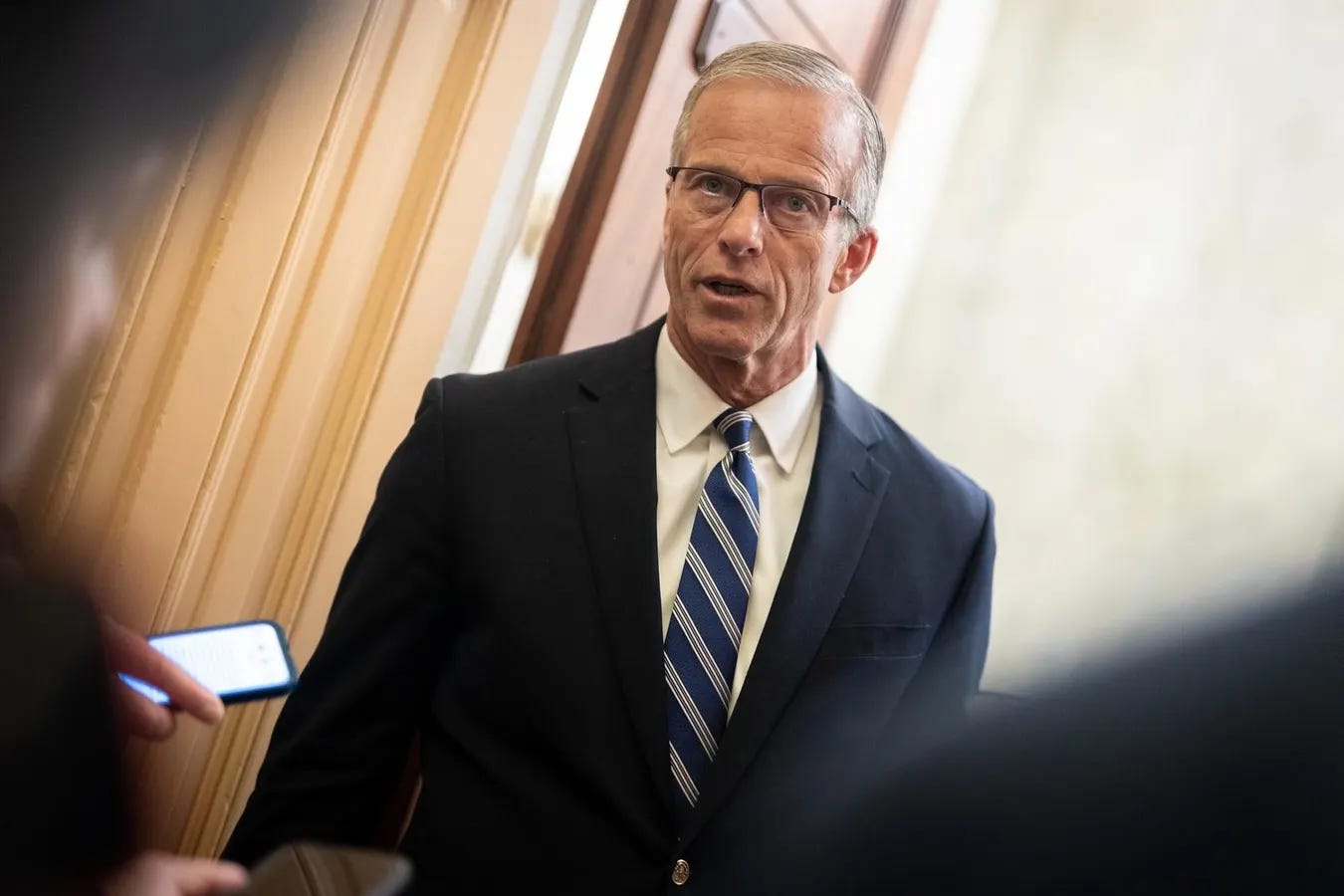
“We have a deadline ahead of us, we need Democrat votes,” Thune told reporters this afternoon. “Irrespective of what you think about Bill Pulte, providing the reforms that are included in the 702 reauthorization is a safeguard regardless of who’s in that job or which party is in power here.”
Thune declined to speculate on whether the White House might replace Pulte or nominate a permanent director this week. But he acknowledged discussions are occurring behind the scenes and repeatedly emphasized that Republicans cannot pass the bill without Democratic support.
“If we don’t meet it, it’s not good for the country,” Thune said of the looming deadline.
The emerging impasse underscores how dramatically the debate has shifted in recent days. What began as a familiar fight between national-security hawks seeking a long-term extension and privacy advocates demanding stronger warrant protections has evolved into a broader argument about trust, oversight and the officials responsible for wielding some of the government’s most powerful surveillance authorities.
Whether removing Pulte would ultimately unlock enough Democratic support to break the stalemate remains unclear. Jeffries made it clear Monday that Democrats' concerns extend beyond a single personnel decision.
But with just days remaining before Section 702 expires, both parties now appear to agree on at least one thing: Congress is running out of time.